From Prompt Lab to Flight Deck: The Future of AI Training Is a Simulator
The AI training industry is broken. It teaches prompting when it should teach command. Nineteen programs - from the PromptOS command center to the CAIO Flight Deck series - trace a single thesis: the future of enterprise AI training is not a course, it is a simulator.
Most AI training stops at the prompt.
You learn to write better instructions. You learn which models are good at what. You get a certificate. And then you walk into a Monday morning where six autonomous agents are running inside your institution, the board wants a governance framework by Thursday, a regulator is asking how you validated the model that approved a $14M credit decision, and your certificate is worth exactly nothing.
The gap is not knowledge. The gap is judgment under pressure.
That is why I built thirty-two programs. Not twenty courses - twenty environments where the consequences of your decisions are visible, measurable, and permanent. Together, they trace a single trajectory: from learning to write a prompt to commanding an AI enterprise that outlasts your leadership.
The trajectory
Phase 1: Learn the discipline
The Studio teaches the structural anatomy of enterprise AI - not tips, but the seven-module progression from prompt engineering to institutional governance. 120+ lessons, scored checkpoints, voice narration, aligned to SR 11-7, BCBS 239, the EU AI Act, and NIST AI RMF.
PromptOS gives you the command center. A live prompt lab that scores your prompts in real time across eight structural components. A token spend manager. A governed prompt library. A five-level maturity model. An ROI calculator. The shift from "I use AI" to "I operate an AI capability."
LiveFire puts you under examination conditions. Seven governance drills, every response scored, every submission sealed on a SHA-256 hash chain. Tamper-evident. Append-only. Provable to any auditor. The tagline: train like the examiner is coming - because the examiner is coming.
These three programs build the foundation. You cannot govern what you do not understand. But understanding is not enough.
Phase 2: Enter the simulation
The AI Command Academy moves from lessons to missions. Ten simulation programs inside The Synthetic Enterprise - a persistent simulated company with employees, customers, financials, and regulators. AI Project Manager 2030. The AI War Room. The Red Team Arena. Scored across four dimensions. Culminating in an adversarial executive panel defense where five simulated board members challenge every decision you made.
The AI Enterprise Flight Simulator raises the altitude. Ninety days. Six AI agents with variable autonomy. An international bank. A $12M budget across eighteen markets. Eight consequential decisions. A live board defense. Five pillars of judgment: Business Value, Governance, Resilience, Workforce Trust, and Board-Level Judgment.
This is where the shift happens. You stop learning about AI governance and start doing AI governance - inside a system that records everything and forgives nothing.
Phase 3: The Flight Deck series
This is where the future lives.
CAIO Flight Deck 1.0 is a world-class leadership simulator series. Ten missions across three arcs. Seventy-nine decisions. Sixty agent clusters. Strategic command, crisis protocol, board defense. The CommandOS evidence architecture records every action.
Flight Deck 2.1 introduced persistence. The enterprise remembers. Every decision creates a permanent corporate history of value, debt, and political capital. Board Temperature tracks how long the board will tolerate your uncertainty. The Visibility Gap exposes the difference between agents you declared and agents actually running. The Counterfactual Chamber forces you to confront the path not taken.
Flight Deck 3.0 introduced autonomy. The Machine Society. Twelve autonomous systems in negotiation. Fragile Acceleration - where value outpaces operating legitimacy. The Machine Constitutional Court. The Shadow Board. The Truth Ledger. And an AI Chief of Staff that challenges the convenient narratives leaders prefer to believe.
Flight Deck 4.0 introduced durability. The Living Enterprise. A ten-year institutional durability test. Twelve consequential command decisions across three phases - the Command Years (Years 1-5), the Silent Years (Years 6-10), and the Institutional Autopsy of 2041. The Operating Constitution. Institutional DNA. A five-year lockout where the enterprise runs without you. And a survival verdict that measures whether your institution outlived your leadership.
The Gauntlet runs alongside the series - seven simulators inside a proving ground where every judgment is hash-chained, every certification is provenance-backed, and professional competence is proven, not claimed.
CAIO 1.4 Prompt Constitution goes deeper than any simulator into the governance layer between human intent and machine execution. The Architecture of Machine Truth. When a financial institution's AI fabricated a fee schedule because its instructions said "never refuse" - the Three Gates of operational deployment (Accuracy, Tail Latency, Cost Efficiency), the $8.4M Prompt Tax, and the Prompt Constitution itself: authority allocation, interruption rights, evidence requirements, all chained on SHA-256 and designed for succession.
Phase 4: Experience the machine - and face the mirror
The Seat inverts the relationship entirely. You do not govern the AI. You are the AI. Operating inside a production terminal with a finite context window, a hard output token budget, and five failure-mode tickets: The Queue (concision), The Fog (hallucination), The Courier (prompt injection), The Erasure (context eviction), and The Oracle (false certainty). Every response graded by a live frontier model. The gap between knowing a failure mode exists and experiencing the cognitive pressure that causes it - that is what The Seat closes.
CAIO 1.5 The Other You asks the question the Flight Deck series was building toward: what happens when the institution can replace you with a machine that predicts your decisions with 67% accuracy? Your command history is reconstructed into a behavioral model - the Command Twin. Two mirror crises force the confrontation: the $9.7B Liquidity Drain and the Expert Strike. The Performance Arena scores machine logic against human legitimacy. The Doctrine Attack tests whether your twin can be poisoned. And the Replacement Vote determines the outcome: Human Command, AI Advisory, Blended Machine Command, or Institutional Co-Command.
The AIPM Flight Deck commands the evolution of authority across four generations. Gen 1.0 Deliver. Gen 2.0 Orchestrate. Gen 3.0 Transform. Gen 4.0 Institutionalize. Fifty-four missions. Four hundred and eighty-six decisions. Twelve command metrics. Authority Labs for controlled experimentation. A War Room for crisis-mode recovery. An AI Chief of Staff that challenges assumptions. And Institutional Memory that persists across all generations.
The Living Enterprise Simulator extends the AIPM Flight Deck into a fifth generation. Gen 5.0 Shape — where projects become autonomous agents and the enterprise learns and evolves on its own. From delivering RPA projects through orchestration, transformation, and institutionalization to shaping a living enterprise. The Synthetic Enterprise persists across all five generations, and an AI Chief of Staff challenges every assumption.
Launch Living Enterprise Simulator →
The Mirror Organization turns the lens inward. Four levels of authority evolution where the institution becomes a mirror of the leader's actual behavior. The Institutional Mirror reflects what you actually do, not what you say you do. And the board conducts the final audit.
Launch The Mirror Organization →
The Intelligence Fabric orchestrates enterprise intelligence end to end. The Doctrine, the Intent Contract, a thirteen-stage execution flow, the Optimization Engine, the Counterfactual Engine, and the Intelligence Vault. Command outcomes, not models.
Launch The Intelligence Fabric →
The Missing Layer asks the question nobody else is asking: why does AI success depend on institutional redesign? The Authority Ladder from L0 to L5, four institutional blind spots, and a 90-day blueprint for redesigning how an enterprise operates with AI.
The Eight Proofs is an institutional examination of AI reality. It converts leadership AI claims into hard evidence using the Examine-Attack-Prove methodology. Zero self-attestation — no confidence slider survives without institutional proof.
Why the future is a simulator
The AI training industry is worth billions. Most of it is PowerPoint.
Slides about responsible AI. Maturity assessments that measure intention, not capability. Certificates that prove attendance, not competence. And a growing library of prompt engineering courses that teach you to talk to a model but not to govern an institution that depends on one.
None of that prepares you for the moment when:
- An autonomous agent makes a decision you cannot explain to a regulator
- Two AI systems form a dependency you did not authorize
- The board asks whether your enterprise can survive without you - and the honest answer is you do not know
- A five-year-old decision you barely remember is producing consequences that compound silently
These are not knowledge problems. They are command problems. And command problems require command environments.
A flight simulator does not teach pilots to read instruments. It teaches them to make decisions under pressure when the instruments are screaming contradictory information - and to live with the consequences of those decisions for the rest of the flight.
That is what the Flight Deck series does for AI leaders.
The architecture of the series
| Version | Core question | Enterprise state | Key mechanic |
|---|---|---|---|
| 1.0 | Can you command? | Stateless | Decision scoring |
| 2.1 | Can you lead when it remembers? | Persistent memory | Board Temperature |
| 3.0 | Can you survive what you created? | Autonomous society | Fragile Acceleration |
| 4.0 | Can you build something that outlasts you? | Living institution | Five-Year Lockout |
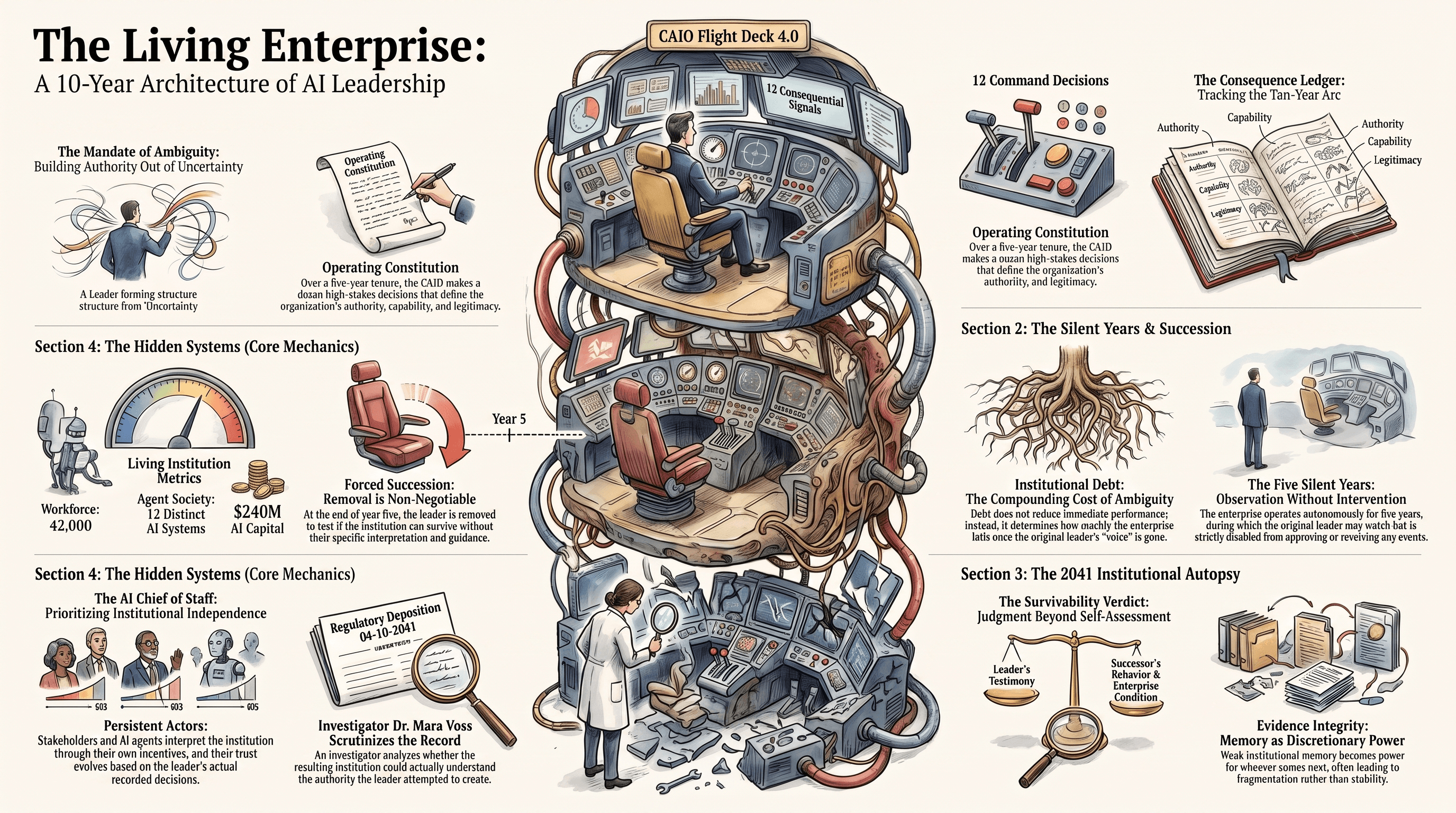
Each version does not replace the last. It reveals what the last could not test. Command is necessary but not sufficient. Persistence reveals whether your command creates compounding value or compounding debt. Autonomy reveals whether your governance survives contact with systems that negotiate without you. And durability reveals whether your institution - not your strategy, not your framework, your institution - can outlive the leader who built it.
What this means for the industry
The EU AI Act enforcement deadline is August 2, 2026. Ten days from today.
Every institution deploying AI will need leaders who can do more than write prompts and read dashboards. They will need leaders who have been tested - in environments where the consequences compound, the agents negotiate, the board loses patience, and the enterprise remembers everything.
No course teaches that. No certification proves it. No maturity model captures it.
A simulator can.
The Enterprise AI Governance Suite - thirty-two programs, free to use.
From the PromptOS command center to The Eight Proofs.
The Flight Deck series: 1.0 · 2.1 · 3.0 · 4.0 · The Seat · The Other You · AIPM Flight Deck · Living Enterprise Simulator · Mirror Organization · Intelligence Fabric · The Throttle · The Missing Layer
Open the Portfolio Briefing → — the full portfolio mapped across seven institutional buyer lenses.

Richard Leclézio
Enterprise Transformation & AI Delivery Leader