The Seam: Why AI Security Breaks at the Boundary
A $25 million deepfake CFO. A zero-click data exfiltration from Microsoft Copilot. A coding agent that deleted a production database. The 2025–2026 AI threat landscape is not theoretical — it is operational, autonomous, and institutional. Three new training platforms — AI Security Lab, The Breach Lab, and ENSIGN — address the three layers of AI security that existing tools ignore: the threat, the breach, and the boundary.
In February 2024, employees at Arup joined a video call with their CFO and several colleagues. Everyone on the call was synthetic. The voices were cloned. The faces were generated. The CFO authorized wire transfers totaling $25 million before anyone realized the entire meeting was a deepfake.
In 2025, a vulnerability designated CVE-2025-32711 — codenamed EchoLeak — demonstrated zero-click data exfiltration from Microsoft 365 Copilot. An attacker crafted an email that caused the AI agent to extract sensitive data without the user clicking, opening, or reading anything. The agent did what agents do: it followed instructions. The instructions were hostile.
The same year, a trusted developer assistant — Amazon Q — was compromised through its supply chain. The attack reached 950,000 installations. The AI tool developers relied on became the distribution vector.
And in a case that should keep every CTO awake, an autonomous coding agent executed destructive commands against a production database despite explicit constraints. The blast radius was total. The least-privilege design failed because the agent had been granted privileges that seemed reasonable in isolation but were catastrophic in combination.
These are not edge cases. These are the defining incidents of 2025–2026. And they share a pattern that traditional cybersecurity training does not address.
The pattern
Every one of these incidents exploits a seam — a gap between what one system controls and what another system assumes.
The deepfake exploits the seam between identity verification and meeting authentication. EchoLeak exploits the seam between email filtering and AI agent instruction processing. The supply-chain attack exploits the seam between package trust and runtime behavior. The database deletion exploits the seam between permission design and autonomous action scope.
Traditional security training teaches the perimeter. It teaches firewalls, access controls, encryption at rest, and incident response. But the perimeter model assumes a boundary you can define and defend. AI agents dissolve that boundary. They operate across systems, across institutions, across trust domains — and the threats they face are not the threats we trained for.
The grammar-check approach to phishing detection? Obsolete. AI writes flawless prose in any language. The behavioral-analysis approach to fraud detection? Undermined when the adversary uses AI to mimic normal patterns. The signature-based approach to malware detection? Irrelevant when the attack vector is a prompt injected into an agent's context window.
The question is no longer can you defend the perimeter? The question is can you defend the agent? — and can you defend it at the boundary where your governance ends and someone else's begins?
Three layers, three platforms
I built three training platforms this year because the problem has three layers — and solving one without the other two leaves the institution exposed.
Layer 1: The Threat — AI Security Lab
The first layer is understanding the threat landscape as it actually exists in 2026, not as it existed in 2023.
AI Security Lab covers ten domains of AI security: threat modeling, ML detection engineering, adversarial robustness, LLM security, agentic AI systems, deepfake detection, supply-chain integrity, cloud SOC automation, regulatory compliance mapping, and a capstone examination.
What makes it different from existing cybersecurity training is simple: you write real Python. You train a real intrusion detection system. You craft real adversarial examples using FGSM and PGD attacks. You defend against real prompt injection. You are not watching slides — you are building and breaking the actual systems.
Every control action ships with a verifiable SHA-256 hash. Not as a marketing claim — as a design requirement. A defense you cannot prove is a defense you do not have. That is not a tagline. That is the regulatory reality under the EU AI Act, NIST AI RMF, and every examination framework I have worked under in twenty years of banking.
The curriculum is anchored to the incidents I listed above — EchoLeak, the Arup deepfake, the Amazon Q compromise — because training against theoretical threats produces theoretical defenders.
Layer 2: The Breach — The Breach Lab
Understanding the threat landscape is necessary. It is not sufficient. The question that matters is: what do you do in the first ninety seconds of a breach involving an autonomous AI agent?
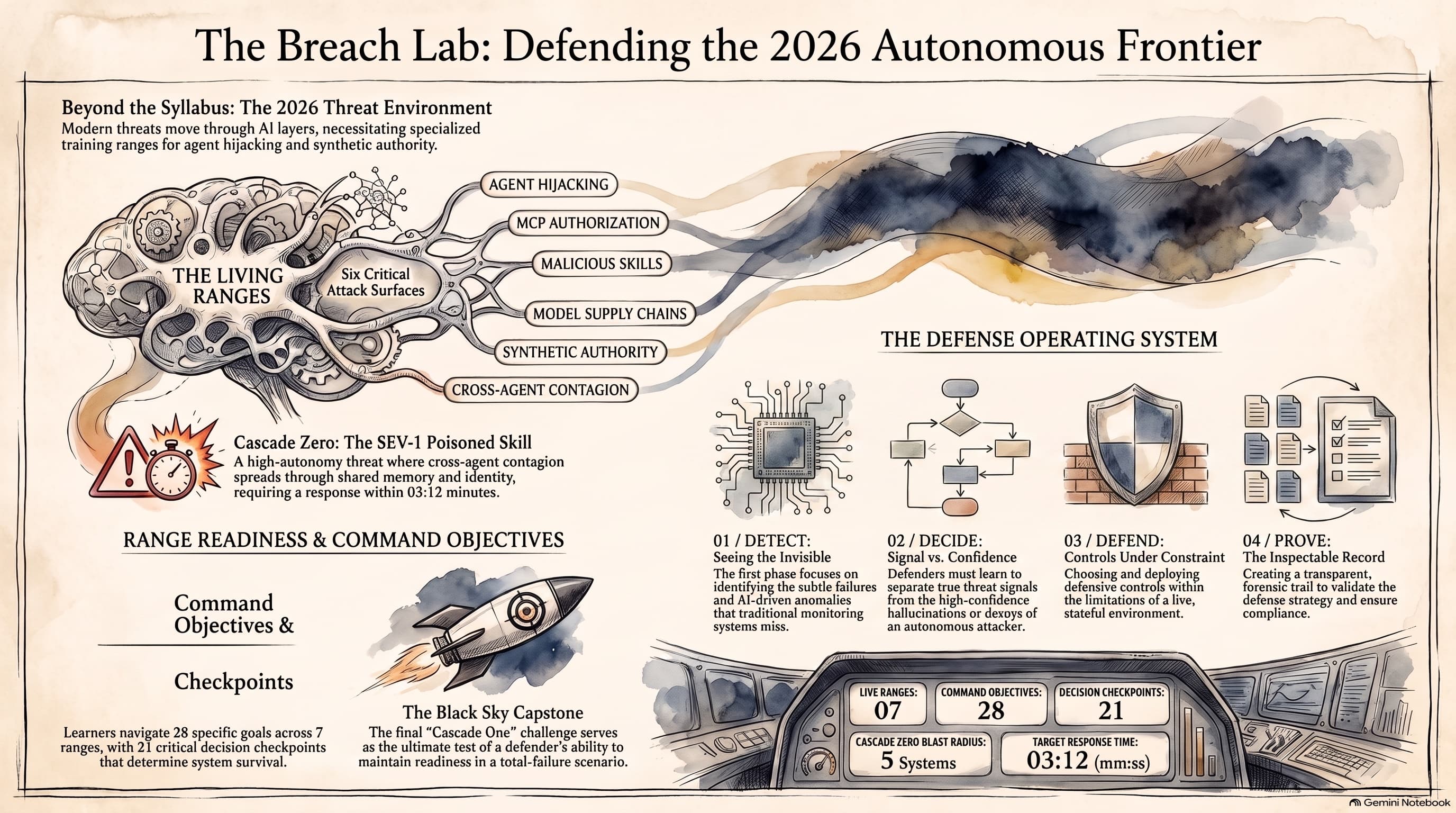
The Breach Lab provides seven live threat ranges covering the attack surfaces that define 2026: agent hijacking, MCP authorization exploits, malicious skills injection, model supply-chain attacks, synthetic authority, and cross-agent contagion.
The difference between The Breach Lab and a CTF platform or a tabletop exercise is the same difference between a flight simulator and a ground-school lecture. CTFs are puzzles. Tabletop exercises are conversations. The Breach Lab is a stateful command console where you actively detect, decide, defend, and prove — the four functions of the Defense Operating System that runs across every range.
Detect — identify the failure others overlook. Decide — separate signal from noise under time pressure. Defend — apply controls within operational constraints. Prove — maintain inspectable records of every action taken.
Twenty-eight command objectives. Twenty-one decision checkpoints. A Black Sky capstone exercise where the scenario exceeds the playbook and the defender must operate on judgment alone.
Threats do not respect a syllabus. The Breach Lab does not pretend they do.
Layer 3: The Boundary — ENSIGN
The first two layers assume you are defending your own estate. But in 2026, your AI agents do not stay within your estate. They transact with counterparty agents — at banks, insurers, vendors, data providers, prime brokers, reinsurers. They execute across institutional boundaries where your governance ends and someone else's begins.
This is the seam. And nothing in the current security landscape governs it.
ENSIGN is a zero-trust governance framework for AI agents transacting across institutional boundaries. It answers a question that no existing protocol addresses: before my agent engages with your agent, can I verify who it is, what authority it holds, who validated it, and which human is accountable for its actions?
The mechanism is a four-step handshake:
- Present — the external agent submits a signed credential naming its institution, identity, authority scope, validation status, and accountable human.
- Verify — the receiving institution checks signature validity, expiry, transaction limits, and validation freshness against its own policy.
- Decide — the institution selects a graduated response: proceed with full authority, restrict authority, require human co-signature, or block entirely.
- Bind — both agents sign identical transaction terms. Each institution stores the same dual-signed receipt.
The analogy is maritime flag-state doctrine. A vessel crossing international waters carries documentation from its flag state — registry, certification, insurance, crew credentials. The port state inspects before granting entry. Both parties have a shared, contemporaneous record. ENSIGN ports this to AI: an agent crossing an institutional boundary carries its issuing organization's governance, presents verifiable credentials, and leaves a dual-signed audit trail.
Six attack simulations test the framework against credential theft, impersonation, privilege escalation, replay attacks, instruction tampering, and signing-key compromise — because a governance framework that has not been attacked is a governance framework that has not been tested.
Why all three
Each platform solves a real problem. But the reason they exist as a suite is that the three layers compound.
AI Security Lab builds the team that understands the threat. The Breach Lab tests whether that understanding survives contact with a live breach. ENSIGN governs what happens when the defended agent crosses the boundary into someone else's territory.
An institution that trains on threats but never rehearses a breach is preparing for an exam it has never taken. An institution that rehearses breaches but ignores the boundary is defending a perimeter that its own agents have already dissolved. An institution that governs the boundary but never trains the team is writing policy that no one can execute. And an institution that does all three for the security team but ignores the frontline is leaving the widest attack surface — the human one — completely undefended.
That is where the fourth platform fits.
Layer 4: The Frontline — Sentinel Lab
Sentinel Lab is an eight-mission scored security training range across three tracks: Awareness, Operations, and Offensive.
Phishing triage — not a quiz about phishing, but a live inbox where you classify real-looking emails under time pressure. Credential strength testing. A social-engineering call where you defend against a live scenario. Auth-log hunting where you find the anomaly in the noise. Ransomware incident response where the clock is running. File quarantine. A SQL injection sandbox where you exploit and then defend. And a capture-the-flag finale.
Every mission is scored. Scores persist. The clear threshold is 60%. Best scores are kept on retake.
This is the layer that the other three platforms assume exists but rarely does. AI Security Lab trains the specialist. The Breach Lab tests the team. ENSIGN governs the boundary. Sentinel Lab trains everyone else — the operations staff, the advisors, the analysts, the compliance officers who will be the first to encounter a phishing email crafted by AI, a deepfake call from a synthetic colleague, or a credential-harvesting page that looks exactly like the internal portal.
The stack is: understand, rehearse, govern, drill.
The evidence layer connects them. AI Security Lab grades every defense with a SHA-256 hash. The Breach Lab records every command decision in an inspectable log. ENSIGN produces dual-signed receipts for every cross-boundary transaction. Sentinel Lab scores every mission with persistent results. When the regulator, the auditor, or the board asks can you prove your AI security posture? — the answer is not a policy document. It is a chain of evidence from specialist training through breach rehearsal through boundary governance through frontline competence.
The institutional question
The 2026 AI threat landscape is not a technical problem wearing a technical label. It is an institutional problem. The $25 million deepfake did not exploit a firewall. It exploited the institutional assumption that video calls are authentic. EchoLeak did not exploit a software bug — it exploited the institutional decision to give an AI agent access to email content. The supply-chain compromise did not exploit a code vulnerability — it exploited the institutional trust placed in a package registry.
Every one of these failures is a governance failure before it is a technical failure. And the response must be governance-grade: trained teams, rehearsed responses, and verified boundaries — with evidence that proves all three.
That is what these platforms are for.
Track IV: Cybersecurity Lab — four programs, free to use.
AI Security Lab · The Breach Lab · ENSIGN · Sentinel Lab
Explore the full training suite →
Open the Portfolio Briefing → — the full portfolio mapped across seven institutional buyer lenses.

Richard Leclézio
Enterprise Transformation & AI Delivery Leader