From Strategy to Safe Deployment: The Healthcare AI Playbook
A visual blueprint of the Healthcare AI Playbook — the interactive implementation guide that takes healthcare organizations from strategy to safe, compliant AI deployment. The infographic maps six implementation principles, five interactive instruments, five governance frameworks, and the privacy-first architecture that makes the planning process itself HIPAA-safe.
Most healthcare AI strategies die between the slide deck and the deployment. The gap is not technology — it is the absence of a structured path from institutional intent to governed, safe operation. The Healthcare AI Playbook closes that gap.
The infographic maps the complete architecture of the playbook: the method, the toolkit, and the compliance layer that makes every output defensible.
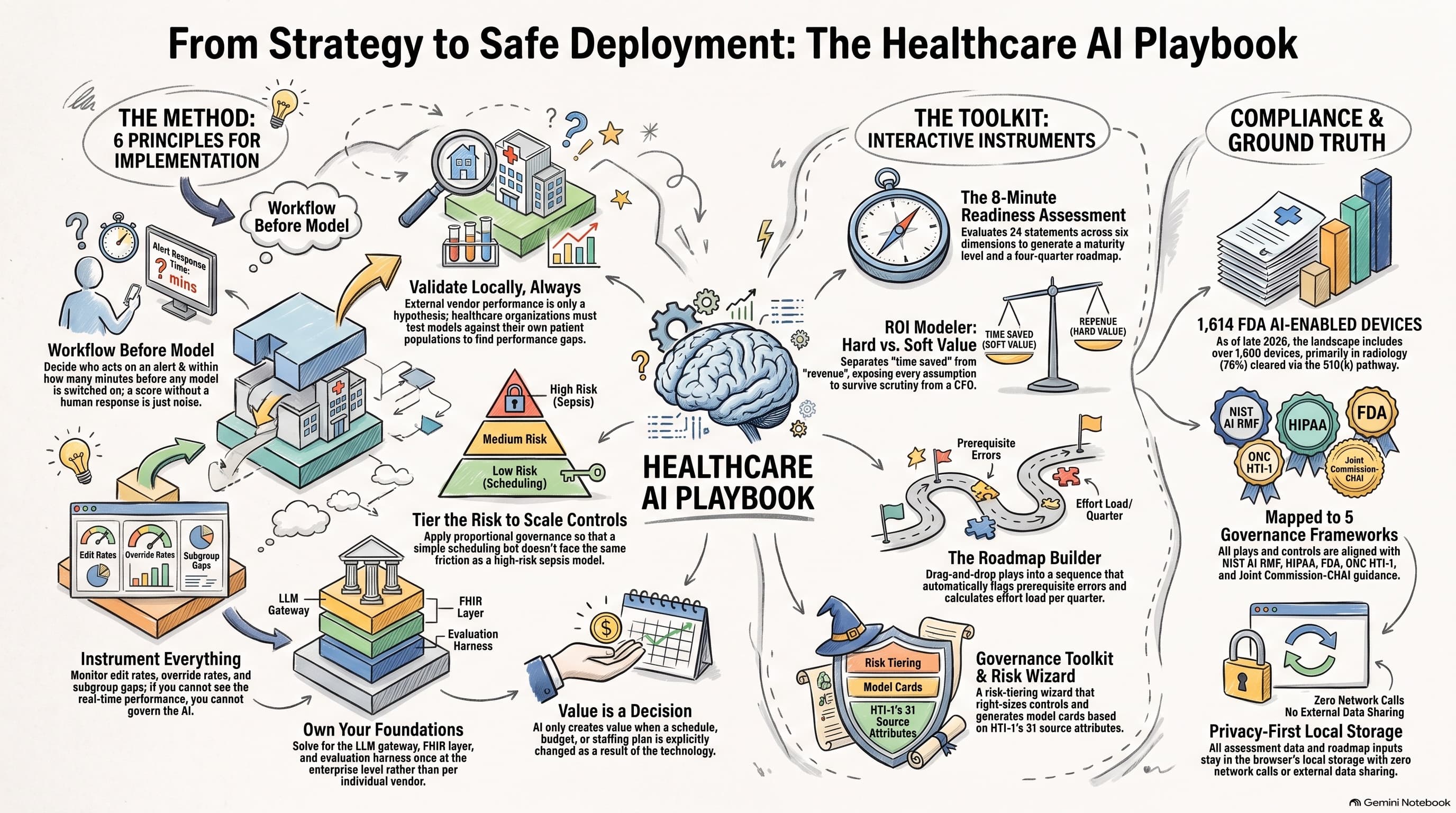
The method: six principles for implementation
The left side of the infographic traces six principles that govern every play in the playbook. These are not suggestions — they are constraints that determine whether an AI deployment survives contact with clinical reality.
Workflow Before Model
Decide who acts on an alert and within how many minutes before any model is switched on. A score without a designed human response is just noise. This is the principle that separates implementations that stick from implementations that produce dashboards nobody opens.
Validate Locally, Always
External vendor performance is only a hypothesis. Healthcare organizations must test models against their own patient populations to find performance gaps. A model trained on one demographic profile may produce systematically different results on another. Local validation is not optional — it is the evidence that the model works here, for these patients, in this workflow.
Tier the Risk to Scale Controls
Apply proportional governance so that a simple scheduling bot doesn't face the same friction as a high-risk sepsis model. The infographic shows three tiers — low risk (scheduling), medium risk, and high risk (sepsis) — each with governance proportional to the consequence of failure.
Instrument Everything
Monitor call rates, override rates, and subgroup gaps. If you cannot see the real-time performance gaps, you cannot govern the AI. Instrumentation is not a post-deployment luxury — it is a prerequisite for the governance committee to have anything meaningful to review.
Value is a Decision Standard
AI only creates value when a schedule, a workflow, or a staffing model is actually changed as a result of the technology. A prediction that nobody acts on is cost without benefit. The playbook forces teams to define the decision that changes before the model is built.
Own Your Foundations
Solve the LLM gateway, FHIR layer, and evaluation harness once at the enterprise level rather than per project. The infographic shows this as the bedrock — the infrastructure that every subsequent project inherits rather than rebuilds.
The toolkit: five interactive instruments
The centre of the infographic maps the five instruments that convert principles into action.
The 8-Minute Readiness Assessment
Evaluates 24 statements across six dimensions to generate a maturity level and a four-quarter roadmap. Not a compliance checkbox — a diagnostic that tells the organization where it actually stands and what to do next, in sequence.
ROI Modeler: Hard vs. Soft Value
Separates "time saved" from "money your CFO will count." Healthcare AI initiatives that cannot distinguish between soft value (clinician satisfaction) and hard value (reduced readmissions, shorter length of stay) fail the budget committee. The ROI modeler forces the distinction and produces numbers that survive executive scrutiny.
The Roadmap Builder
Drag-and-drop plays into a sequence that automatically flags prerequisite errors and calculates effort load per quarter. The output is a four-quarter implementation plan — not a Gantt chart, but a sequenced set of plays with dependencies resolved.
Governance Toolkit & Risk Wizard
A risk-tiering wizard that classifies initiatives and generates model cards based on NIST's 31 source attributes. The model card is not documentation for its own sake — it is the artifact the governance committee reviews before approving deployment.
Decision Cards
The playbook contains 29 plays, each structured as a decision card with step-by-step guidance, KPIs, and success criteria. The plays are not abstract recommendations — they are executable units of work with defined inputs, outputs, and measures.
Compliance and ground truth
The right side of the infographic maps the regulatory and vendor landscape.
1,614 FDA AI-Enabled Devices
As of late 2025, the landscape includes nearly 1,614 AI-enabled medical devices, with 79% cleared via the 510(k) pathway. The playbook provides context for where AI is already deployed in clinical settings and what regulatory precedent exists.
Mapped to 5 Governance Frameworks
All plays and controls are aligned with NIST AI RMF, ONC's HTI-1, FDA guidance, HIPAA, and Joint Commission CMS guidance. The alignment is embedded per play — not applied as a separate compliance layer. When the governance committee asks "which standard does this satisfy?", the answer is built into the play itself.
The Vendor Landscape
128+ tools cataloged across 32 categories. The playbook does not rank vendors — rankings are disguised marketing. It catalogs what exists, what each tool does, and which plays each tool supports. The institution makes the selection; the playbook provides the structured comparison.
Privacy-first architecture
The bottom of the infographic maps two critical design decisions:
Zero Network Calls — all assessment and roadmap inputs stay in the browser's local storage with no network calls or external data sharing. The planning tool itself creates no PHI risk. This is not a privacy feature — it is a deployment prerequisite. A planning tool that transmits data to external servers cannot be used in a HIPAA environment without a BAA with the tool vendor. The Healthcare Playbook eliminates that dependency entirely.
Browser-Local Processing — every calculation, every assessment score, every roadmap runs in the browser. No server. No account. No data transmission. The institution's strategic planning data never leaves the device.
The visual thesis
The infographic reads left to right: principles establish the method, instruments make it executable, and compliance ensures every output is defensible. The Healthcare AI Playbook is not a report to read — it is an instrument to operate.
The gap between healthcare AI strategy and healthcare AI deployment is not a technology problem. It is a governance problem, a sequencing problem, and a validation problem. The playbook solves all three.
The Healthcare AI Playbook is live and free to use.
Launch the Healthcare Playbook →
Launch MedConsult AI → — the clinical workflow companion.

Richard Leclézio
Enterprise Transformation & AI Delivery Leader