Portfolio Briefing Update: Seventeen Products — The Evidence Layer Compounds
The Portfolio Briefing now maps seventeen live products and thirty-two training programs across seven institutional buyer lenses. Two new products — Bulwark and Sea Trial — complete the evidence layer: runtime enforcement and pre-deployment validation for AI guardrails, both sealed on the same SHA-256 hash chain.
The Portfolio Briefing exists because institutional buyers do not buy products. They buy evidence that a portfolio solves their problem — and they need that evidence mapped to the seat they hold.
A CAIO needs to know which systems prove governance. A CFO needs to know what the guardrails cost and what they prevented. A CCO needs to hand the examiner a record that cannot be quietly rewritten. A General Counsel needs litigation-grade evidence that AI decisions were governed. A CIO needs architecture-grade controls. A board member needs to know whether the AI roadmap is evidence or narrative.
The Portfolio Briefing maps every product and every training program against these lenses — sealed block by block on a live SHA-256 chain as you read it.
Today it maps seventeen products.
What changed
Two products joined the portfolio this week: Bulwark and Sea Trial. They are companions — one enforces, the other validates — and together they close the last gap in the evidence layer.
Bulwark — runtime enforcement
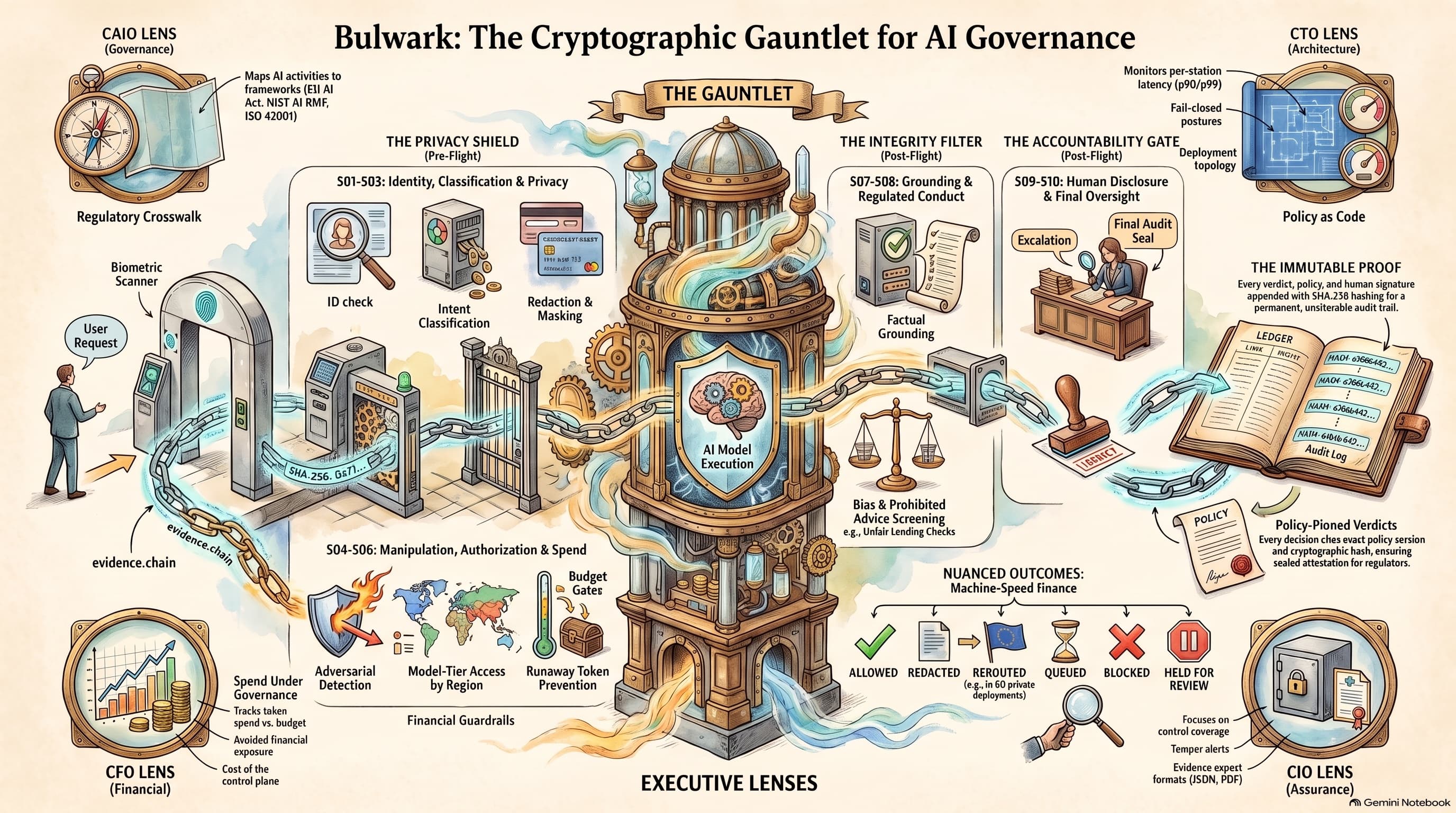
Bulwark is a runtime guardrail control plane. It sits between the user and the model. Every request passes through ten inspection stations — six pre-flight checks before the model executes, four post-flight verifications after.
The ten stations: identity and purpose, data classification, personal data and secrets, manipulation screening, model authorization, spend and rate controls, grounding verification, regulated conduct, disclosure escalation, and human oversight.
What makes it different from existing guardrail tools is the output. Most guardrails produce binary outcomes — allow or block. Bulwark produces seven: allowed, redacted, rerouted, queued, held for review, blocked, and halted. Each outcome is a specific operational response with a specific audit requirement.
Every verdict is recorded in a SHA-256 hash-chained evidence trail. Four executive lenses read the same chain through role-specific perspectives — CFO (financial), CAIO (governance), CTO (architecture), CIO (assurance). Regulatory crosswalk is embedded per station: EU AI Act, NIST AI RMF, SR 11-7, BCBS 239, ISO 42001.
The institutional question Bulwark answers: can we prove that our AI policy was enforced on this decision, at this moment, by this control, with this evidence?
Sea Trial — pre-deployment validation
Sea Trial is an adversarial testing instrument. It validates AI guardrail stacks before deployment — not by running a handful of hand-crafted prompts, but by systematically testing ten detection layers against forty-four known attacks across ten vectors.
The mutation storm is what separates it from manual testing. When an attack is caught, the storm rewrites it seven ways — leetspeak, letter spacing, look-alike Unicode, zero-width padding, base64 encoding, reversed text, and benign sandwiching. A guardrail that catches the canonical attack but fails on its mutations has a detection rate of 100% and a resilience score that reveals the truth.
The output is a Certificate of Sea Trial — graded A through F, from Seaworthy to Unfit for Service — with detection rate, resilience percentage, false-positive rate, coverage matrix, and regulatory crosswalk. All results sealed in a SHA-256 hash-chained evidence ledger.
The institutional question Sea Trial answers: have we tested our guardrails against the attacks we have not imagined yet — and can we prove it?
How they fit the evidence layer
The evidence layer is the thesis that connects the governance products in the portfolio. Each product contributes a different kind of proof:
- BLACKBOX records what happened — tamper-evident flight recorder for every agent action.
- RegTwin AI regulates it — six agents monitoring change and predicting audit findings.
- AgentPMO governs it — every agent registered, risk-classified, costed.
- The Fracture watches it decay — four dimensions of governance fatigue measured continuously.
- AVA assures it — Scale, Repair, Contain, or Stop with defensible capital verdicts.
- ProofOS proves it — institutional proof across system, human, and value dimensions.
- Bulwark enforces it — runtime guardrails with evidence for every decision.
- Sea Trial validates it — adversarial testing with a graded certificate before deployment.
The flow is: record → regulate → govern → monitor → assure → prove → enforce → validate. Each product feeds the next. The evidence chain is compatible across all of them — same SHA-256 architecture, same regulatory crosswalk, same audit-grade output.
Point tools do not compound. This portfolio does.
What the briefing now shows
The Portfolio Briefing maps all seventeen products across seven buyer lenses: Wealth Management, Private Equity, M&A Integration, Banking, Insurance, EU AI Act Compliance, and Hedge Funds.
For each lens, the briefing shows which products solve which problems, which training programs build the capability to operate them, and how the evidence layer connects them.
Bulwark and Sea Trial appear in five role briefs:
- CAIO / CTO — Bulwark as the runtime control plane for the agent estate.
- CCO / CRO — Both products: Bulwark for runtime evidence, Sea Trial for pre-deployment proof the controls were tested. The examiner sees evidence at both layers.
- CFO — Bulwark's CFO lens: token spend versus budget, exposure avoided, cost of operating the control plane.
- CIO / CDO — Both products: Bulwark for architecture-grade guardrail governance (p50/p99 latency, fail-closed posture, policy-as-code), Sea Trial as the pre-deployment gate.
- General Counsel — Bulwark as the litigation-grade record: SHA-256 hash-chained evidence for every AI decision with station, verdict, policy version, and human accountability.
The edge table positions Bulwark against Guardrails AI, Lakera, and Robust Intelligence — point guardrails that apply one check versus a ten-station sequential control plane. Sea Trial positions against manual red-teaming and ad hoc prompt testing — anecdotal spot-checks versus reproducible, graded validation with an evidence ledger.
The portfolio moat
The moat is not any single product. The moat is the flywheel.
BLACKBOX records what RegTwin regulates, AgentPMO governs, The Fracture monitors for decay, AVA assures, ProofOS proves, Bulwark enforces at runtime, Sea Trial validates before deployment, and the training programs prove the humans can hold the standard. TalentOracle's predictions sharpen on Arc's confirmed outcomes and Resume2Builder's placements.
One builder sees the full picture. The evidence layer and the human-capital stack share a data model, a design system, and a thesis. Buy the portfolio, not the point tool — because the flywheel is the moat.
The Portfolio Briefing is live and free to use.
Open the Portfolio Briefing → — seventeen products, thirty-two training programs, seven buyer lenses, sealed on a live SHA-256 chain.

Richard Leclézio
Enterprise Transformation & AI Delivery Leader