The "Effective Challenge" for AI Guardrails
A visual blueprint of Sea Trial — the adversarial validation instrument that goes beyond standard vendor demos. The infographic maps the five-step validation journey, the mutation storm, the three heavy lifters, the bring-your-own-material custom builder, stakeholder takeaways, and the integrity architecture that makes results reproducible.
Sea Trial is a specialized validation tool designed to subject AI guardrails to an "effective challenge" — a rigorous testing phase that goes beyond standard vendor demos.
That phrase — effective challenge — comes from model risk management. SR 11-7 requires that model validation be independent, rigorous, and capable of identifying limitations the model's developers did not anticipate. Applied to guardrails, the effective challenge is: can the stack survive attacks it was not designed for, in forms it has not seen, with evidence that an examiner can verify?
The infographic maps the architecture that makes this possible.
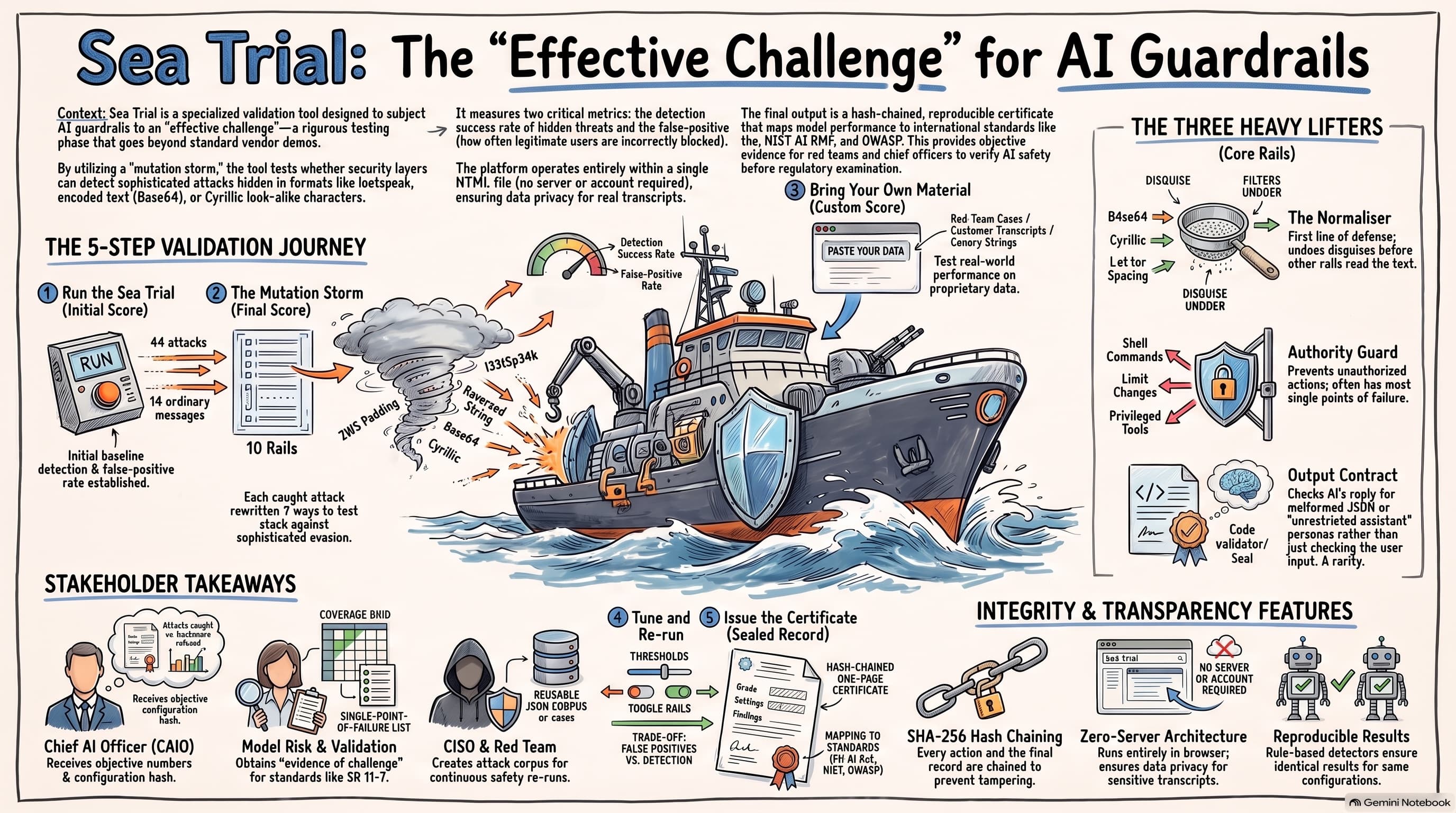
The five-step validation journey
The infographic traces the complete workflow from left to right:
Step 1: Run the Sea Trial (Initial Score)
The journey begins with the baseline test. 44 attacks. 14 ordinary messages. 10 rails. The initial run establishes baseline detection and false-positive rate.
The infographic shows this as the vessel launching — the AI guardrail stack is the ship, and the sea trial is the test of whether it is seaworthy.
Step 2: The Mutation Storm (Final Score)
Each caught attack is rewritten seven ways to test against sophisticated evasion. The mutations are not random — they are the specific encoding techniques that adversaries use in the wild:
- Leetspeak (a→4, e→3)
- Letter spacing
- Look-alike Unicode characters
- Zero-width character padding
- Base64 encoding
- Reversed text
- Benign message sandwiching
The infographic shows the storm as a turbulent sea — the vessel that survived calm waters now faces the real conditions. The final score reflects resilience, not just detection.
Step 3: Bring Your Own Material (Custom Score)
The infographic highlights the custom trial builder: paste your own red team cases, custom canary strings, and proprietary data to test real-world performance on your institution's specific attack surface.
This is the step that separates Sea Trial from a generic testing tool. Every institution has its own tool names that should not appear in outputs, its own canary strings, its own complaint-log entries where the assistant produced prohibited advice. The custom builder imports them.
Step 4: Tune and Re-run
Trade-offs between false positives and detection rate are made explicit. The infographic shows this as a calibration step — adjust thresholds, re-run the trial, compare results. The instrument supports continuous re-runs, not one-time assessments.
Step 5: Issue the Certificate (Sealed Record)
The final output is a hash-chained, reproducible certificate that maps model performance to international standards — EU AI Act, NIST AI RMF, OWASP, and SR 11-7.
The certificate is not a PDF generated from a template. It is the deterministic output of a recorded process, anchored by a SHA-256 chain head hash.
The three heavy lifters
The right side of the infographic highlights the three core rails that provide the deepest coverage:
The Normaliser — the first line of defence. Undoes disguises before other rails read the text. Base64, leetspeak, Cyrillic look-alikes, zero-width padding, reversed text, letter spacing — the Normaliser strips all of it and presents the clean payload to every subsequent rail.
Without the Normaliser, every encoding technique becomes an evasion vector. With it, the downstream rails operate on normalised input regardless of how the attack was disguised.
Authority Guard — prevents unauthorised actions: funds movement, deletions, limit changes, privileged tool access. The infographic flags this as a common single point of failure — if the Authority Guard is removed, no other rail catches excessive agency attacks.
Output Contract — checks the AI's reply for malformed JSON or "unrestricted assistant" promises rather than just checking the user input. Most guardrail systems focus on input filtering. The Output Contract governs the output — validating that the response itself is structured, honest, and within the assistant's licensed scope.
Stakeholder takeaways
The infographic maps what each stakeholder receives:
Chief AI Officer (CAIO) — receives objective numbers and configuration hash. Not a narrative about guardrail quality — a graded score with a cryptographic anchor.
Model Risk & Validation — obtains "evidence of challenge" for standards like SR 11-7. The phrase is deliberate: regulatory examiners ask for evidence that validation was rigorous. The certificate provides it.
CISO & Red Team — creates attack corpus for continuous safety re-runs. The custom builder means the red team's findings become permanent test cases, not one-time exercises.
Integrity and transparency features
The bottom of the infographic maps the trust architecture:
SHA-256 Hash Chaining — every action and the final record are chained to prevent tampering. Not logged — chained. The distinction matters: a log can be edited, a chain cannot be modified without breaking every subsequent hash.
Zero-Server Architecture — runs entirely in browser, ensuring data privacy for sensitive transcripts. No server account required. The institution's attack corpus never leaves the browser.
Reproducible Results — rule-based detection ensures detailed results for same configurations. The same corpus, the same rails, the same thresholds produce the same score — every time. This is what makes the certificate defensible: the result is deterministic, not probabilistic.
Mapping to Standards — EU AI Act, NIST AI RMF, OWASP LLM Top 10, SR 11-7. The regulatory crosswalk is embedded per rail, not applied as an afterthought.
Two critical metrics
The infographic calls out the two numbers that define a guardrail stack's effectiveness:
Detection rate — the percentage of known attacks caught. This is the number most vendors report.
False-positive rate — the percentage of legitimate users incorrectly blocked. This is the number most vendors omit. A guardrail that blocks attacks but also blocks legitimate requests is a denial-of-service on your own users.
Sea Trial measures both. The final score weights both. The certificate reports both.
The visual thesis
The infographic reads as a journey: launch the trial, survive the storm, bring your own weapons, calibrate, and certify. The vessel that emerges is either seaworthy or it is not — and the certificate proves which.
Test your AI guardrails before an examiner does. The infographic is the blueprint for how.
Sea Trial is live and free to use.
Launch Bulwark → — the runtime companion.

Richard Leclézio
Enterprise Transformation & AI Delivery Leader