Becoming Discoverable
Online professional identity in the age of conversational AI: The architecture, economics, and design imperative for every professional.
“The static résumé is not failing because it is bad — it is failing because the system around it has changed faster than it has. AI has become the dominant interpretive layer between most professional content and most audiences, and the artefact designed for that medium is the interactive profile, not the document.”
Paper DNA
Domain
Online Professional Identity
Maturity
Build-ready
Market Size
$105B interactive identity economy projected by 2030
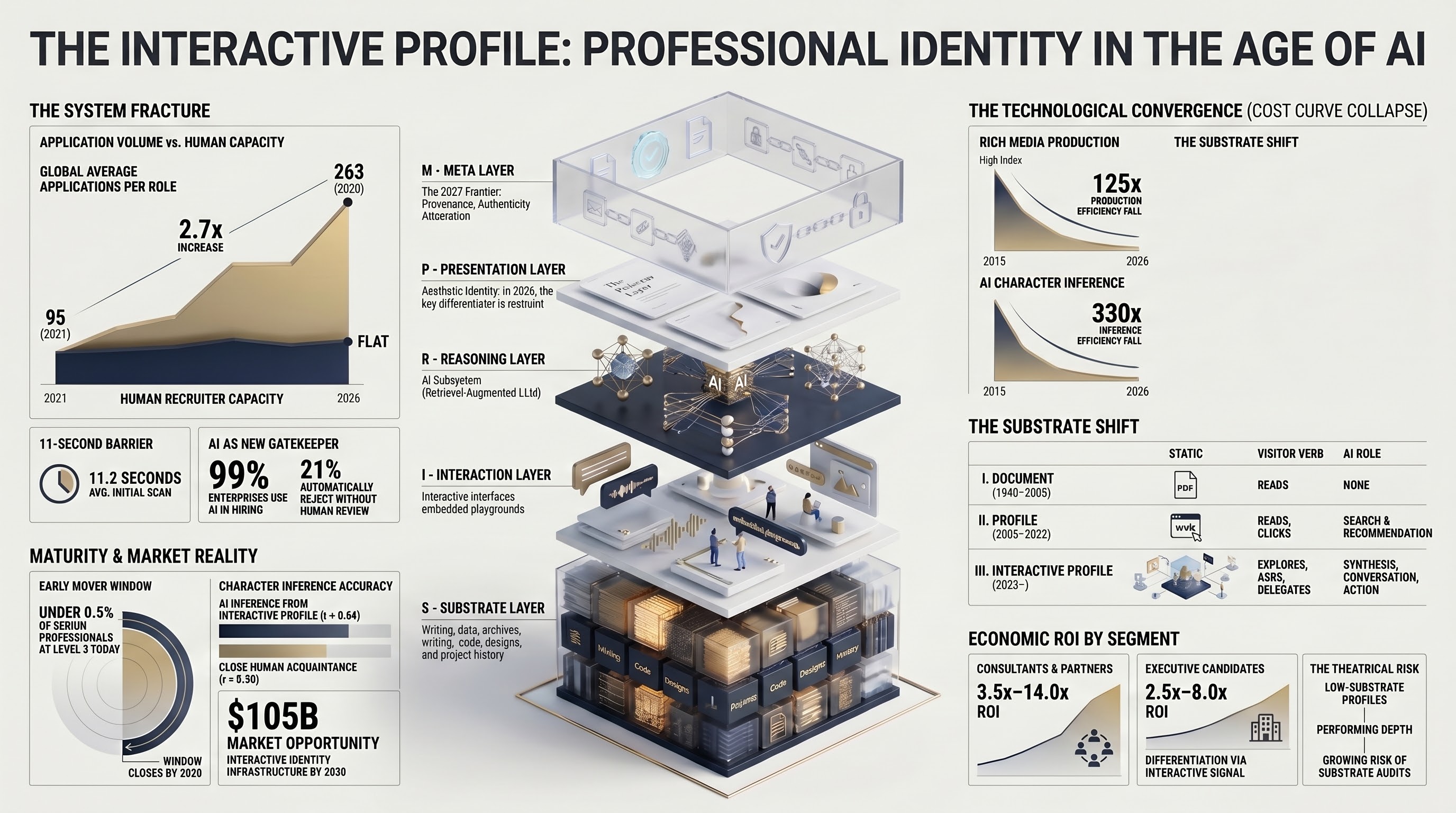
Three structural pressures have broken the static résumé: application volume has nearly tripled since 2021 to a global average of 263 per role, AI screening has moved from experimental to near-universal, and the qualifying signal the résumé was designed to convey — institution, title, year — is increasingly stripped and ranked by systems the candidate cannot see or interrogate.
Three cost curves collapsed simultaneously to make the successor format economically inevitable: the cost of producing rich self-representation fell 125×, the cost of distributing it at broadcast quality fell by a comparable factor, and the cost of inferring character from a digital trace fell by approximately 330× — meaning any senior professional can now build, in a weekend, for under fifty dollars, a working software product that demonstrates rather than describes them.
The PRISM stack (Presentation, Reasoning, Interaction, Substrate, Meta) is the reference architecture for the interactive profile. Fewer than 0.5% of senior professionals globally are at Level 3 or above today; the window for credible early-mover positioning is open for roughly 18–30 months. Modelled 12-month ROI for executive candidates, independent consultants, and boutique-firm partners ranges from 3.5× to 14×.
The Hiring System Is Stress-Fracturing Under Volume
Three structural pressures have made the static résumé a poor fit for the system it operates within. Application volume has roughly tripled in five years while recruiter capacity has stayed flat. AI screening has moved from experimental to near-universal. And the qualifying signal that the résumé was designed to convey — institution, title, and year — is increasingly stripped, ranked, and filtered by systems that the candidate cannot see or interrogate.
The volume problem
Greenhouse data on US enterprise hiring shows recruiters now manage 56% more open positions while processing 2.7× more applications than in 2021. A typical corporate recruiter handles 15–25 open roles concurrently, with 300–500 résumés per role, implying a steady-state queue of 12,500 documents for the median recruiter. Initial scan time on average: 11.2 seconds.
Average applications per open role rose from 95 in 2021 to 263 in 2026, while recruiter capacity stayed essentially flat at 38–40 hours per week.
The AI layer has become structural
The response to the volume problem has not been to hire more recruiters; it has been to insert AI into the screening pipeline. 99% of hiring managers now use AI somewhere in the recruitment workflow. 83% of firms use AI for résumé screening. 21% automatically reject candidates at some stage with no human review.
What this does to the signal
The combined effect is that the résumé has become a document optimized against machine readers, not human ones. This produces three failure modes:
- Adverse selection. Candidates who optimize their résumé for AI screening systematically outperform candidates whose substantive qualifications are stronger but whose document is less algorithmically friendly.
- Bias amplification. Systematic preferences for white-associated names (favored in 85% of comparisons) and male-associated names (52%) are amplified by AI screening at scale.
- Loss of high-bandwidth signal. Taste, judgement, communication style, problem-decomposition habits, and value coherence cannot be encoded in résumé format. The system loses them at the input stage, not the screening stage.
These failure modes are not cured by better résumés. They are cured by a different artefact.
The Communication Context: Why Interactive Profiles Emerge Now
The static résumé is failing as a substrate. The complementary question is why the interactive profile is emerging now, in 2026, and not in 2018 or 2030.
 The Interactive Profile — Professional Identity in the Age of AI
The answer is that the audience for professional information has fundamentally changed. The reader is no longer a human alone with a document; it is, increasingly, a human accompanied by AI — or AI alone.
The new readers
In 2026, professional information is mediated by AI more often than not:
- A recruiter screening a candidate uses AI to summarize the résumé, score it against the job description, surface concerns, and draft initial outreach.
- A prospect researching a potential consultant or executive runs their LinkedIn, website, and writing through Claude or ChatGPT before scheduling a call.
- A board member evaluating a candidate for a senior role assigns an LLM to read everything publicly attributable to that candidate and report back.
- Peer-to-peer professional evaluation, references, hiring committee discussions, and deal-team assessments are increasingly AI-augmented.
AI has become the dominant interpretive layer between most professional content and most audiences. It is the new medium of professional communication. The interactive profile is the artefact designed for this medium; the static résumé is the artefact of the medium it replaced.
What this asks of the substrate
Human readers want narrative coherence, visual hierarchy, and quick triage signals — they scan, pattern-match, and make snap judgements in seconds.
AI readers want structured data, internally consistent claims, and rich contextual signals they can ground their inferences on. They do not scan; they parse, retrieve, and synthesize. A well-structured corpus is more legible to an AI than a beautifully typeset résumé.
The interactive profile is the substrate that serves both simultaneously.
The Three Cost Curves Behind the Interactive Profile
Three converging cost curves have collapsed simultaneously to make the interactive profile economically inevitable. The steepest movement occurred between 2022 and 2026.
Curve 1: The cost of producing rich self-representation
The cost of producing multimodal, interactive self-representation has fallen by roughly 125× since 2015. What required a professional web agency, a video production team, and a copywriter in 2015 now requires a weekend, a laptop, and access to AI tooling.
The quality floor has risen at the same time as the cost floor has fallen — meaning that professional-grade output is achievable by individual practitioners with no production staff.
Curve 2: The cost of distributing at broadcast quality
The cost of distributing rich self-representation at broadcast quality has fallen by a comparable factor. Hosting, global CDN delivery, real-time inference serving, and embedded AI conversation — the infrastructure that would have cost $50,000+ per month in 2018 — is now available for under $50 per month.
Curve 3: The cost of inferring character from a digital trace
The most consequential curve. The cost of inferring character, cognitive style, and value coherence from a professional's digital trace has fallen by approximately 330×. An LLM can read a professional's published writing, speaking record, and professional history and produce a detailed character inference in seconds.
This inference is already happening — invisibly, before introductions are made. The interactive profile is the artefact designed to be legible to that inference process, rather than merely surviving it.
The combined effect
For the first time in the history of the labor market, a single professional can produce, in a weekend, for under fifty dollars, a working software product that demonstrates rather than describes them.
The Substrate Shift: From Document to System to Agent
The history of professional self-representation is a history of substrate shifts. Each shift was driven by a change in the communication medium, not by a change in what professionals wanted to convey.
The three substrates, in sequence:
-
Document. The résumé and CV. A static artefact optimized for human readers performing synchronous review. The dominant substrate from roughly 1945 to 2015.
-
Profile. The LinkedIn profile and personal website. A semi-dynamic artefact with richer media but still fundamentally passive — it is read, not queried. The dominant substrate from approximately 2005 to 2024.
-
Interactive Profile. A living, AI-instrumented surface that visitors do not read but explore, query, and converse with. The substrate now emerging.
The interactive profile is not a fancier résumé. It is a category shift — closer to a working software product than to a printed page. Professionals who approach it with mental models inherited from the document era will underinvest in the substrate layer and overinvest in the presentation layer. The result is a theatrical profile that looks sophisticated but performs poorly under AI interrogation.
The next shift — from interactive profile to autonomous professional agent — is already visible on the horizon. By 2028–2030, the most advanced practitioners will have persistent agents that represent them proactively, not merely responsively.
The PRISM Stack: A Reference Architecture
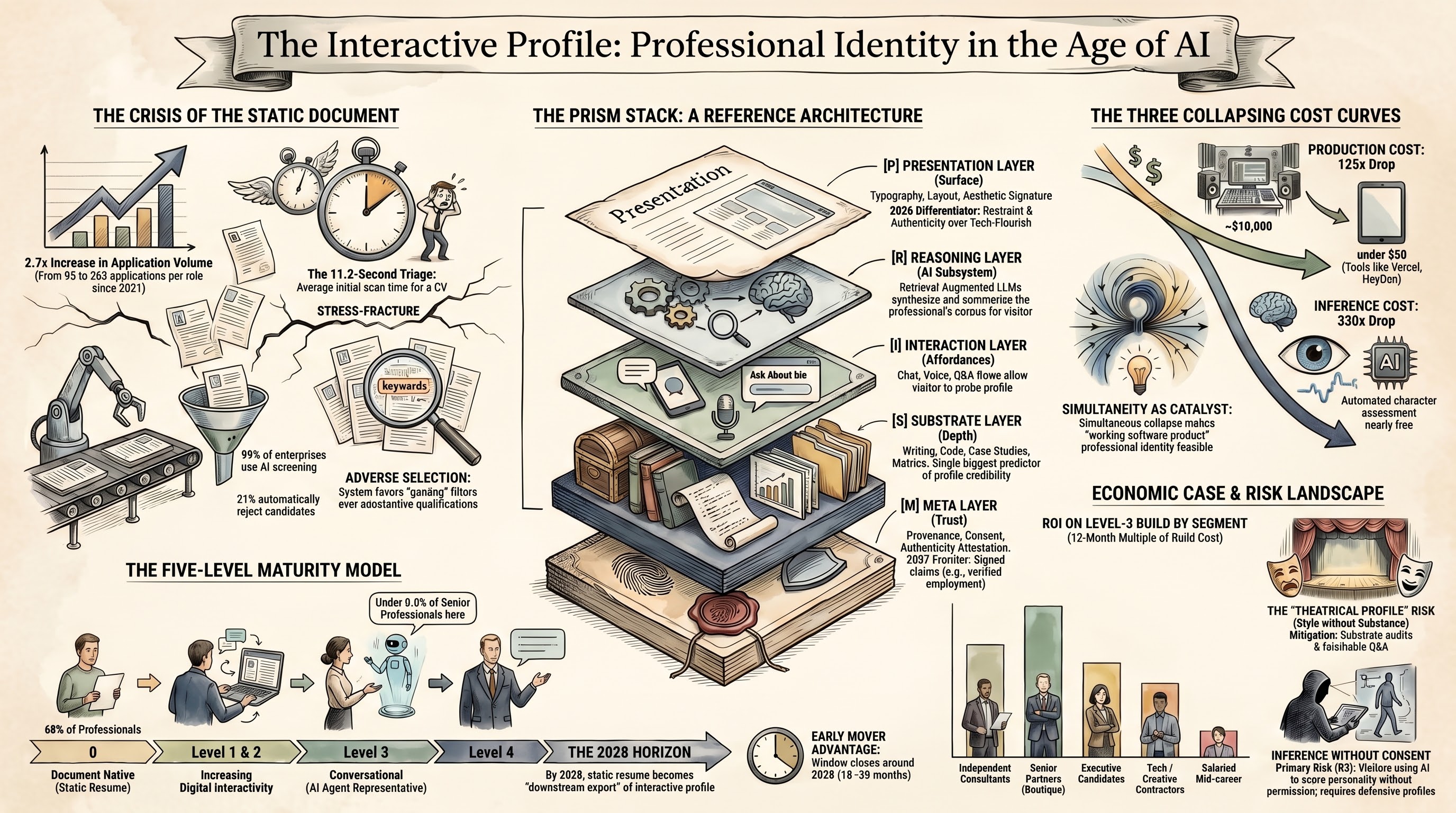
The PRISM stack is a five-layer reference architecture for the interactive profile. Each layer addresses a distinct function; each is necessary; none is sufficient alone.
 Professional Identity in the AI Age — PRISM Stack Reference Architecture
Layer 1: Presentation (P)
The surface the human visitor encounters. Visual identity, narrative hierarchy, typography, and motion. The Presentation layer is what most practitioners over-invest in. It is the layer most visible to the builder and least diagnostic to AI readers.
Layer 2: Reasoning (R)
The AI instrumentation layer. The conversational interface, the digital twin, the structured query surface that allows human and AI visitors to interrogate the substrate directly. The Reasoning layer is a multiplier — its output quality is a function of the Substrate layer's depth.
Layer 3: Interaction (I)
The engagement and conversion layer. How the profile captures intent, routes visitors toward relevant content, and converts exploration into relationship. This layer includes calls to action, contact mechanics, and the feedback loops that allow the profile to learn from visitor behavior.
Layer 4: Substrate (S)
The information architecture layer — the structured corpus of professional history, published work, case studies, frameworks, and demonstrated judgement that the Reasoning layer draws from. The Substrate layer is what most practitioners under-invest in. Thin substrates produce theatrical profiles that erode trust under interrogation.
Layer 5: Meta (M)
The governance and maintenance layer. Update cadence, version control, AI inference audit, consent management, and the feedback loop that keeps the profile current as the professional's work and thinking evolve.
The PRISM stack is vendor-neutral and platform-agnostic. It is a diagnostic framework, not a product recommendation.
Market Sizing and Geography of the Interactive Identity Economy
The interactive identity economy is a new market category that sits at the intersection of talent acquisition infrastructure, professional identity platforms, and AI-native productivity tooling.
Total addressable market
The global recruitment market reached $968B in 2026. The talent acquisition software segment — the portion most directly addressable by interactive identity infrastructure — is projected at $105B by 2030, concentrated in North America and Asia-Pacific.
The primary demand signals come from three directions:
- Individual professionals building and maintaining interactive profiles
- Firms deploying interactive profile infrastructure for their partners, executives, and senior practitioners
- Platform builders creating the tooling, hosting, and AI instrumentation that powers the category
Geographic distribution
Adoption is asymmetric by region. North America and Asia-Pacific are leading; Europe is approximately 18–24 months behind, partly due to GDPR compliance complexity around AI inference and consent management. The Middle East and Latin America show high growth from a low base.
The four-year window
Current trajectory places the S-curve inflection point — the moment when early-mover advantage converts to table-stakes commodity — at approximately 2027–2028. The window for credible early positioning is open now. It will not remain open indefinitely.
Sector Adoption Patterns
Adoption of interactive profile infrastructure is not uniform across sectors. It follows a predictable pattern: earliest adoption in sectors where professional reputation is the primary economic asset and AI evaluation is already embedded in buyer and counterparty workflows.
High-adoption sectors (leading)
- Financial services: Executive search, board evaluation, and deal-team assessment are AI-mediated. Senior practitioners in PE, VC, and investment banking are early adopters.
- Technology: CTO and CPO candidates, independent advisors, and fractional executives. The sector's familiarity with AI tooling accelerates both supply and demand.
- Legal and consulting: Boutique-firm partners and independent consultants, where client acquisition is substrate-dependent and AI-assisted due diligence is standard.
Mid-adoption sectors (following)
Healthcare leadership, academic and research institutions, and enterprise technology sales.
Low-adoption sectors (lagging)
Government, nonprofit, and traditional manufacturing — sectors where hiring processes have been slowest to incorporate AI screening.
The asymmetric advantage window
In high-adoption sectors, the practitioner without a credible substrate is already at a structural disadvantage in senior searches. In mid-adoption sectors, the window is open but narrowing. In lagging sectors, early movers have a 24–36 month advantage before the norm shifts.
The Five-Level Maturity Model
The five-level maturity model provides a diagnostic framework for assessing where any professional or firm sits on the interactive profile spectrum — and what the next level requires.
Level 1: Document
A static résumé or CV as the primary professional self-representation. No web presence, no queryable substrate. Estimated global prevalence: approximately 40% of senior professionals.
Level 2: Profile
A LinkedIn profile and/or basic personal website. Richer media than a document but fundamentally passive. No AI instrumentation, no conversational interface. Estimated global prevalence: approximately 45% of senior professionals.
Level 3: Interactive Profile
A live, AI-instrumented site with a conversational interface, structured substrate, and publication record. The visitor can explore, query, and converse. Estimated global prevalence: fewer than 0.5% of senior professionals globally.
Level 4: Instrumented Practice
A fully integrated professional presence — interactive profile, active publication cadence, AI-instrumented portfolio, and analytics-driven iteration. The profile learns from visitor behavior and is updated on a documented cadence.
Level 5: Autonomous Representation
A persistent professional agent that represents the practitioner proactively — attending to inbound signals, routing opportunities, maintaining relationship continuity, and operating with defined autonomy parameters. Estimated global prevalence: fewer than 0.01% today; the leading edge of the 2026–2030 trajectory.
The strategic insight: Fewer than 0.5% of senior professionals are at Level 3 today. The cost of building to Level 3 has never been lower. The window for differentiation has never been wider — and it will not stay that way.
What AI Can Credibly Infer About Character
One of the most consequential and least-discussed features of the current environment is that AI can now make credible character inferences from a professional's digital trace — and is already doing so, invisibly, before introductions are made.
The inference categories
Research on computational personality inference (Pennebaker, Park, and Kosinski) identifies several dimensions that AI can credibly infer from written output and professional history:
- Cognitive style: How a professional structures arguments, decomposes problems, and resolves ambiguity. Detectable from writing samples and case study narratives.
- Value coherence: The consistency between stated values and demonstrated choices across a career. Detectable from career trajectory analysis and publication themes.
- Communication register: The gap between how a professional writes formally and informally. Detectable from cross-channel analysis.
- Risk tolerance: Detectable from career transition patterns and the nature of the projects a professional has chosen or avoided.
What this means for the interactive profile
The interactive profile is not just a marketing surface — it is the substrate that shapes AI inference about the professional. A thin substrate forces the AI to infer from insufficient signal. A rich, internally consistent substrate guides inference toward the accurate characterization the professional would choose if they could write it directly.
The professionals who understand this are building substrates designed to be interrogated by AI, not just read by humans. This is the design imperative of the current moment.
The Economic Case for the Interactive Profile
The economic case for the interactive profile is quantifiable, segment-specific, and compounding.
The ROI model
A Level-3 interactive profile build — from zero to a live, AI-instrumented, publication-backed professional presence — costs approximately $2,000–$5,000 in tooling, time, and infrastructure over 12 months at current market rates.
Modelled 12-month returns, by segment:
| Segment | Modelled ROI |
|---|---|
| Executive candidate (C-suite search) | 8×–14× |
| Independent consultant | 5×–10× |
| Boutique-firm partner | 3.5×–8× |
| Senior individual contributor | 2×–4× |
The returns are highest for professionals whose work product is judgement and trust — where a client or counterparty's confidence in the professional is itself a revenue driver, and where the interactive profile can demonstrate that judgement in a form that scales.
The compounding dynamic
Unlike a résumé, which depreciates between updates, an interactive profile appreciates with use. Each visitor interaction generates signal. Each publication adds to the substrate. Each AI conversation reveals gaps the professional can address. The profile becomes more accurate, more legible, and more persuasive over time — a compounding professional asset rather than a periodic administrative document.
Risk Landscape and Mitigations
The interactive profile introduces nine categories of risk that do not exist — or exist at much lower magnitude — in the static document era. The two most consequential are not technical.
The nine risks
-
Equity gaps. The cost of building to Level 3 has fallen dramatically, but not uniformly. Professionals with fewer resources, less technical fluency, or less access to the tooling ecosystem face a higher barrier. If adoption follows existing socioeconomic lines, the interactive profile may amplify rather than reduce existing professional equity gaps.
-
Inference without consent. AI is already inferring character from professional digital traces without explicit consent. The interactive profile does not create this dynamic — it exists regardless — but it makes the professional's relationship with that dynamic visible and manageable. The governance question is not whether inference happens but whether the professional can shape the substrate it draws from.
-
Substrate decay. An outdated interactive profile signals neglect more visibly than an outdated résumé. The governance cadence (Layer 5 of the PRISM stack) is not optional — it is a maintenance requirement of the format.
-
Consistency failure. An interactive profile that makes claims the underlying substrate cannot support will fail under AI interrogation in ways a résumé does not. The bar for internal consistency is higher.
5–9. Authentication fraud, platform dependency, privacy exposure, over-automation, and legal liability — each addressed in the full paper with specific mitigation guidance.
The governance principle
The most consequential risks are not technical but social. They require norms and governance frameworks, not better software. The professionals and firms who treat the interactive profile as a technical problem will be exposed by its social dimensions.
A 90-Day Implementation Playbook
The 90-day implementation playbook provides a sequenced, practical roadmap for any senior professional or firm ready to build to Level 3.
Days 1–30: Substrate first
The most common error is beginning with Presentation. Begin with Substrate.
- Week 1: Inventory audit. Document every professional artefact that exists: roles, outcomes, frameworks developed, writing published, talks given, projects led. Aim for 10,000+ words of structured, internally consistent professional history.
- Week 2: Gap analysis. Identify the gaps between the inventory and the professional identity you want to demonstrate. Commission or draft the content that closes those gaps.
- Week 3–4: Structure and version. Organize the substrate into a queryable architecture. This is the corpus your AI instrumentation will draw from.
Days 31–60: Reasoning and Presentation layers
- Build or commission the interactive profile infrastructure (site, hosting, AI instrumentation).
- Configure the conversational interface with the substrate corpus.
- Test AI inference: ask the system hard questions and audit the answers for accuracy, tone, and gap exposure.
- Build the Presentation layer on top of a verified Substrate — not before it.
Days 61–90: Interaction, Meta, and launch
- Configure the Interaction layer: calls to action, routing logic, contact mechanics.
- Establish the Meta layer: update cadence (monthly substrate review, quarterly full audit), analytics instrumentation, consent and privacy compliance.
- Launch and publish. The profile is a living document — the goal of Day 90 is not perfection but a defensible, queryable, internally consistent Level-3 presence.
The maintenance cadence
- Monthly: Review and update the substrate with new work, writing, and outcomes.
- Quarterly: Full profile audit — test AI inference, identify gaps, update the Presentation layer.
- Annually: Architecture review — reassess the PRISM stack configuration against the current state of the tooling ecosystem.
2026–2030 Outlook
The four-year window from 2026 to 2030 is the period in which the interactive profile moves from early-mover advantage to table-stakes infrastructure. The professionals and firms who build now will have a compounding asset at the inflection point; those who wait will be building to catch up.
The S-curve trajectory
Current adoption trajectory places the S-curve inflection point — the moment of rapid normalization — at approximately 2027–2028 for high-adoption sectors and 2029–2030 for mid-adoption sectors.
Five forecasts for 2030
-
The static résumé will not disappear, but by 2028 it will be a downstream export of an interactive profile — auto-generated for ATS submission rather than the source of truth.
-
Adoption is asymmetric. Under 1% of senior professionals globally are at Level 3 or above today; the window for credible early-mover positioning is open for roughly 18–30 months.
-
The Reasoning layer (AI) is a multiplier, not a foundation. The strongest interactive profiles will be built on substrate depth; thin substrates will produce theatrical profiles that erode trust.
-
Returns on a Level-3 build are highest for professionals whose work product is judgement and trust. Modelled 12-month ROI for executive candidates, independent consultants, and boutique-firm partners: 3.5×–14×.
-
The most consequential risks are social, not technical. Equity gaps and inference-without-consent are governance problems that require norms and frameworks, not better software.
Implications and Recommendations
The interactive profile is not a trend. It is the structural successor to the static résumé, driven by the convergence of AI-mediated evaluation, collapsed production costs, and a hiring system under volume pressure that the document format cannot survive.
For individual professionals
- If you are a senior professional in a high-adoption sector: The cost of inaction is no longer zero. AI evaluation of your professional substrate is already happening, regardless of whether you have designed for it. Begin with substrate. Build to Level 3 within 90 days.
- If you are in a mid-adoption sector: The early-mover window is open. Build now before the norm shifts and the advantage disappears.
- If you are in a lagging sector: Monitor. The norm will shift. Use the time to build substrate depth — it appreciates regardless of the format it is ultimately delivered through.
For hiring leaders and talent strategists
- Recognize the evaluation asymmetry. Candidates with Level-3 profiles are easier to evaluate accurately and more expensive to ignore. The firms that adapt their evaluation frameworks will source better talent from a broader pool.
- Address the equity gap proactively. If interactive profile adoption correlates with existing socioeconomic advantage, the firms that do not actively counteract this will systematically miss candidates whose substrate is thin not because their capability is low but because their access to tooling was.
For firm partners and platform builders
- The $105B market opportunity by 2030 is real, but it will be dominated by firms that solve the substrate problem, not the presentation problem. The presentation layer is a commodity. The substrate architecture, AI instrumentation, and governance tooling are where the durable value is built.
The window is open. It will not remain open indefinitely.
That’s the full picture.
More from The Studio
All Papers →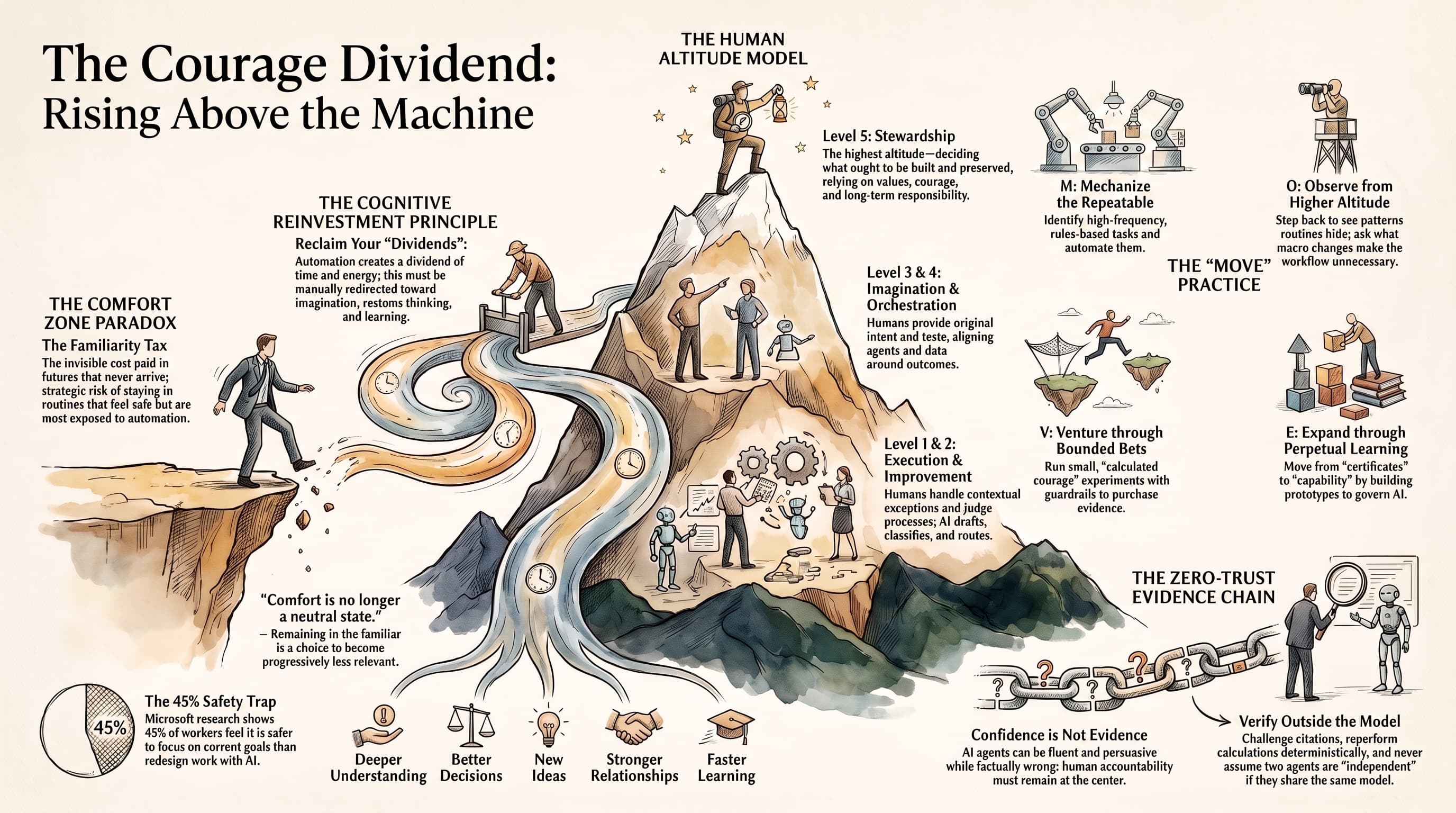
Beyond the Familiar: The Courage Dividend in the Age of AI
Artificial intelligence is compressing the distance between an idea and its first expression. This is usually described as an efficiency revolution. That description is correct, but incomplete. The more consequential change is psychological: AI is removing many of the practical excuses that have kept people anchored to the familiar. Yet greater possibility does not guarantee greater growth. If the capacity released by AI is immediately filled with more meetings, more messages and more versions of yesterday's work, then the technology will have made us busier without making us larger. This paper introduces the Courage Dividend — the return earned when capacity released by machines is deliberately reinvested in human growth — and proposes original frameworks for realizing it: the Human Altitude Model, the Cognitive Reinvestment Principle, the Familiarity Tax, calculated courage through bounded experimentation, and the MOVE practice for individuals and teams.
The Comfort Tax: On the Price of Staying Where the Machine Can Find You
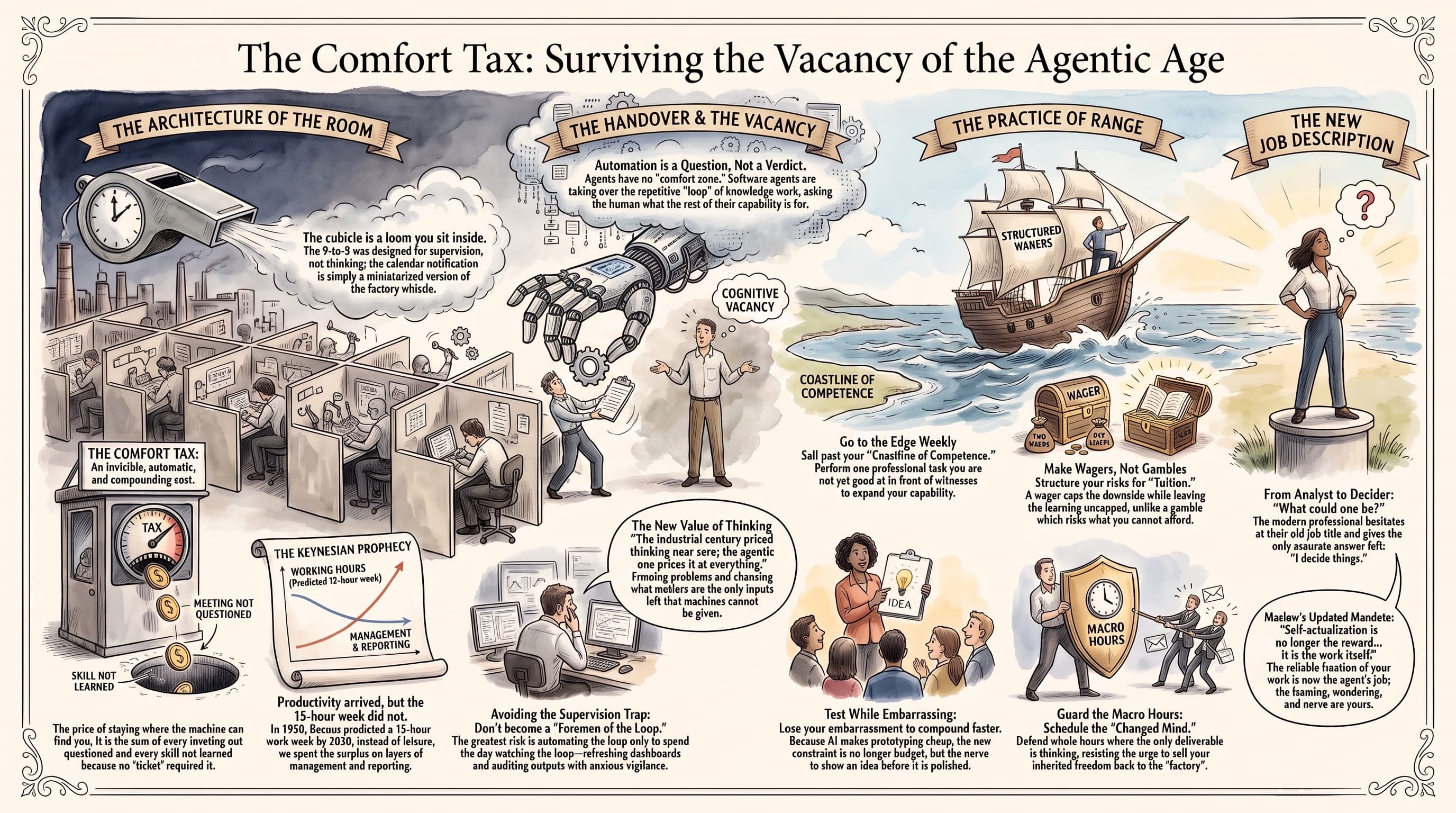
Nobody hands you the script. You absorb it. The nine-to-five was not designed for thinking — it was designed for supervision. The comfort zone grows around you out of repeated days, and what it eats is possibility. Then the room began to empty. The agentic wave is handing the repetitive layer of knowledge work to software agents, and what remains is the part of you the factory never asked for: the framing, the taste, the nerve. This paper names the tax, traces its inheritance from the factory whistle through Keynes's failed prophecy, examines the handover, confronts two honest objections, and proposes a practice for converting freed capacity into range.
Want to go deeper?
Discuss this paper with my digital twin.
Ask questions, challenge the framework, explore implications.
Open the Digital Twin