The Career Operating System: Anatomy of Winning a Rigged Job Market
Why the job market is structurally asymmetric — and the six-layer operating system that closes the gap.
“A career in 2026 is not a sequence of resumes and applications. It is an operating system — and the professionals who build it deliberately will consistently outperform those who don't.”
Paper DNA
Domain
Career Strategy & AI Tools
Maturity
Live
Market Size
~100M job seekers · $45B career services market
60–75% of applicants are rejected by ATS before a human reads their resume, while 50–80% of roles are filled through the hidden market — candidates operating without a system are playing a game they cannot win.
The Career OS treats job search as an engineering problem: six interdependent layers that compound over time when maintained as a system, not activated under pressure at the moment of crisis.
The 90-Day Career Sprint operationalizes the OS into an executable timeline — Foundation (days 1–30), Velocity (days 31–60), Conversion (days 61–90) — with specific milestones, primary focus areas, and anti-patterns to eliminate at each stage.
The Rigged Reality
The job market of 2026 is not a meritocracy. It is a system with five structural asymmetries that systematically advantage employers over candidates — and the professionals who understand those asymmetries will consistently outperform those who don't.
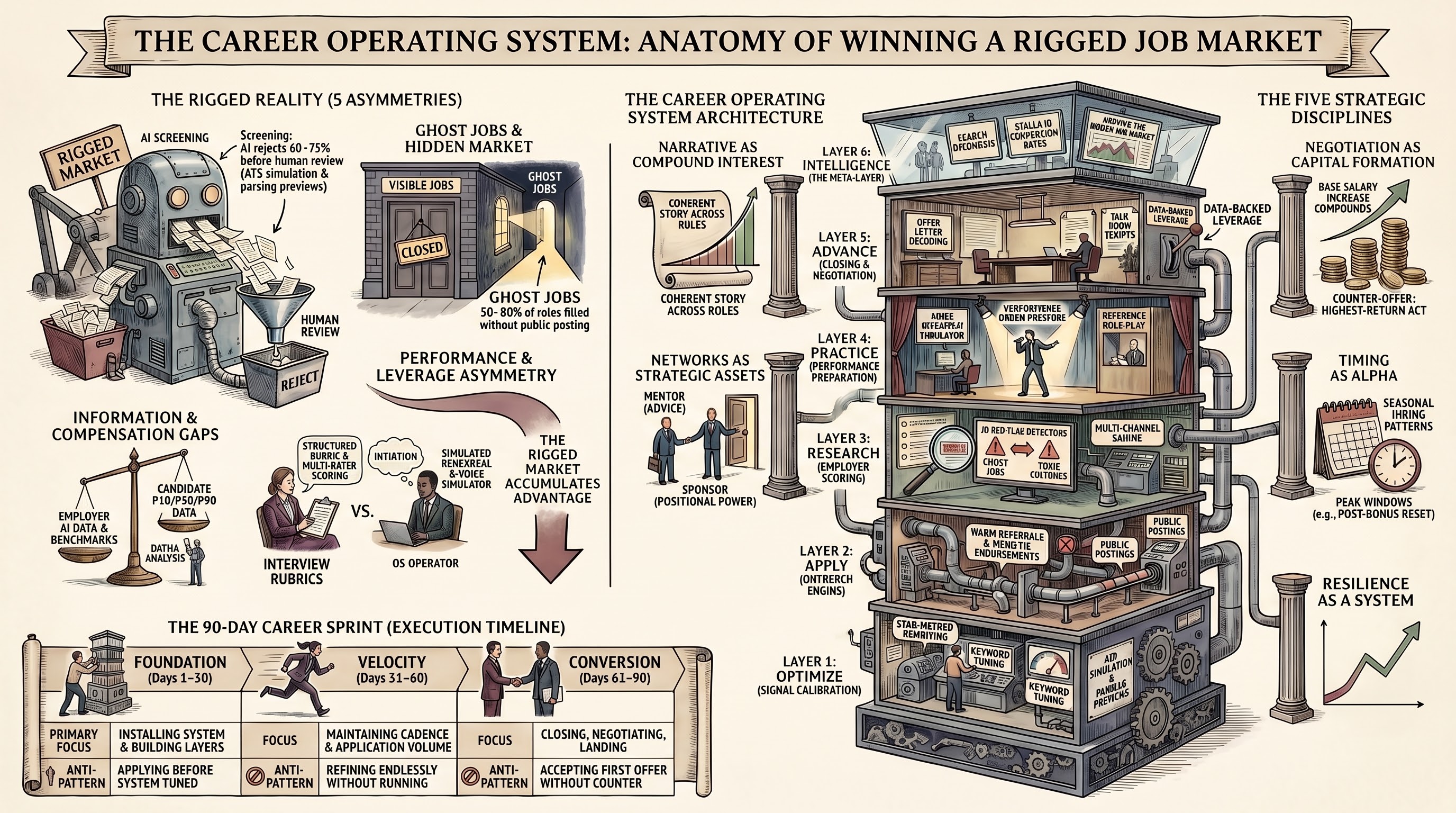 Career Operating System — Full Architecture Infographic
The Five Structural Asymmetries
1. ATS Screening — The Invisible Gate
60–75% of applications are rejected by Applicant Tracking Systems before a human reads them. The filter is not intelligence. It is keyword density, format compliance, and structural parsing. A highly qualified candidate submitting a creatively formatted resume to a role they are objectively right for will be filtered out while a less qualified candidate with a keyword-optimised document advances.
The ATS is not evaluating merit. It is evaluating signal fidelity.
2. Ghost Jobs — The Phantom Market
10–30% of posted roles are ghost jobs: positions that are already filled internally, listed to build a candidate pipeline, or posted in compliance with policy without genuine intent to hire externally. Candidates spend hours tailoring applications for roles that were never available.
There is no reliable way to identify a ghost job before applying. The only mitigation is system efficiency — reducing the cost per application so that ghost job encounters don't derail the search.
3. Information & Compensation Asymmetry
Employers have access to salary benchmarks, candidate market rates, and compensation history (where legal). Candidates largely do not. Pay transparency legislation exists in pockets — New York, California, Colorado — but is inconsistently applied and frequently gamed. The result is a negotiation where one party walks in with full information and the other guesses.
4. The Hidden Market — Where Most Roles Live
50–80% of roles are filled without ever being publicly posted. They are filled through referrals, alumni networks, retained search, and internal mobility. The visible job market — the one where most candidates spend most of their time — represents the minority of available opportunities, and specifically the ones with the highest competition density.
Operating only in the visible market is the strategic equivalent of fishing where everyone else is fishing.
5. Fragmented Pay Transparency
Even where salary bands are disclosed, they are routinely listed at maximum range, structured to anchor candidate expectations, or omitted for "competitive" roles. The candidate who enters a negotiation without independent compensation intelligence has already conceded ground before the conversation begins.
The Compound Effect
These five asymmetries do not operate independently. They compound. A candidate who is filtered by ATS (asymmetry 1) never reaches the negotiation table (asymmetry 5). A candidate who only applies to posted roles (asymmetry 4) is competing in maximum-density water for minority-of-market opportunities. A candidate who accepts the first offer (asymmetry 3) has given back what they earned with months of search effort.
The answer is not optimism. It is architecture.
The Career OS Architecture
A career in 2026 is an operating system. Not a document. Not a series of interviews. A set of interdependent layers that, when maintained continuously and activated deliberately, compound over time into a durable competitive advantage.
The Career OS has six layers. They are not sequential. They run in parallel.
Layer 1: Optimize
Your materials. Resume, LinkedIn profile, executive bio, portfolio.
Optimized means: ATS-compliant structure, keyword-calibrated to your target role family, achievement-led rather than responsibility-listed, with quantified impact wherever possible. It also means a LinkedIn profile that is findable — recruiter-search-optimised, with a headline that speaks to your next role, not your current title.
Most professionals treat this layer as a one-time project. It is a continuous process. When your target role evolves, your materials must evolve with it.
Anti-pattern: Sending the same resume to every role. Every application should be a targeted calibration of a master document — not a generic submission.
Layer 2: Apply
Your targeting engine. A disciplined, prioritised pipeline with conversion metrics.
Apply is not spray-and-pray. It is a deliberate selection process: companies you have researched, roles that align with your medium-term trajectory, applications that are timed to cycles and triggers (leadership changes, funding events, expansion announcements), with a tracking system that shows you conversion rates at each stage.
A well-run Apply layer generates data. Where are you converting? Where are you dropping out? Which application variables predict interview progression? Without this data, you are guessing.
Anti-pattern: Applying to 50 roles in a week without tracking or follow-up. Volume without targeting is noise.
Layer 3: Research
Your intelligence layer. Deep company and role research before you apply, before you interview, before you negotiate.
Research means: understanding the organisation's strategic priorities well enough to position your experience as a solution. It means knowing the hiring manager's background, their team's challenges, the company's recent news, and the competitive context they operate in. It means arriving at an interview with a point of view — not just answers.
Research also means market intelligence: compensation benchmarks, hiring velocity by sector, the names of the people who are actually making decisions.
Anti-pattern: Researching a company the night before an interview. Research should precede the application.
Layer 4: Practice
Your performance layer. Interview preparation that simulates real conditions, not ideal ones.
Most candidates prepare for the questions they hope they'll be asked. High-performing candidates prepare for the questions they hope they won't be asked — the gaps, the transitions, the setbacks. They practice out loud, with timing, under conditions that approximate the pressure of the real conversation.
Practice also means pitch rehearsal: a 90-second professional narrative that is consistently compelling and precisely targeted to the role at hand.
Anti-pattern: Preparing answers in your head. Cognitive preparation is not performance preparation.
Layer 5: Advance
Your trajectory design. Promotion strategy, lateral moves, career architecture — not left to annual performance reviews.
Advance is the layer most professionals ignore when they're not actively searching. It is the layer that determines what opportunities are available when you are. Building it means: developing a sponsor (not just a mentor), making your work visible to decision-makers, positioning for the next role before you need it, and understanding the unwritten rules of advancement in your specific organisation and sector.
Anti-pattern: Assuming strong performance alone drives advancement. Performance is the entry condition. Visibility and sponsorship determine the outcome.
Layer 6: Intelligence
Your market signal layer. Tracking trends, mapping your field, sensing shifts before they reach you.
Intelligence means knowing which skills are appreciating, which sectors are contracting, which companies are scaling, and which technologies are creating new role categories. It means reading the market as an ongoing practice — not a panic response to an unexpected redundancy.
Professionals who run a continuous Intelligence layer are never surprised by market shifts. They position ahead of them.
Anti-pattern: Updating your market awareness only when you start a job search. By then, the cycle is already behind you.
The Five Career Arcs
The Career OS architecture is universal. The calibration is not. Five distinct career situations require different prioritisation of the six layers, different tactical emphasis, and different sequencing of the 90-day sprint.
Arc 1: The New Graduate
Primary challenge: No track record. A credentials market that rewards experience you haven't had time to accumulate.
OS calibration: Layer 1 (Optimize) must compensate for limited experience with transferable signal — academic projects, internships, extracurricular leadership, quantified contributions in any context. Layer 3 (Research) is critical because the new graduate has the most to gain from information advantages they can actually access. Layer 5 (Advance) should be activated immediately — the first 90 days in any role establish the trajectory for the first three years.
Critical anti-pattern: The endless application loop. New graduates often apply to hundreds of roles with an identical document. The leverage is in targeting 10–15 roles deeply rather than 150 superficially.
Arc 2: The Career Pivoter
Primary challenge: A track record that doesn't translate. How do you convince a hiring manager that your experience in one sector is directly relevant to a role in another?
OS calibration: Layer 1 (Optimize) requires aggressive translation — every achievement reframed in the language and metrics of the target sector. Layer 3 (Research) is essential for identifying the transferable vocabulary: what do they call the thing you already know how to do? Layer 2 (Apply) should prioritise roles with explicit transferable skill signals in the job description.
Critical anti-pattern: Leading with the pivot story. Hiring managers buy solutions, not journeys. Your narrative must lead with value, not transition.
Arc 3: The Academic-to-Corporate Translator
Primary challenge: A deep domain credential (PhD, MD, JD, research career) that is simultaneously an asset and a liability. Overqualified for junior roles, underexperienced in corporate context for senior ones.
OS calibration: Layer 4 (Practice) is the highest-leverage layer — academic professionals are typically under-prepared for the pacing, structure, and commercial framing of corporate interviews. Layer 5 (Advance) requires early attention to the unwritten rules of corporate advancement that academic environments don't teach.
Critical anti-pattern: Over-explaining credentials. The academic instinct is to demonstrate depth of knowledge. The corporate instinct is to demonstrate clarity of application.
Arc 4: The Executive in Ascent
Primary challenge: Visibility without overexposure. Building the reputation and relationships that make the next step inevitable — without signalling disloyalty or desperation to current leadership.
OS calibration: Layer 5 (Advance) is the primary layer — sponsor development, board visibility, external thought leadership. Layer 6 (Intelligence) determines the timing of moves: executives who advance fastest are those who move at market inflection points, not at performance review cycles. Layer 3 (Research) at this level is relationship intelligence, not role intelligence.
Critical anti-pattern: Waiting to be identified. At the executive level, advancement is rarely a reward for performance. It is a consequence of deliberate relationship architecture.
Arc 5: The Outplaced Professional
Primary challenge: Time pressure, psychological disruption, and a market that can sense urgency. The outplaced professional must operate at maximum efficiency while managing the cognitive load of uncertainty.
OS calibration: Layer 2 (Apply) must be ruthlessly prioritised — a tight target list, high-quality applications, fast follow-up. Layer 4 (Practice) is non-negotiable: rusty interview performance is the most common failure mode for professionals who haven't interviewed in years. Layer 1 (Optimize) should be completed in week one before any applications go out.
Critical anti-pattern: Accepting the first offer out of relief. Outplaced professionals frequently under-negotiate because the desire for certainty overrides the discipline of the process. One well-negotiated offer is worth months of search time reclaimed.
The Five Strategic Disciplines
Beyond the six layers of the OS, five disciplines separate professionals who consistently advance from those who perform well and stay still. These are not skills. They are habits of strategic practice.
Discipline 1: Narrative as Compound Interest
A career narrative is not a summary of your work history. It is a deliberately constructed story that makes the next role feel inevitable.
The professional who can tell a coherent, compelling career story — one that connects their past decisions to a clear future direction — controls how they are perceived. The professional who leads with a list of titles and responsibilities leaves that interpretation to the interviewer.
Narrative compounds. A well-constructed story, told consistently across interviews, networking conversations, and written materials, creates a perception of direction and intentionality that attracts opportunity. It also shortens the time from first conversation to offer because the hiring manager doesn't have to do the interpretive work.
Build your narrative. Test it out loud. Refine it until it is both true and compelling.
Discipline 2: Network as Strategic Asset
Most professionals think of networking as an activity: attending events, collecting contacts, sending connection requests. High-performing professionals think of their network as infrastructure — a distributed intelligence system that generates information, creates access, and provides referrals.
The difference is in how the network is maintained. Strategic networks are maintained continuously, not activated transactionally when a job search begins. They are built around genuine value exchange — not requests. They are mapped deliberately: who has access to what you need, and what can you offer that they find genuinely valuable?
The hidden market (50–80% of roles) is accessed entirely through this infrastructure. It is not a shortcut. It is the primary channel.
Discipline 3: Negotiation as Capital Formation
Every compensation negotiation is a capital formation event. The outcome does not just affect current income — it sets the base for every future raise, bonus, equity grant, and counter-offer for the next three to five years.
The professional who accepts the first offer without counter-offering leaves compounding money on the table. The discipline is not aggression — it is preparation. Know your number before the conversation begins. Know the market range. Know the company's approval process for exceptions. Know what non-cash compensation is available when the cash number is fixed.
One well-prepared negotiation on a $120K offer — resulting in a $135K outcome — is worth more in lifetime earnings than six months of optimization effort.
Discipline 4: Timing as Alpha
In investing, alpha is the return that exceeds the market benchmark. In career strategy, timing alpha is the advantage generated by moving at moments when the market rewards movement — rather than moving when you need to.
Market inflection points — sector expansions, technology transitions, leadership changes, regulatory shifts — create disproportionate opportunities for professionals who are positioned ahead of them. The professional who moves into AI product management in 2023 has different options in 2026 than the one who moves in 2026.
Timing discipline means reading the market continuously (Layer 6: Intelligence) and being willing to make decisions before they are forced. The best career moves are rarely urgent. They are anticipated.
Discipline 5: Resilience as Operating Condition
A job search is a statistical process. There will be rejections. There will be silences. There will be roles that felt right and didn't close. The professional who recalibrates their self-assessment after every rejection is operating at a cognitive disadvantage.
Resilience is not optimism. It is the ability to separate signal from noise in rejection data — to extract what is actionable (this resume didn't pass ATS, this interview answer missed the mark) from what is not (this company didn't hire me therefore I am not hireable).
Build systems that buffer against the psychology of rejection: a tracking system that shows conversion rates improving over time, a peer group that provides perspective, a defined decision criteria for when to adjust strategy versus when to stay the course.
The professionals who navigate job searches most effectively are not the ones who feel the rejections least. They are the ones who have built the infrastructure to process them most efficiently.
The 90-Day Career Sprint
The Career OS is a continuous system. The 90-Day Career Sprint is how you activate it under time pressure — whether you are newly outplaced, have set a deliberate departure date, or are executing a targeted pivot.
The sprint has three phases: Foundation, Velocity, and Conversion. Each has a primary focus, specific milestones, and critical anti-patterns to eliminate.
Phase 1: Foundation (Days 1–30)
Primary focus: Installing the system and building layers.
Foundation is not about applications. It is about building the infrastructure that makes every subsequent application better and faster.
| Action | Milestone |
|---|---|
| Resume optimisation | ATS-compliant master document complete |
| LinkedIn overhaul | Recruiter-search-optimised profile live |
| Target company list | 20–30 companies researched and tiered |
| Compensation research | Market range identified for target roles |
| Network audit | Top 50 relationships mapped and prioritised |
| Narrative construction | 90-second pitch rehearsed and tested |
Anti-pattern: Starting applications before Foundation is complete. The cost of sending a poorly optimised application to a high-priority target is measured in months, not days — that company now has your document in their system.
Phase 2: Velocity (Days 31–60)
Primary focus: Maintaining cadence and application volume.
Velocity is where the system runs. Applications go out daily. Network conversations happen weekly. Research is continuous. Interview preparation is active, not reactive.
| Action | Milestone |
|---|---|
| Application cadence | 3–5 targeted applications per week |
| Network activation | 2–3 meaningful conversations per week |
| Interview preparation | Mock interviews, timed, with feedback |
| Pipeline tracking | Conversion rate by application stage visible |
| Offer pipeline | At least 2 active conversations in progress |
Anti-pattern: Refining endlessly without running. Foundation-phase candidates often continue optimising their materials instead of applying. The data needed to improve your materials comes from the market — not from another revision pass.
Phase 3: Conversion (Days 61–90)
Primary focus: Closing, negotiating, and landing.
Conversion is where discipline pays. Offers come in. Negotiations happen. Decisions are made.
| Action | Milestone |
|---|---|
| Offer evaluation | At least 1 offer received |
| Negotiation execution | Counter-offer made on every offer |
| Decision framework | Non-negotiables defined and applied |
| Transition planning | Notice period and start date negotiated |
Anti-pattern: Accepting a first offer without counter-offering. The conversion phase is where most of the financial value of the entire sprint is either captured or left behind. Every offer should be countered — the worst a company can say is no, and most will not.
The OS After the Sprint
The sprint ends. The OS does not.
The professionals who build the most durable career advantages are those who maintain all six layers continuously — not as a job-search activity, but as a permanent operating practice. The network stays warm. The intelligence layer runs. The materials stay current. The advance layer is always active.
When the next opportunity arrives — expected or not — the OS is already running. The sprint is merely an acceleration of a system that never stops.
The Platform: Resume2Builder
The Career OS framework exists in two forms: as a methodology and as a platform.
Resume2Builder is the software implementation of the Career OS — 46 tools distributed across all six layers, designed to compress the time required to install and run the system.
What the Platform Does
Every layer of the Career OS has a corresponding tool set:
Layer 1 — Optimize ATS compliance checker, keyword density analyser, achievement rewriter, LinkedIn headline generator, executive bio builder, role-specific resume tailoring engine.
Layer 2 — Apply Application pipeline tracker, target company research template, role scoring matrix, follow-up sequence generator, application timing adviser.
Layer 3 — Research Company intelligence compiler, hiring manager research template, industry trend summariser, compensation benchmark tool, insider network identifier.
Layer 4 — Practice Interview question generator (role-specific), STAR answer constructor, objection preparation tool, 90-second pitch builder, panel interview simulator.
Layer 5 — Advance Promotion readiness assessment, sponsor identification framework, visibility strategy builder, performance narrative generator.
Layer 6 — Intelligence Market signal tracker, skill gap analyser, sector growth monitor, emerging role identifier.
The Design Philosophy
The platform is built on a single insight: most career management tools address Layer 1 only — the resume — and leave the rest of the system unaddressed. The professional who optimises their resume but doesn't run a targeting engine (Layer 2), doesn't build a research infrastructure (Layer 3), and doesn't prepare systematically for performance (Layer 4) has improved their entry document but not their outcome.
Resume2Builder is not a resume tool that happens to have additional features. It is a Career OS platform that happens to start with the resume — because that is where most professionals are already focused when they recognise they need help.
The Outcome
A candidate running all six layers simultaneously, supported by the platform's tooling, compresses the typical job search by 30–60%. Not because they apply faster. Because they convert better: higher interview rates from better-optimised materials, better interview performance from systematic preparation, and higher offer values from negotiation discipline.
The job market is still rigged. The OS is how you win it anyway.
That’s the full picture.
More from The Studio
All Papers →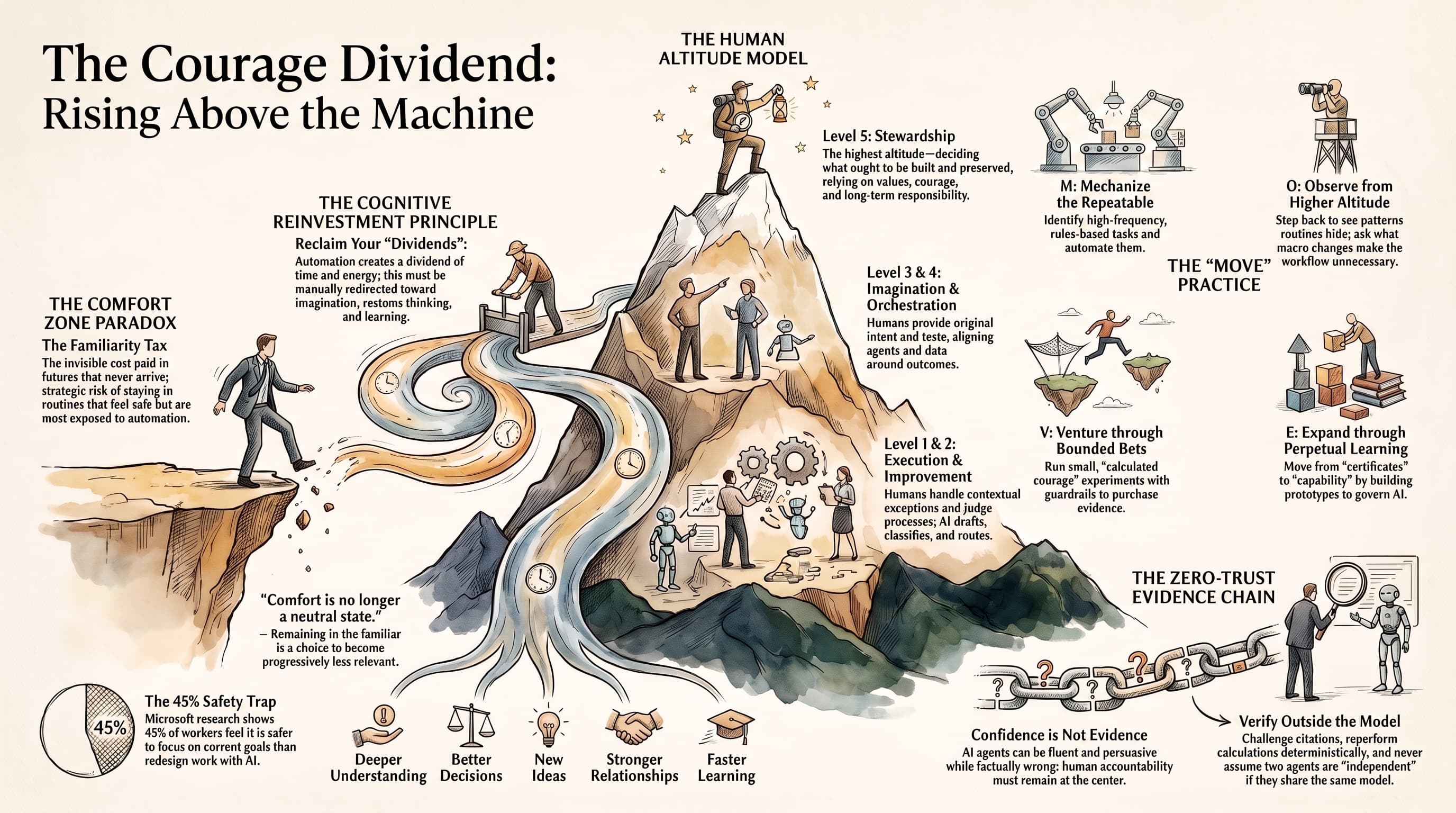
Beyond the Familiar: The Courage Dividend in the Age of AI
Artificial intelligence is compressing the distance between an idea and its first expression. This is usually described as an efficiency revolution. That description is correct, but incomplete. The more consequential change is psychological: AI is removing many of the practical excuses that have kept people anchored to the familiar. Yet greater possibility does not guarantee greater growth. If the capacity released by AI is immediately filled with more meetings, more messages and more versions of yesterday's work, then the technology will have made us busier without making us larger. This paper introduces the Courage Dividend — the return earned when capacity released by machines is deliberately reinvested in human growth — and proposes original frameworks for realizing it: the Human Altitude Model, the Cognitive Reinvestment Principle, the Familiarity Tax, calculated courage through bounded experimentation, and the MOVE practice for individuals and teams.
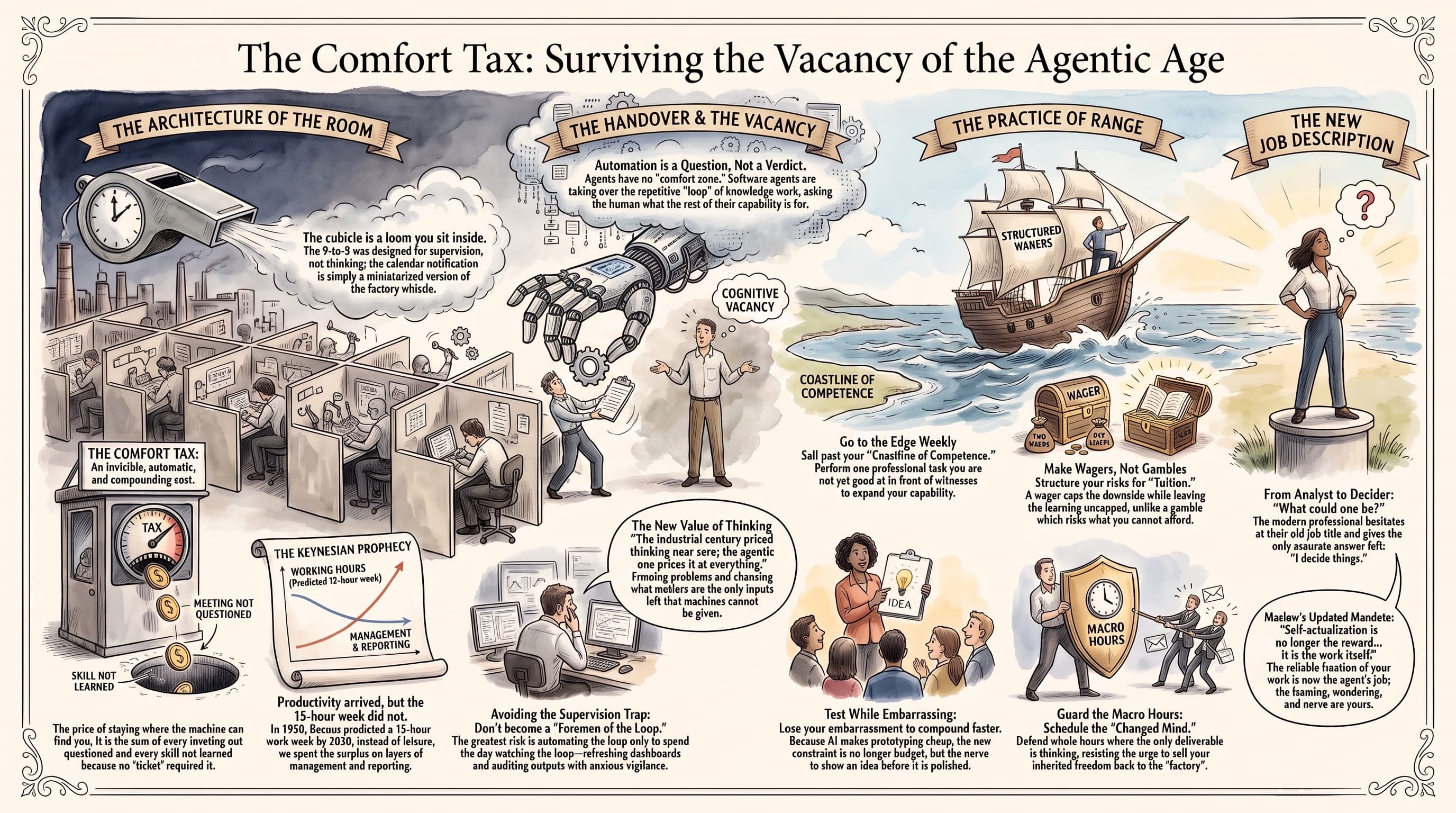
The Comfort Tax: On the Price of Staying Where the Machine Can Find You
Nobody hands you the script. You absorb it. The nine-to-five was not designed for thinking — it was designed for supervision. The comfort zone grows around you out of repeated days, and what it eats is possibility. Then the room began to empty. The agentic wave is handing the repetitive layer of knowledge work to software agents, and what remains is the part of you the factory never asked for: the framing, the taste, the nerve. This paper names the tax, traces its inheritance from the factory whistle through Keynes's failed prophecy, examines the handover, confronts two honest objections, and proposes a practice for converting freed capacity into range.
Want to go deeper?
Discuss this paper with my digital twin.
Ask questions, challenge the framework, explore implications.
Open the Digital Twin