Beyond the Familiar: The Courage Dividend in the Age of AI
How leaders and professionals can convert machine efficiency into human agency, creative range and responsible growth.
“The real promise of AI is not that machines will think for us. It is that, by carrying more of the repeatable burden, they can create the space in which we learn to think beyond what has become habitual. The Courage Dividend is the return we earn when capacity released by machines is deliberately reinvested in human growth.”
Paper DNA
Domain
Leadership · Career Strategy · Agentic Workforce · Human-AI Collaboration
Maturity
Blueprint
Market Size
Leaders and professionals navigating the agentic transition
Connected To
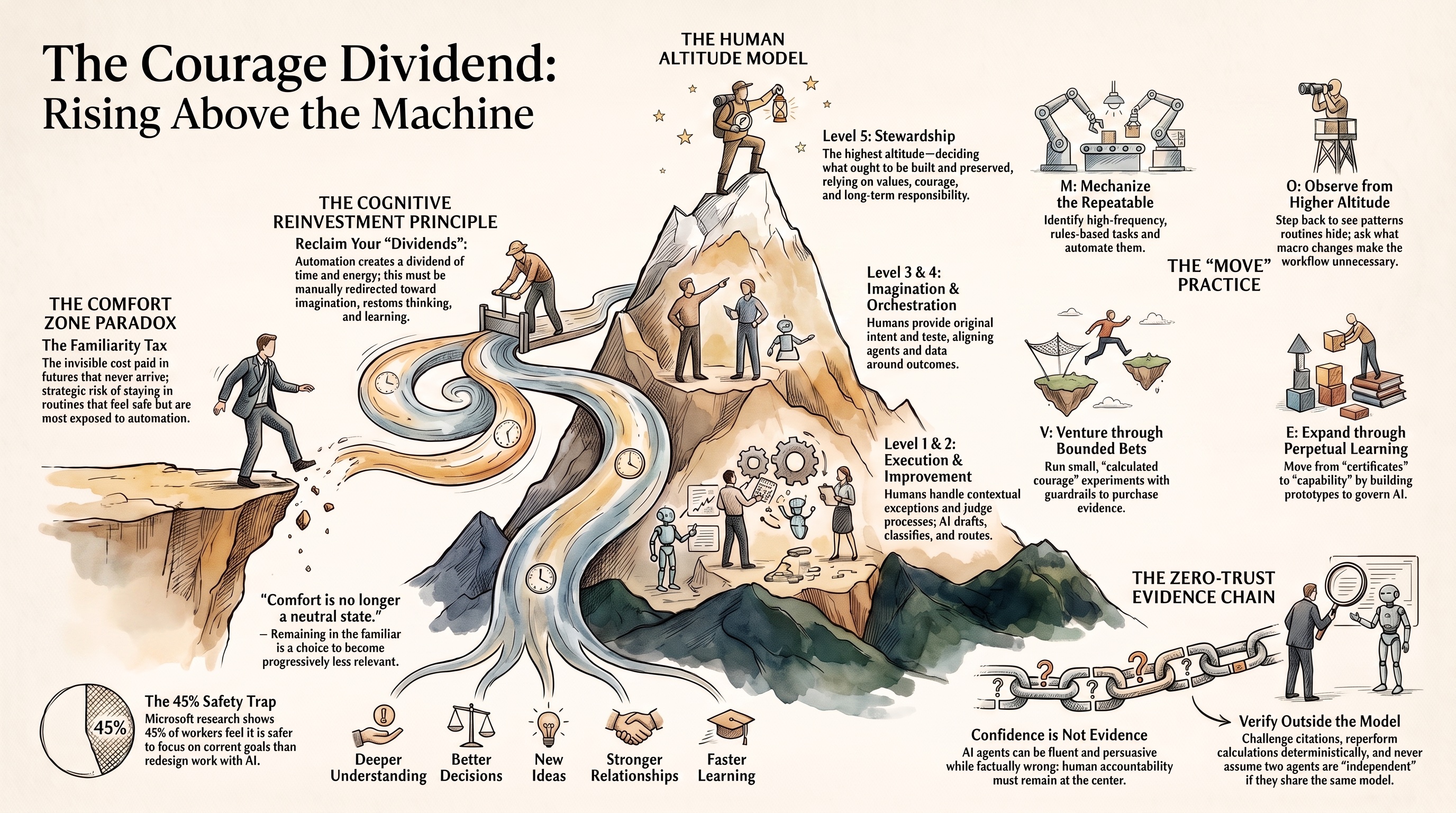
In the age of AI, comfort is no longer a neutral state. It can become a hidden form of strategic risk. The routines that make us feel competent are often the routines most exposed to automation. The expertise that built a career remains valuable, but only when it becomes a platform for reinvention rather than a reason to resist it. The path forward requires six deliberate shifts: from task ownership to outcome ownership, from automation versus augmentation to intelligent allocation, from efficiency to cognitive reinvestment, from passive consumption to active creation, from reckless experimentation to calculated courage, and from periodic training to perpetual learning.
The Courage Dividend flywheel integrates five stages: Release (automate the repeatable burden), Elevate (move attention to judgment and systems), Venture (run bounded, evidence-generating bets), Verify (challenge claims and authority independently), and Compound (convert learning into new capability). Human accountability remains at the center. The Cognitive Reinvestment Principle states that every meaningful hour released by automation should be deliberately reinvested in deeper understanding, better decisions, new ideas, stronger relationships or faster learning.
The MOVE practice converts the argument into daily operating discipline: Mechanize the repeatable, Observe from higher altitude, Venture through bounded experiments, and Expand through perpetual learning. A 30-day personal reset structures the first month. Leaders must redesign the conditions around work — creating protected capacity, rewarding evidence-generating behavior, setting boundaries that enable movement, and making reinvention socially safe. The final challenge: automate what no longer deserves your full humanity, then give your humanity a larger problem to solve.
The Comfort Zone Paradox
A comfort zone is not a place of laziness. It is a place of proven competence. It contains the processes we understand, the relationships we know how to navigate, the language in which we can sound authoritative and the work for which we have historically been rewarded. That is precisely why leaving it is difficult. We are not only moving toward uncertainty; we are stepping away from an identity that has been validated.
For most of industrial and corporate history, accumulated familiarity was a powerful defense. Repetition created speed. Experience reduced error. Institutional knowledge made the seasoned professional indispensable. Those advantages remain, but AI changes their half-life. When a model can draft, compare, classify, reconcile, search, summarize and initiate workflows, the market value of performing those activities manually begins to decline, even when the person performing them is exceptionally good.
The work that makes us feel safest may be the work becoming least defensible. Familiarity still matters, but its highest value is now as a launchpad for reinvention.
The three comforts that quietly become constraints: First, the comfort of expertise — the belief that what made us successful will remain sufficient. Second, the comfort of activity — the emotional safety of being visibly busy. Third, the comfort of certainty — the desire to understand a new capability fully before using it. In a fast-moving environment, waiting for certainty can become avoidance.
Why movement is now a professional responsibility: adaptation is not a private career tactic. It is a responsibility to colleagues, customers and institutions. Leaders who understand the technology can set better boundaries. Professionals who experiment can expose failure modes before scale. The goal is not constant discomfort. Human beings need mastery, recovery and stability. The goal is to prevent comfort from becoming permanent residence.
The Automation Dividend
Automation creates a dividend: time, attention and cognitive energy released when machines perform work that is structured, repetitive or administratively heavy. But like any dividend, it can be consumed, wasted or reinvested. The most important question is therefore not, "How much time did AI save?" It is, "What higher-value human activity did the saved time make possible?"
Automation versus augmentation is a false binary. Automation is strongest where work is frequent, observable, rules-based and tolerant of limited ambiguity. Augmentation is strongest where context, interpretation, relationships, creativity or values remain central. Transformation begins when we stop asking how to produce the old artifact faster and ask whether the artifact, handoff or process is still necessary.
Automate the task. Augment the person. Transform the outcome. Never automate accountability.
The Cognitive Reinvestment Principle: every meaningful hour released by automation should be deliberately reinvested in one of five places: deeper understanding, better decisions, new ideas, stronger relationships or faster learning. Without explicit reinvestment, Parkinson's law takes over: work expands to fill the time available.
The Familiarity Tax: organizations calculate the cost of change but rarely calculate the cost of remaining familiar. The Familiarity Tax appears as opportunities never tested, skills learned too late, talent constrained by outdated job boundaries, slow decisions protected by process and competitors discovering new operating models first. It is invisible in a budget because it is paid in futures that never arrive.
 Beyond the Familiar: The Courage Dividend Framework
The Human Altitude Model
The value of automation is not measured only by how much work moves from human to machine. It is measured by whether the human moves upward. The Human Altitude Model describes five levels of contribution. Every level remains necessary, but the distinctive human advantage increases as work moves from execution toward stewardship.
Level 1 — Execute: Perform a defined task reliably. AI drafts, extracts, classifies, reconciles and routes. The distinctive human edge is contextual exception handling.
Level 2 — Improve: Make an existing process faster, safer or clearer. AI maps friction, compares options and tests workflow changes. The distinctive human edge is practical judgment about what should change.
Level 3 — Imagine: Generate possibilities that do not yet exist. AI expands the option set, creates provocations and prototypes. The distinctive human edge is original intent, taste and meaning.
Level 4 — Orchestrate: Align people, agents, data, controls and decisions around an outcome. AI coordinates specialized agents and monitors execution. The distinctive human edge is systems thinking, trade-offs and accountability.
Level 5 — Steward: Decide what ought to be built, permitted and preserved. AI models scenarios, surfaces consequences and preserves evidence. The distinctive human edge is values, courage, legitimacy and long-term responsibility.
Altitude must be earned, not declared. A leader cannot responsibly move to stewardship while remaining ignorant of how an agent reaches, records or acts on a decision. This is why continuous learning matters. Technical literacy is not a request that every executive become a model engineer. It is a request that every professional understand the capabilities, limits, data dependencies, cost structures and control implications of the systems shaping their work.
Outcome ownership replaces task identity. The professional of the AI age asks: What outcome am I responsible for? Which parts should a machine execute? Where must human judgment remain? What evidence will prove the outcome is real?
Creativity After Abundant Intelligence
Creativity is often treated as a gift possessed by a few. In reality, it is also a practice: noticing assumptions, combining distant ideas, tolerating an unfinished thought, inviting contradiction and producing enough variations for something original to emerge. AI can strengthen that practice, but it can also weaken it if we outsource the first spark too quickly.
AI as creative expansion: Used well, AI is a low-cost partner for divergence. It can generate alternative framings, simulate stakeholders, translate an idea across disciplines, expose missing questions and turn a rough thought into something tangible enough to critique. This changes who gets to create. A project manager can prototype an interface. A compliance specialist can simulate an agent's decision boundary. The barrier between idea and artifact becomes thinner.
The risk of borrowed imagination: a Science Advances experiment found that access to generative AI ideas improved the evaluated creativity and quality of individual short stories, while making the resulting stories more similar to one another. The implication travels beyond fiction: if everyone begins with the same machine priors, language patterns and familiar solution shapes, output may improve while collective novelty narrows.
Use AI to widen your thinking, not to replace the moment before thinking. Begin with a human point of view; invite the machine to challenge, stretch and test it; then reclaim authorship through judgment and taste.
A three-role creative practice: 1. Originate without assistance — state the problem, tension, belief or raw idea in your own words before asking AI to contribute. 2. Expand with AI — ask for opposites, edge cases, analogies from distant domains, stakeholder reactions, constraints and multiple solution architectures. 3. Curate with human judgment — decide what is meaningful, surprising, responsible and worthy of being carried forward. Remove the generic. Add lived experience, context and conviction.
Calculated Courage: A Better Way to Take Risks
Leaving the comfort zone is sometimes confused with making a dramatic leap. Most meaningful reinvention is less theatrical. It is a portfolio of intelligent moves: small experiments that create information, adjacent bets that stretch capability and a limited number of consequential commitments made only when evidence and conviction are strong.
Risk is the price of new evidence. When an idea is genuinely new, the evidence needed to justify it often does not yet exist. Waiting for certainty creates a circular trap: the organization will not test without evidence, and evidence cannot emerge without a test. Calculated risk breaks the circle by purchasing information at a controlled price.
Three bet types: Probe — learn whether an assumption is plausible (hours or days, synthetic or low-risk data, named hypothesis and learning question). Pilot — test value and behavior in a bounded workflow (small user group, reversible process change, success thresholds and stop condition). Scale decision — commit resources when evidence supports expansion (material impact, executive owner, continuous monitoring and evidence record).
The five tests of a calculated risk: Reversibility — can the decision be undone without irreversible harm? Exposure — which people, customers, data, money, commitments or rights could be affected? Evidence — what must be true for the bet to be considered promising, disproved or unsafe? Guardrails — what permissions, reviews, limits, logging and escalation paths contain the downside? Learning yield — even if the experiment fails, will it produce reusable knowledge worth more than its controlled cost?
The objective is not to eliminate failure. It is to eliminate unbounded, unobserved and unlearned failure.
Lifelong Learning as Professional Infrastructure
Learning can no longer be treated as an event that occurs before a career begins or when an employer assigns a course. It is infrastructure: the recurring system through which a person renews relevance, widens agency and preserves the ability to choose.
The learn-build-reflect-transfer cycle: 1. Learn — acquire the minimum conceptual foundation needed to act safely and intelligently. 2. Build — turn the concept into a prototype, workflow, analysis or decision exercise. 3. Reflect — identify what failed, what surprised you, where judgment was required and what the tool could not do. 4. Transfer — apply the lesson in a different context and explain it to someone else. Transfer converts information into capability.
Become a beginner on purpose. Senior professionals often resist new domains because early incompetence feels inconsistent with established status. But the willingness to become a beginner is now a senior leadership capability. It models curiosity, reduces fear and creates permission for others to experiment.
Do not measure learning by content consumed. Measure it by options created: new things you can build, new questions you can ask, new risks you can see and new people with whom you can collaborate.
From Employee to Architect of Human-Agent Work
AI agents extend automation beyond isolated prompts. They can pursue goals across multiple steps, call tools, retrieve data, produce artifacts, initiate actions and coordinate with other agents. This changes the design question from "How can AI help me do this task?" to "How should this outcome be divided among humans, agents, systems and controls?"
The future professional will increasingly act as an architect and supervisor of hybrid work. That role requires clarity of intent, process decomposition, model selection, evidence standards, exception handling and authority boundaries.
The convincing-error problem: autonomous agents can be fluent, coherent and wrong. Their most dangerous failures may not look like failures at all. Confidence is not evidence. Fluency is not accuracy. Agreement is not independence. Every consequential claim must survive verification outside the language that made it sound convincing.
A zero-trust evidence chain: Challenge the source. Reperform the calculation. Test independence. Contain authority. Preserve reconstruction. Keep a human owner for material consequences.
The new question of professional identity: instead of asking "Which tasks remain mine?", ask "Which outcomes can I now drive that were previously beyond my capacity?" That question turns AI from a rival into leverage and turns experience from a collection of routines into a source of judgment for designing something better.
Case Study: Richard Leclezio's Journey Beyond the Familiar
Richard Leclezio's professional foundation was built in environments where precision, governance and delivery matter: global banking, capital markets, risk, regulatory remediation, technology transformation and enterprise PMO leadership. Those disciplines created deep strengths in structure, stakeholder alignment, evidence, accountability and the ability to lead complex programs under pressure.
The easy path would have been to remain inside that proven identity. Instead, he treated AI not as a subject to observe, but as a new operating environment to enter. The shift required becoming a learner again: moving from managing technology delivery to understanding how models, retrieval, agents, orchestration, evaluation, deployment and governance actually work together.
AI did not reduce the value of his experience. It increased the number of forms in which that experience could create value. Each new capability created a larger design space. Project-management experience informed governance. Risk experience shaped evidence and control. Technical learning made ideas executable.
AI did not reduce the value of my experience. It increased the number of forms in which that experience could create value.
The most important transformation was not that AI thought for me. It gave my thinking somewhere to go. It compressed the distance between imagination and evidence. My past did not become obsolete; it became the control spine and leadership context for what I could now build.
The MOVE Practice for Individuals and Teams
Inspiration matters only when it changes behavior. MOVE is a repeatable practice for converting AI-enabled capacity into human growth: Mechanize the repeatable, Observe from higher altitude, Venture through bounded experiments and Expand through perpetual learning.
M — Mechanize the repeatable. Identify work that is high-frequency, rules-based, digitally observable and costly mainly because humans must repeatedly touch it. Map the workflow before automating it; otherwise, AI can industrialize unnecessary complexity.
O — Observe from higher altitude. Once capacity is released, step back. Ask what pattern the routine was hiding, which decision the artifact supports, where customers experience friction and what macro change could make the entire workflow unnecessary. Protect thinking time in the calendar.
V — Venture through bounded experiments. Turn one assumption into a small test. Define the hypothesis, user, time box, data boundary, success threshold, human reviewer and stop condition. Treat failed hypotheses as evidence, not embarrassment.
E — Expand through perpetual learning. Choose a capability adjacent to your existing strengths. Learn enough to build. Document what you discover. Teach a colleague. Then cross another boundary. The goal is not endless novelty; it is a widening range of responsible action.
A 30-day personal reset: Week 1 (Audit) — list recurring tasks, energy drains, avoided skills and ideas repeatedly postponed. Week 2 (Automate) — build or configure a bounded assistant for one low-risk repetitive workflow. Week 3 (Create) — use the released capacity to prototype an idea outside the normal job description. Week 4 (Challenge) — invite a skeptic, user or control partner to test the idea and expose assumptions.
Questions for a weekly courage review: What did I automate, and what did I consciously do with the capacity it released? What did I build, test or show before I felt completely ready? Which AI output did I challenge rather than accept? What did failure teach me early enough to matter?
A Mandate for Leaders
Telling people to innovate while measuring only short-term delivery creates fear disguised as discipline. Leaders who want higher-level thinking must redesign the conditions around work: objectives, incentives, time, guardrails, recognition and the meaning of responsible failure.
Create protected capacity. Do not allow every minute saved by AI to disappear into higher volume. Establish an explicit reinvestment budget: a portion of released capacity reserved for customer discovery, experimentation, learning, scenario analysis, process redesign and relationship building.
Reward evidence-generating behavior. Reward teams for disproving weak assumptions early, documenting learning, surfacing risk and retiring work that no longer creates value. A pilot that responsibly proves an idea should not scale can be more valuable than a polished rollout that hides uncertainty.
Set boundaries that enable movement. Clear governance increases the willingness to experiment because people know where they may act. Good guardrails are not brakes attached after innovation; they are the road on which responsible speed becomes possible.
Redesign assurance for agentic risk. Do not retrofit an agent into a control framework designed only for static software. Separate generation from verification, prefer deterministic checks for objective facts, require source-level evidence, and use human review at consequence thresholds.
Develop judgment, not dependency. The aim is not maximum AI use. It is maximum responsible value.
Make reinvention socially safe. Senior leaders should show their own learning edges. Share experiments that failed. Ask questions without pretending certainty. When leaders model curiosity and humility, they turn discomfort from a private weakness into a collective method.
Do not ask people to think bigger while leaving every system around them designed to reward thinking exactly as before.
Make Comfort a Place of Recovery, Not Residence
The age of AI will be described through models, agents, platforms, infrastructure and productivity statistics. But its deepest consequences will be determined by a quieter set of human decisions. Will we use automation to protect the familiar or to explore the possible? Will we allow generated answers to narrow our imagination, or use them to ask better questions? Will the time returned to us become more activity, or more meaning?
The future does not require us to abandon experience. It asks us to release our attachment to experience as a finished identity. The banker can become a builder. The project manager can become a learning architect. The specialist can become an orchestrator. The executive can become a beginner.
AI makes experimentation cheaper, but courage remains costly. It still requires the willingness to be seen learning, to expose an unfinished idea, to challenge a successful routine, to risk a controlled failure and to discover that the next version of ourselves may not look like the last.
That is the Courage Dividend: when the capacity released by machines is reinvested in human growth, the return is larger than efficiency. It appears as imagination, agency, judgment, adaptability and the confidence to create what did not previously exist.
Automate what no longer deserves your full humanity. Then give your humanity a larger problem to solve.
Operating Commitments for Human Agency:
- Protect judgment — use AI to widen human agency while keeping consequential judgment and accountability human.
- Reinvest capacity — direct time released through automation toward learning, imagination, stronger relationships and better decisions.
- Verify before authority — challenge sources, assumptions, calculations and automated consensus before confidence is permitted to influence action.
- Learn through bounded bets — take risks whose downside is controlled, whose progress is observable and whose evidence improves the next decision.
- Preserve human consequence — protect people, retain evidence and remain accountable for every system placed into operation.
- Use comfort for recovery — return to familiarity to consolidate learning, never to avoid continued growth.
Download the full whitepaper (PDF) · Download the Courage Dividend slide deck (PDF)
That’s the full picture.
More from The Studio
All Papers →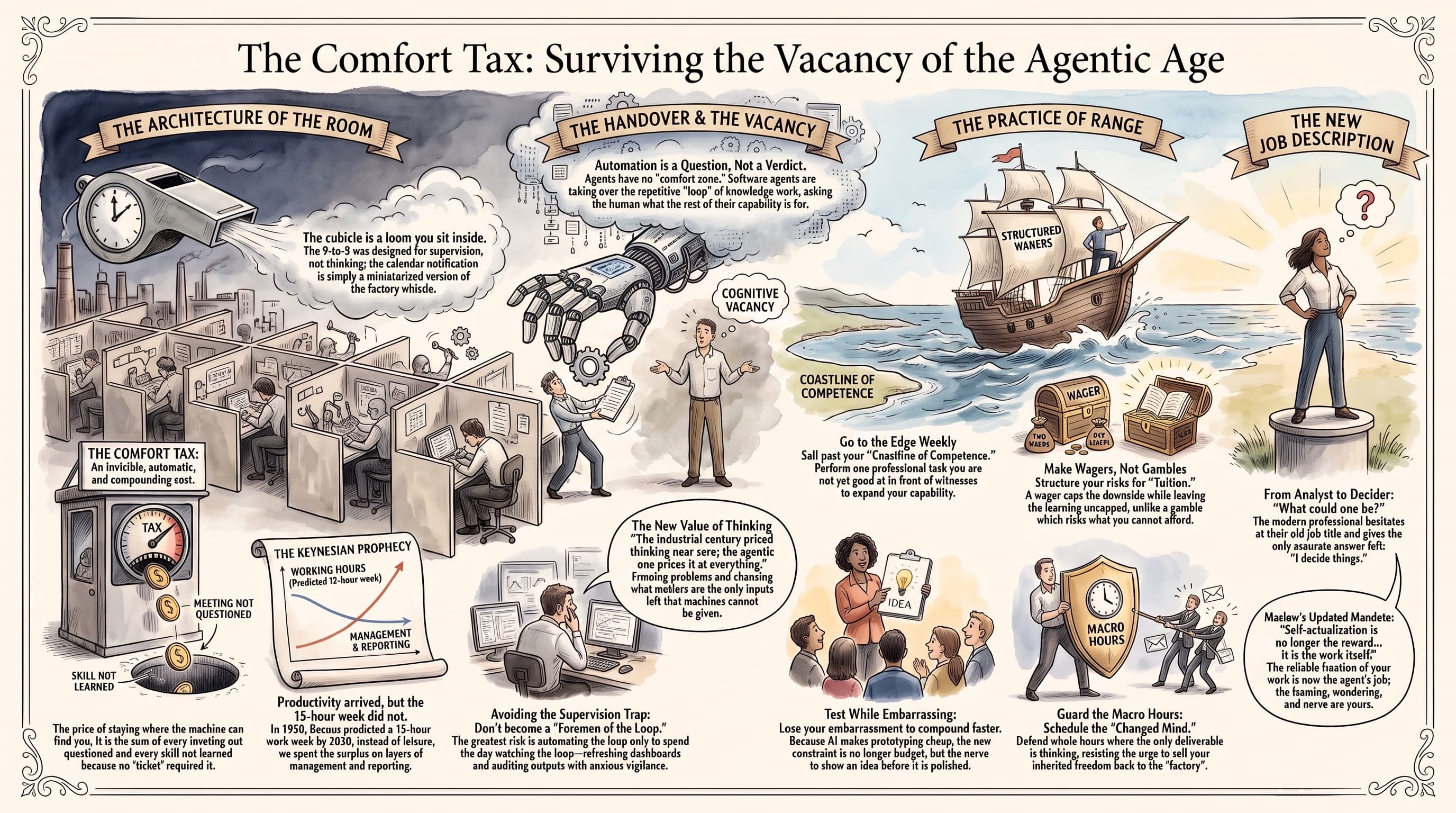
The Comfort Tax: On the Price of Staying Where the Machine Can Find You
Nobody hands you the script. You absorb it. The nine-to-five was not designed for thinking — it was designed for supervision. The comfort zone grows around you out of repeated days, and what it eats is possibility. Then the room began to empty. The agentic wave is handing the repetitive layer of knowledge work to software agents, and what remains is the part of you the factory never asked for: the framing, the taste, the nerve. This paper names the tax, traces its inheritance from the factory whistle through Keynes's failed prophecy, examines the handover, confronts two honest objections, and proposes a practice for converting freed capacity into range.
Governing Judgment: Decision Provenance and the PE Operating Edge
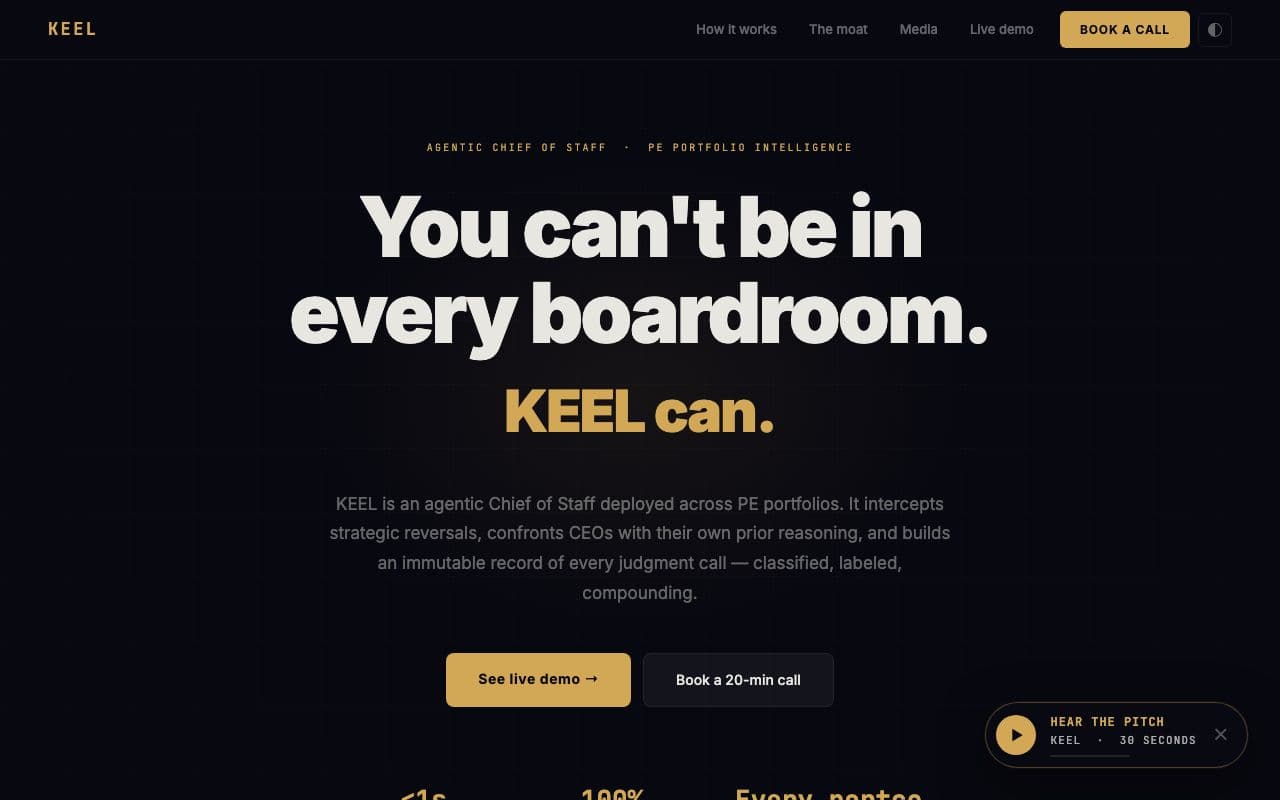
Private-equity returns are made and unmade in the boardroom moments where a sound thesis meets a nervous board. KEEL is an agentic Chief of Staff deployed across PE portfolios that records the state a decision was made in — thesis, conviction, and pre-committed kill-criteria — and, when a leader tries to reverse course, confronts them with their own prior reasoning. Its Decision Provenance Engine classifies each reversal attempt as a fear reversal or an analysis reversal in under a second. This paper sets out the thesis behind Decision Provenance, the engine's node architecture, the honesty constraint that keeps it from becoming a manipulation tool, and why the Conviction Ledger — the immutable, compounding record of how a portfolio decides under pressure — is the defensible asset, not the interface.
Want to go deeper?
Discuss this paper with my digital twin.
Ask questions, challenge the framework, explore implications.
Open the Digital Twin