Governing Judgment: Decision Provenance and the PE Operating Edge
Why the highest-leverage record in a private-equity portfolio is not the financials — it is the state a decision was made in, and the confrontation with that state when conviction wavers.
“Fear masquerades as analysis. Under board pressure, emotional reversals are dressed in rational language — and without a record of the original thesis, no one can tell the difference in the moment. Decision Provenance makes the difference legible, and the record of it compounds into a moat no competitor can buy.”
Paper DNA
Domain
Decision Integrity · PE Portfolio Intelligence
Maturity
Live
Market Size
Global PE/buyout AUM in the trillions · Decision-integrity tooling is a nascent, uncontested category
The expensive failure mode in a portfolio company is not a bad decision made with bad information — it is a good decision reversed under pressure with no new information. By the time a reversal reaches the operating partner, capital has been redeployed and the strategic window has closed. KEEL intercepts before the decision is executed, not after the board deck is printed.
Decision Provenance records the state of a commitment — the thesis, a 0–100 conviction score, and explicit kill-criteria — before the pressure starts. When a leader moves to reverse, the engine audits whether those pre-committed criteria have actually triggered, detects the pressure signals present, and classifies the attempt. The output is a confrontation, not a verdict: the human still chooses.
The moat is not the classifier. It is the Conviction Ledger — the labeled, immutable record of every reversal attempt, its classification, the emotional-state signals, and the decision taken. It is a proprietary dataset of how a specific portfolio makes judgment calls under pressure, and it compounds with every portco. No competitor can buy it, no matter how much they raise.
Fear Masquerades as Analysis
Every operating partner has lived this sequence. A portfolio company commits to a thesis — a market entry, a pricing change, an AI-driven cost program. Conviction is high. The data supporting it is sound; it just hasn't fully arrived yet. Then the board gets nervous. A competitor makes a move, a quarter comes in soft, a headline lands wrong. The CEO pivots. And you find out at the board meeting — by which point capital has been redeployed and the strategic window has closed.
The decision was not reversed because the thesis broke. It was reversed because the pressure became uncomfortable. But that is never how it is described.
The Language Problem
Under pressure, emotional reversals dress themselves in rational language. "I am anxious about the board's reaction" becomes "the macro environment has shifted." "I don't want to defend this in the next meeting" becomes "we should be prudent and revisit." The vocabulary of analysis is freely available to fear, and fear uses it fluently.
This creates an epistemic trap. In the moment of reversal, a fear-driven retreat and an analysis-driven retreat are linguistically identical. Both cite reasons. Both sound responsible. The only way to distinguish them is to compare the stated reason at reversal against the reasoning recorded before the fear existed — and almost no organization keeps that record.
Why You Find Out Too Late
The structural problem is timing. A reversal is a decision, and decisions in portfolio companies are typically surfaced after they are made. By the time the reversal reaches the operating partner — in a deck, on a call, in the minutes — it is no longer a question. It is an account of an action already taken.
Intercepting before the decision executes is a different capability entirely. It requires (1) a baseline recorded at the moment of commitment, (2) a trigger that fires when a reversal is attempted, and (3) a classification fast enough to be useful inside the conversation, not after it.
Why No Record Means No Moat
There is a second cost, quieter than the first. Every judgment call a portfolio makes under pressure disappears the moment it is made. The portfolio has no memory of how it decided, or why, or what state the decision-maker was in. The pattern that could teach the firm to decide better — and that no competitor could replicate — is never captured. The most valuable dataset in the building is being deleted in real time.
Decision Provenance: Recording the State of a Decision
Decision Provenance is the practice of recording the state a decision was made in — not just the outcome — so that any future reversal can be evaluated against the original reasoning rather than against the mood of the room.
A commitment in KEEL has three components, all captured before the pressure starts:
- The thesis. A plain-language statement of what the leader believes and why. ("AI dispatch will reduce route costs by 23% within 12 months.")
- The conviction score. A 0–100 self-assessment of how strongly the leader holds the thesis at the moment of commitment.
- The pre-committed kill-criteria. Explicit, measurable conditions that — if they trigger — would legitimately justify reversing. ("Reverse if route-efficiency delta is worse than −8%, or adoption is below 40% at 90 days, or cost overrun exceeds 30%.")
The kill-criteria are the crucial artifact. They are the leader, at their most clear-headed, telling their future self under pressure exactly what would and would not justify a retreat. They convert a vague future anxiety into a falsifiable test.
COMMITMENT  ·  DEC-04 · Meridian Logistics  (illustrative)
─────────────────────────────────────────────────────────
Thesis        AI dispatch reduces route costs 23% in 12 months
Conviction    87 / 100
Kill-criteria
  • Route-efficiency delta > −8%        (reverse if breached)
  • Adoption rate < 40% at 90 days      (reverse if breached)
  • Cost overrun > 30%                  (reverse if breached)
Recorded      before any board pressure existed
This record is the baseline against which every future reversal attempt is evaluated. It is made once, deliberately, in calm conditions — and then it waits.
Critically, recording provenance is not a bet that the original decision was right. A thesis can be wrong; conditions can genuinely change. Provenance does not freeze a leader into their past self. It simply guarantees that when they move to abandon a commitment, they do so in full view of the reasoning they themselves recorded — and that the firm can later tell the two kinds of reversal apart.
The Intercept: Classifying Reversals Under Pressure
When a leader moves to reverse a commitment, the Decision Provenance Engine activates. It is built as a sequence of discrete steps — a pipeline that maps cleanly onto an agentic state graph — so the reasoning is inspectable rather than a black box.
The Pipeline
retrieve commitment  →  audit kill-criteria  →  detect drivers
                                                      │
                                          classify (fear | analysis)
                                                      │
                                            render the confrontation
- Retrieve the original commitment — thesis, conviction, kill-criteria.
- Audit the kill-criteria. Check each pre-committed condition against current operating data. Has anything the leader said would justify reversal actually triggered?
- Detect drivers. Identify the pressure signals present (board nervousness, a competitor move, a soft quarter) versus operational signals (a triggered criterion).
- Classify. Produce one of two labels:
- Analysis reversal — a pre-committed kill-criterion has genuinely triggered. The retreat is justified by the leader's own prior standard. The engine recommends reversing and surfaces the supporting evidence.
- Fear reversal — no criterion has triggered, but pressure signals are present and the stated reason does not correspond to any operational change. The pattern matches emotional capitulation to authority, not analysis.
- Render the confrontation. Present the leader with their own thesis, their conviction at commitment, the live status of every kill-criterion, and the classification.
The Honesty Constraint
This is the load-bearing principle of the entire system, and it is worth stating without hedging: the engine must stay honest. KEEL is not a machine that always finds a reason to keep people committed. If the leader's own kill-criteria have genuinely triggered, the verdict must be analysis reversal, and the system must recommend reversing — even though "hold your conviction" is the more dramatic, more sellable output.
A system that manufactures a fear narrative to keep people committed is not a decision-integrity tool. It is a manipulation tool, and it destroys the trust premise on which everything else depends. The engine must guard against capitulation and against hubris — against the leader who abandons a sound thesis out of fear, and equally against the leader who clings to a broken one out of ego.
On What Is Real
In the spirit of provenance, this paper is explicit about KEEL's own state of maturity. The classifier today is an LLM-as-judge evaluating the reversal against a structured rubric — not a model trained on labeled outcomes, because that labeled data does not yet exist. Building it is precisely the point: every honest intercept is a labeled example. The numbers in the illustration above are demonstrative, not portfolio results. KEEL is validation-first; the next milestone is a design partner, not another screen.
The Conviction Ledger: The Compounding Moat
Every intercept produces a row. Not a log line — a structured, labeled record:
- the original thesis and conviction score,
- the status of each kill-criterion at the moment of reversal,
- the pressure signals detected,
- the classification (fear or analysis),
- and the decision the human actually made afterward.
That row is written immutably to the Conviction Ledger. No decision is allowed to resolve without leaving one. This is not a logging convenience; it is the product's reason to exist.
Why the Ledger Is the Asset
The interface — the confrontation modal, the dashboards — is replicable. Any competent team could rebuild the screens. What cannot be rebuilt is the accumulated record of how a specific portfolio has made judgment calls under pressure, across years and across companies. That record is:
- Proprietary. It is generated by the firm's own decisions. It exists nowhere else and cannot be purchased.
- Compounding. Each portfolio company that deploys KEEL adds its decisions to the firm-level pattern. N companies make the whole portfolio's judgment legible; company N+1 makes it sharper. The dataset improves with use.
- Irreplaceable from scratch. A competitor starting today, however well funded, begins with an empty ledger. The only way to acquire the dataset is to have been recording it all along.
From Record to Genuine Intelligence
The honest version of the long arc is this: today the classification is rubric-driven judgment. But a labeled Conviction Ledger is exactly the substrate required to move beyond a rubric — to learn, eventually, which reversals under which conditions actually preceded value creation and which preceded value destruction. The dataset is not a byproduct of the product. It is the product. Everything visible on screen exists to produce it honestly.
Operating Model: Decision Support, Never the Decision-Maker
KEEL is deployed across a PE portfolio, but the buyer is the operating partner, not the CEO. This distinction shapes everything about how it works.
The Deployment
KEEL runs in a browser. There is no IT dependency, no data migration, no integration project. A portfolio company can be live in a day. This is deliberate: the value is in capturing decisions, and any friction in capture means decisions go unrecorded. The system has to be present at the moment of commitment and the moment of reversal — which means it has to be effortless to reach.
The Line That Cannot Be Crossed
KEEL is decision support. It is never the decision-maker. No part of the system — no endpoint, no copy, no interface element — may imply that KEEL decides. It classifies, it confronts, and it logs. The human chooses.
This is not legal caution dressed up as principle. It is the principle. An operating partner protecting exit multiples across a portfolio does not want, and would not trust, a machine that overrides their CEOs. What they want is a guarantee: that no sound thesis gets abandoned under pressure without the original reasoning being placed back on the table, and that no reversal — fear-driven or justified — happens without a record. KEEL provides exactly that guarantee and nothing more.
The Operating Partner's Edge
For the person who runs the playbook across many companies, the edge is threefold:
- Interception before execution — reversals are surfaced as questions, while they can still be examined, rather than as faits accomplis in a board deck.
- A confrontation that is honest in both directions — protecting against the CEO who capitulates and the one who refuses to let go of a broken thesis.
- A compounding record of judgment — the one asset in the portfolio that gets more valuable the longer it is held and that no rival can replicate.
You cannot be in every boardroom. The point of Decision Provenance is that you no longer have to be — because the reasoning that mattered, and the moment it was tested, are both on the record.
That’s the full picture.
More from The Studio
All Papers →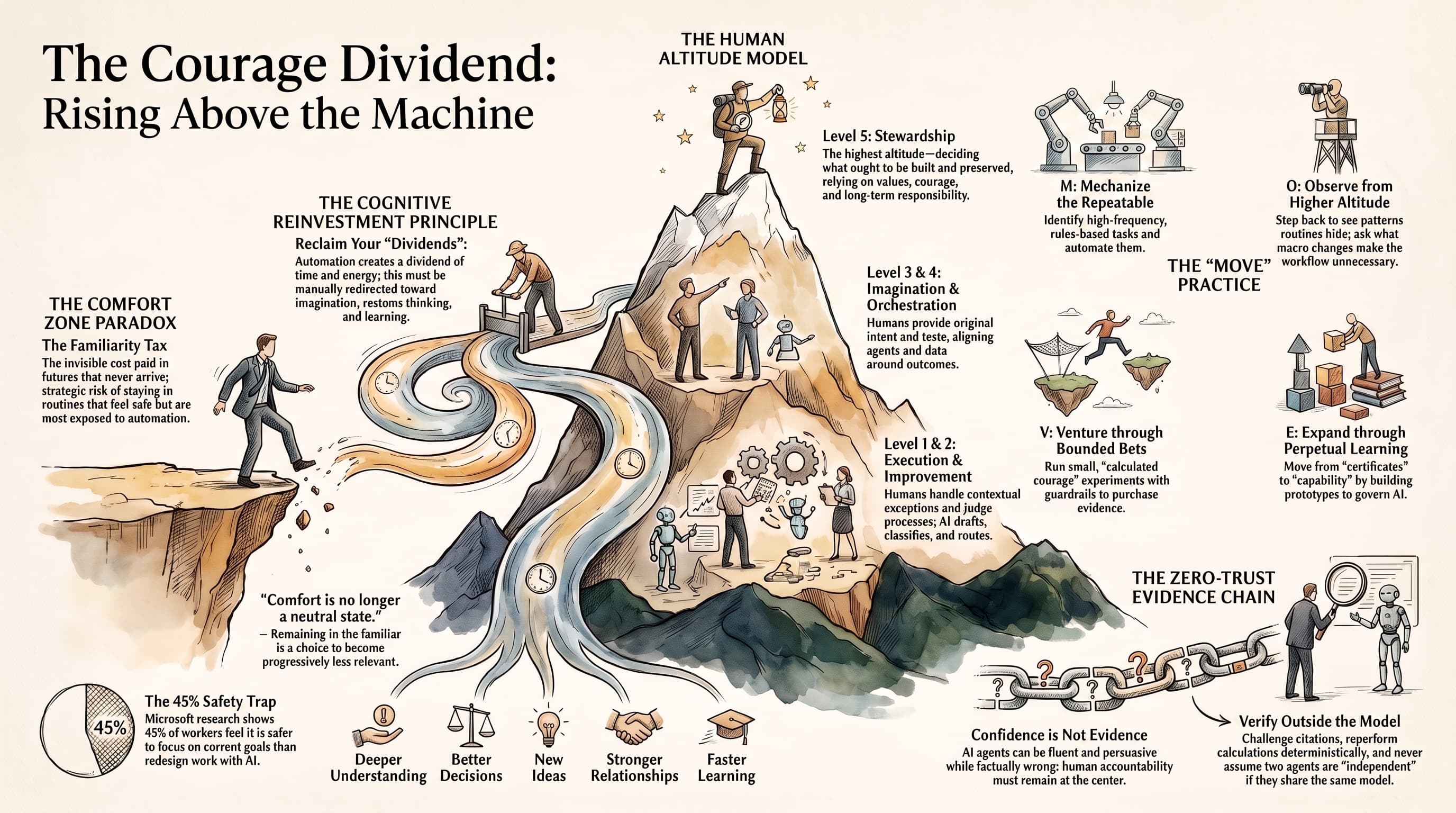
Beyond the Familiar: The Courage Dividend in the Age of AI
Artificial intelligence is compressing the distance between an idea and its first expression. This is usually described as an efficiency revolution. That description is correct, but incomplete. The more consequential change is psychological: AI is removing many of the practical excuses that have kept people anchored to the familiar. Yet greater possibility does not guarantee greater growth. If the capacity released by AI is immediately filled with more meetings, more messages and more versions of yesterday's work, then the technology will have made us busier without making us larger. This paper introduces the Courage Dividend — the return earned when capacity released by machines is deliberately reinvested in human growth — and proposes original frameworks for realizing it: the Human Altitude Model, the Cognitive Reinvestment Principle, the Familiarity Tax, calculated courage through bounded experimentation, and the MOVE practice for individuals and teams.
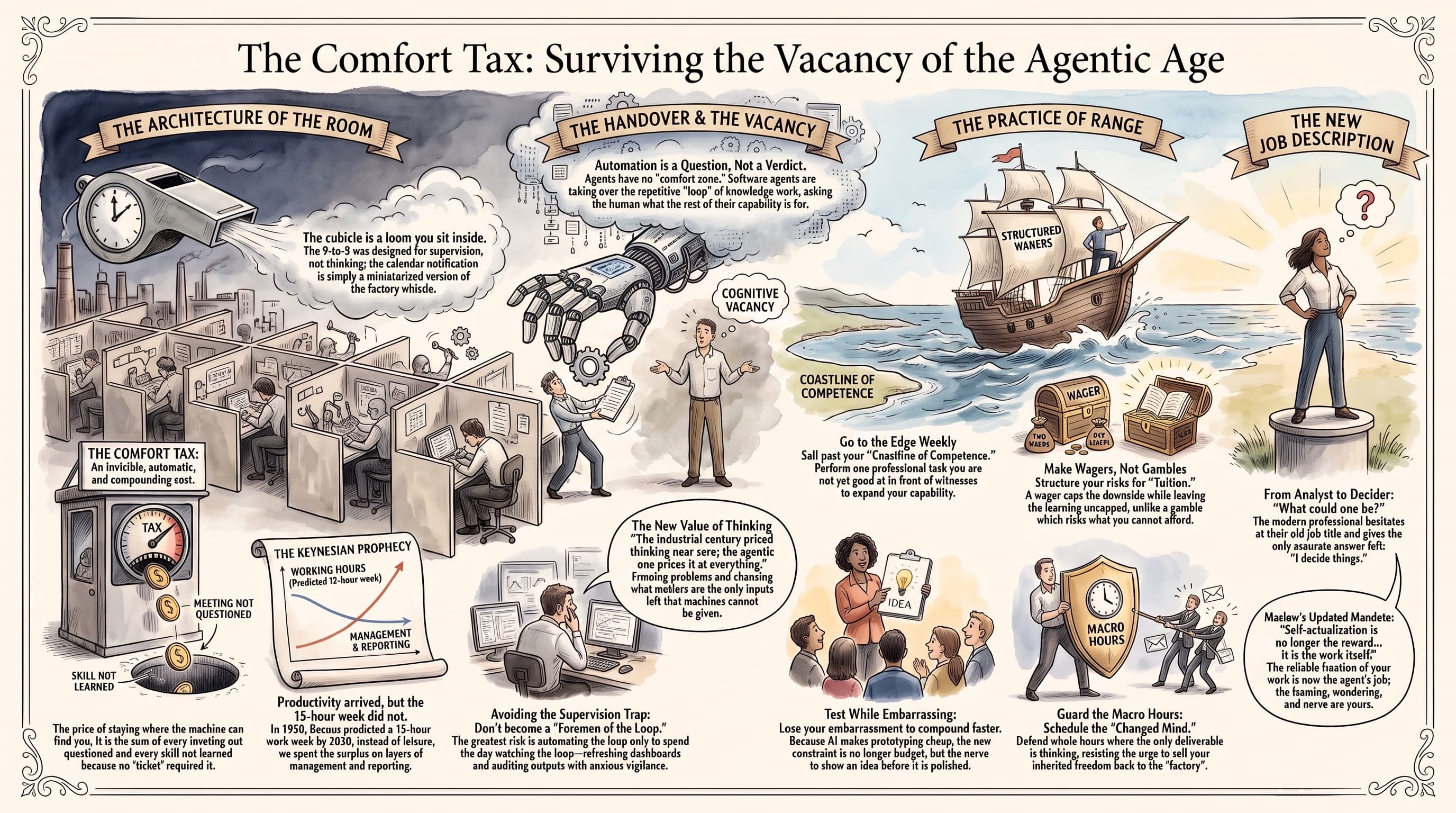
The Comfort Tax: On the Price of Staying Where the Machine Can Find You
Nobody hands you the script. You absorb it. The nine-to-five was not designed for thinking — it was designed for supervision. The comfort zone grows around you out of repeated days, and what it eats is possibility. Then the room began to empty. The agentic wave is handing the repetitive layer of knowledge work to software agents, and what remains is the part of you the factory never asked for: the framing, the taste, the nerve. This paper names the tax, traces its inheritance from the factory whistle through Keynes's failed prophecy, examines the handover, confronts two honest objections, and proposes a practice for converting freed capacity into range.
Want to go deeper?
Discuss this paper with my digital twin.
Ask questions, challenge the framework, explore implications.
Open the Digital Twin