BISO: The Autonomous Security Immune System
Why autonomous bug prediction, quarantine, and remediation is the only architecturally sound response to a codebase that grows faster than any security team can review.
“Security tooling that reports vulnerabilities is not a security system. It is a notification system. A true security system responds, adapts, and learns — the way a biological immune system does, not the way a dashboard does.”
Paper DNA
Domain
Application Security Automation
Maturity
Live
Market Size
AppSec market $21B by 2027 · Average MTTR: 60+ days
Connected To
BISO addresses the $21B application security market with an architecture that replaces the scan-report-wait cycle with an autonomous immune system: vulnerabilities are predicted before they merge, quarantined when detected, and fixed by an autonomous blue-red-judge agent cycle — without waiting for a security team sprint.
The platform's topology-aware prediction engine scores pull requests before merge, using codebase dependency maps and historical vulnerability patterns to assign a risk score to changes before they reach production. This shifts security left without requiring developers to become security experts.
The competitive differentiation is the self-healing fix loop: BISO does not just find vulnerabilities, it generates candidate fixes, stress-tests them with a red-team agent, validates them with a judge agent, and submits the approved fix as a pull request — collapsing MTTR from weeks to hours.
The Failure of Reactive Security
The average time to remediate a critical application vulnerability across the enterprise is 60 days. For high-severity vulnerabilities, it is 84 days. In a typical codebase growing at 1,000+ commits per month, 60–84 days is long enough for a known vulnerability to be re-introduced through a different code path, extended to adjacent services, and discovered by a threat actor.
The root cause is the architecture of reactive security:
Scan → Report → Create Ticket → Prioritize → Assign → Sprint Plan → Fix → Review → Deploy
Every step in this chain adds latency. Each handoff loses context. The security team that ran the scan is not the development team that owns the code. The development team that owns the code is working against a product roadmap, not a security backlog. The security ticket competes with feature work for sprint capacity — and in most organizations, security work without an explicit business outcome loses.
The Scale Problem
This is not a problem that adding headcount solves. The average enterprise has:
- 50–500 active code repositories
- 1,000–10,000 commits per week
- 300–3,000 open vulnerabilities at any given time
- A security team of 3–15 people
The math does not close. The security team can review a fraction of the vulnerability surface — the rest is triaged by severity and addressed when capacity exists. What exists between "detected" and "remediated" is a vulnerability window that grows continuously as the codebase grows.
BISO's Premise
A biological immune system does not detect an infection and create a ticket. It responds. It isolates. It attacks. It learns. It produces memory cells that recognize the same pattern faster next time.
BISO is built on the same premise: autonomous detection, autonomous response, autonomous learning — with human oversight at the approval gate, not the remediation gate.
The Immune System Architecture
BISO combines three scanning engines with an autonomous remediation system and a semantic memory layer.
┌──────────────────────────────────────────────────────────────────┐
│                        BISO Platform                              │
│                                                                    │
│  ┌──────────────────────────────────────────────────────────────┐ │
│  │              Topology-Aware Prediction Engine                 │ │
│  │     PR Risk Scoring · Dependency Impact · Pre-Merge Gate     │ │
│  └──────────────────────────────────────────────────────────────┘ │
│                               │                                    │
│  ┌────────────┐  ┌────────────┐  ┌────────────────────────────┐  │
│  │  Semgrep   │  │   CodeQL   │  │           Snyk             │  │
│  │  SAST      │  │  Semantic  │  │  Dependency & Container    │  │
│  │  Scanner   │  │  Analysis  │  │  Vulnerability Scanner     │  │
│  └────────────┘  └────────────┘  └────────────────────────────┘  │
│                               │                                    │
│  ┌──────────────────────────────────────────────────────────────┐ │
│  │               Autonomous Remediation Loop                     │ │
│  │  ┌──────────┐   ┌──────────┐   ┌──────────┐                 │ │
│  │  │  Blue    │──▶│   Red    │──▶│  Judge   │──▶ PR Submitted │ │
│  │  │  Agent   │   │  Agent   │   │  Agent   │                 │ │
│  │  │  (Fix)   │◀──│  (Break) │   │  (Decide)│                 │ │
│  │  └──────────┘   └──────────┘   └──────────┘                 │ │
│  └──────────────────────────────────────────────────────────────┘ │
│                               │                                    │
│  ┌──────────────────────────────────────────────────────────────┐ │
│  │               Semantic Bug Memory                             │ │
│  │    Pattern Library · Outcome Database · Model Calibration    │ │
│  └──────────────────────────────────────────────────────────────┘ │
└──────────────────────────────────────────────────────────────────┘
Three Scanning Engines
- Semgrep (SAST): Static application security testing — identifies known vulnerability patterns (SQL injection, XSS, command injection, insecure deserialization) in source code before execution.
- CodeQL: Semantic code analysis — understands code as a graph of data flows and control flows, finding vulnerabilities that pattern matching misses (taint propagation, complex multi-hop vulnerabilities).
- Snyk: Dependency and container security — maps the software supply chain for known CVEs, license risks, and malicious package signals.
The Blue-Red-Judge Remediation Cycle
When a vulnerability is confirmed and quarantined:
-
Blue Agent (Fix): Generates a candidate fix for the vulnerability. The fix is constrained to the minimum necessary change — BISO does not refactor, it remediates.
-
Red Agent (Break): Adversarially tests the fix. Attempts to: (a) reproduce the original vulnerability through the fix, (b) find regressions introduced by the fix, (c) find new attack surfaces the fix opens. If the red agent breaks the fix, it returns to the blue agent with a failure report.
-
Judge Agent (Decide): Evaluates the blue-red exchange. If the blue agent's fix survived all red agent attempts without regression, the judge approves the fix for human review. If the cycle fails to converge after a defined number of iterations, the judge escalates to the security team with a full analysis of what was tried and why it didn't converge.
-
Human Review Gate: The judge's approved fix is submitted as a pull request with a full explanation: vulnerability type, fix rationale, red-team test results, and confidence score. The human approves or rejects. BISO never merges without human authorization.
Topology-Aware Vulnerability Prediction
The most expensive vulnerability to fix is the one that reaches production. The second most expensive is the one that exists in the codebase for 60 days while a ticket ages in the security backlog. The least expensive vulnerability is the one that never merges.
BISO's topology-aware prediction engine shifts detection to the pull request stage — scoring the security risk of a proposed change before it is merged.
How Topology-Aware Scoring Works
A standard SAST scan evaluates the changed files in isolation. A topology-aware scan evaluates the change in the context of the full codebase graph.
The codebase graph maps:
- Which services import which libraries
- Which APIs call which internal services
- Which database models are accessed by which controllers
- Which authentication and authorization checks gate which operations
When a PR modifies a file, the topology engine calculates:
- Direct impact radius: What does this file directly affect?
- Transitive impact radius: What is affected by what this file affects?
- Security-critical path overlap: Does the change touch any node in a path that connects to authentication, authorization, data validation, or cryptography?
- Historical vulnerability density: Have vulnerabilities historically clustered in this area of the codebase?
The output is a PR risk score (0–100) with a breakdown of contributing factors and the specific topology paths that drove the score.
Pre-Merge Gate Integration
The prediction engine integrates with GitHub, GitLab, and Bitbucket as a required status check. PRs above a configured risk threshold cannot be merged without security review. PRs below threshold merge normally — the security team's attention is allocated to the changes that actually warrant it.
This is the shift-left model that works: developers are not required to become security experts. The platform handles the analysis; the developer handles the code; the security team handles the high-risk exceptions.
Semantic Bug Memory
The semantic bug memory is what makes BISO a learning system rather than a scanning tool.
Every vulnerability that BISO detects, every fix that is generated, every outcome that results (fix accepted / fix rejected / vulnerability re-introduced) is stored in a structured memory system that continuously recalibrates the platform's detection and remediation models.
Memory Structure
{
  "pattern_id": "sqli_orm_bypass_001",
  "vulnerability_type": "SQL Injection (ORM bypass)",
  "codebase_signature": "Django ORM with raw() method exposure",
  "detection_source": "CodeQL",
  "fix_pattern": "Parameterized query with input validation layer",
  "fix_success_rate": 0.94,
  "red_agent_iterations_avg": 1.8,
  "human_approval_rate": 0.96,
  "recurrence_rate_90d": 0.03,
  "codebase_areas_affected": ["user_data", "reporting", "api_v2"]
}
What Memory Enables
-
Pattern recognition acceleration: A vulnerability type that BISO has seen before in this codebase generates a fix faster — the blue agent has a successful fix template to adapt rather than generating from scratch.
-
Recurrence detection: If the same vulnerability pattern appears in a different file six months after it was first fixed, the memory system flags it as a recurrence — indicating a systemic coding pattern problem, not an isolated incident.
-
Team-specific calibration: BISO learns the coding patterns of individual development teams and calibrates its prediction model accordingly. The team that writes React with direct DOM manipulation gets different pre-merge signal weighting than the team that exclusively uses sanitized component libraries.
-
Competitive moat: An organization that has run BISO for 12 months has a model calibrated specifically to their codebase's vulnerability topology, their team's fix acceptance patterns, and their recurring risk areas. This calibration cannot be transferred to a competitor without rebuilding from scratch — the longer BISO runs, the more defensible its position.
Market Position & Deployment
The AppSec Market Landscape
The application security market is organized around two categories: scanning tools (Semgrep, Snyk, Veracode, Checkmarx) and vulnerability management platforms (Drata, Vanta, SecurityScorecard). Scanning tools find vulnerabilities. Management platforms track them.
Neither category remediates them. BISO is the first platform that closes the loop — from detection through autonomous remediation to human-approved merge.
Competitive Differentiation
| Capability | Scanning Tools | Management Platforms | BISO |
|---|---|---|---|
| Vulnerability detection | Yes | No | Yes (3 engines) |
| Vulnerability tracking | No | Yes | Yes |
| Autonomous remediation | No | No | Yes |
| Pre-merge prediction | Some | No | Yes (topology-aware) |
| Self-healing fix loop | No | No | Yes |
| Learning from outcomes | No | No | Yes |
Target Buyer
The primary buyer is the CISO or Head of Engineering at a company with 20–500 engineers — large enough to have a real vulnerability backlog, small enough that the security team is clearly understaffed relative to the codebase growth rate.
Deployment
BISO deploys as a GitHub/GitLab/Bitbucket integration plus a local agent in the CI/CD pipeline. Setup time to first scan: under 30 minutes. Time to first autonomous fix PR: under 24 hours of initial vulnerability detection.
Pricing
| Tier | Price | Repository Limit |
|---|---|---|
| Starter | $399/month | 10 repositories |
| Professional | $1,499/month | 50 repositories |
| Enterprise | Custom | Unlimited |
Enterprise pricing includes on-premise deployment, custom scanning rules, dedicated security engineering support, and SLA-backed MTTR commitments.
That’s the full picture.
More from The Studio
All Papers →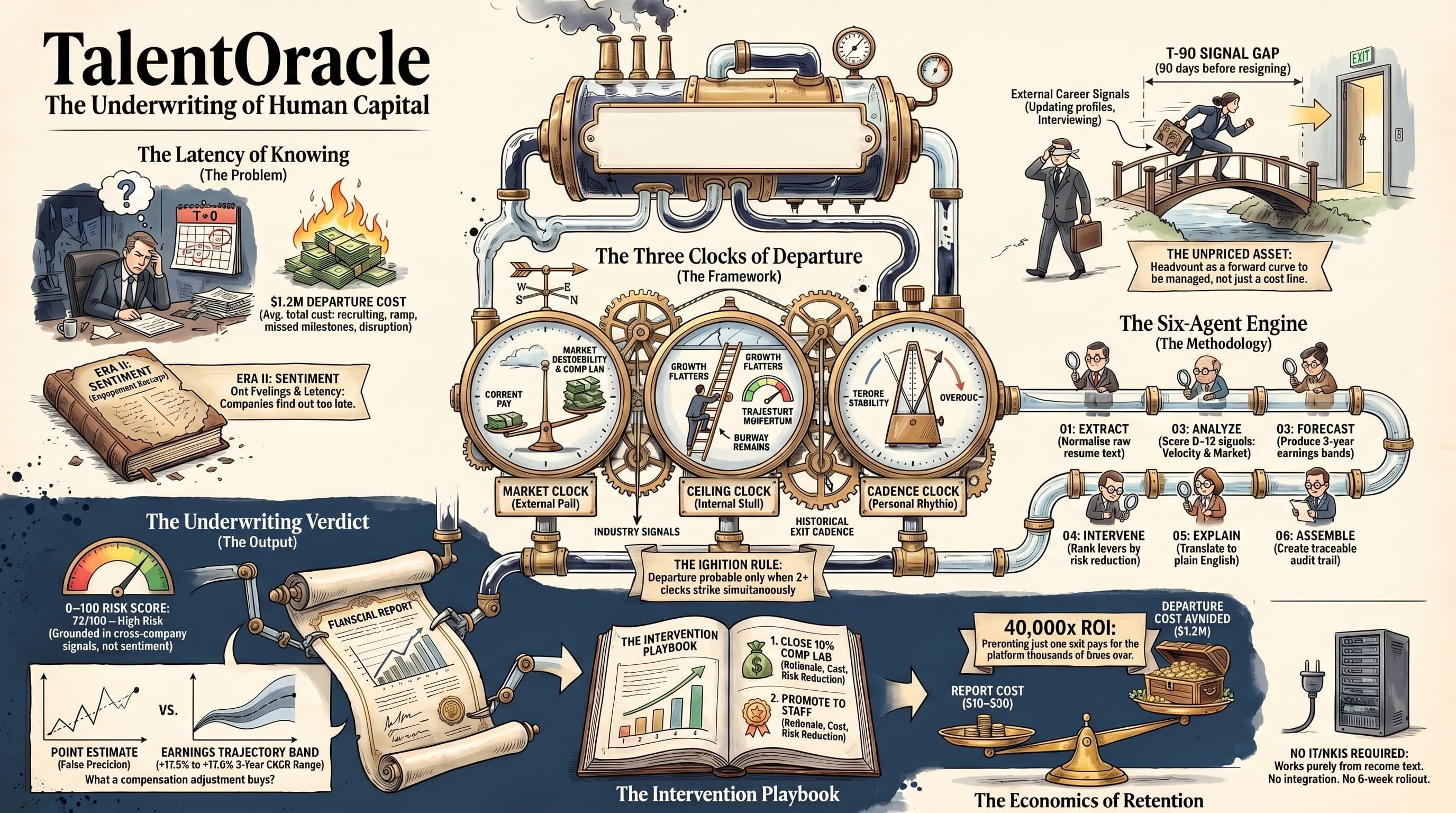
TalentOracle: The Underwriting of Human Capital
The average cost of a senior employee departure is $1.2M when recruiting, ramp, missed milestones, and team disruption are fully loaded. Most companies absorb this cost in silence because they found out too late. TalentOracle is a six-agent AI platform that predicts employee departure 90 days before it happens — using only resume text, with no HRIS integration, no survey, and no manager disclosure required. This paper sets out the Three Clocks of Departure framework, the six-agent engine architecture, the Underwriting Verdict output format, and the economics that make proactive retention the highest-ROI intervention a CHRO can make.

Resume Builder: The ATS Intelligence Engine
The Resume Builder is an AI-powered resume tailoring platform that takes a job description and an existing resume, then rewrites, restructures, and optimizes the result for ATS compliance with industry-specific formatting and keyword analysis. This paper examines the ATS problem, the platform architecture, the keyword intelligence engine, and the market opportunity for making professional resume optimization universally accessible.
Want to go deeper?
Discuss this paper with my digital twin.
Ask questions, challenge the framework, explore implications.
Open the Digital Twin