The Erasure Paradox: The Right to Be Forgotten Meets the Chain That Cannot Forget
Immutable AI audit architecture and the legal right to erasure are on a collision course. The resolution: erasure is an event. The chain remembers that it forgot.
“Everything we have learned to trust about machine accountability rests on records that cannot be altered. Everything privacy law demands rests on records that can be destroyed. These two facts are on a collision course. This paper states the collision precisely, rejects the two easy answers, examines four architectural resolutions, and proposes a doctrine: erasure is an event. The chain does not forget silently. It forgets on the record.”
Paper DNA
Domain
AI Observability · Privacy Architecture · Regulatory Compliance
Maturity
Blueprint
Market Size
Any enterprise running AI agents with personal data in regulated environments
A bank in Frankfurt runs forty agents on an immutable hash chain. A former customer invokes GDPR Article 17 — his personal data sits inside prompts, retrievals, and outputs sealed into blocks whose entire value is that no block can be removed. Delete the blocks and the chain breaks. Refuse him and the bank violates his rights. The lazy reading — citing the Article 17(3)(b) exemption — fails on inspection: the mandated decision record is exempt, but the incidental capture (customer names in prompts, PII in retrievals) is not. The exemption is a narrow bridge; the industry is trying to drive a warehouse across it.
Four architectural resolutions survive examination: crypto-shredding (destroy the key, the ciphertext becomes noise), off-chain payloads with on-chain commitments (the chain never held what dies), redactable chains (lawful scars with authority sealed beside them), and aggressive minimization at ingestion. No single mechanism carries the load. The stack does.
The doctrine: erasure is an event. Every erasure produces a certificate stating the legal basis, scope, authorizing officer, date, and method — and the certificate is sealed onto the chain as a first-class event. The chain does not forget silently. It forgets on the record. One artifact answers the data subject (receipt), the privacy regulator (compliance record), and the financial examiner (warrant for the gap).
The Letter
The letter arrives on a Tuesday. It is short. Most dangerous letters are.
A bank in Frankfurt runs an agentic estate. Forty agents. Onboarding, credit memos, sanctions screening, client correspondence. The bank did the right thing. Every agent action is recorded. Every record is sealed into a hash chain. Nothing can be altered without breaking the chain, and the chain has never been broken. When the examiner came in March, the bank replayed six months of agent decisions verbatim, and the examiner wrote nothing adverse. The record held. People were proud of it. They had reason to be.
The letter is from a former customer. He held a mortgage and two accounts, and he closed all of it two years ago. He owes the bank nothing. He invokes Article 17 of the General Data Protection Regulation. He wants his personal data erased.
The Data Protection Officer traces the request. She finds him in the CRM. Deleted within the hour. She finds him in the marketing database. Deleted. Then she finds him in the agent audit log. His name is inside a prompt. His payment history is inside a retrieval. His correspondence is inside an output. All of it sits in blocks of a chain whose entire value is that no block can be removed.
Delete the blocks and the chain breaks. Break the chain and every record around those blocks loses its standing, including records the bank must keep for seven years by law. Refuse him and the bank violates the rights of a man who owes it nothing.
She has two laws in front of her and one architecture, and the architecture can satisfy only one of them.
You are the DPO. The clock says thirty days. What do you do?
A Notice That Would Not Die
The right to be forgotten did not come from a philosopher. It came from thirty-six words in a Barcelona newspaper.
In 1998, La Vanguardia published a legal notice. A man named Mario Costeja González had fallen behind on social security debts, and a property of his was listed for forced auction. The debt was settled. The auction became irrelevant. The man moved on. The notice did not. The newspaper digitized its archive, and for the next decade, anyone who searched his name found the auction first. His worst financial moment, permanently ranked above everything else he had ever done.
He asked for it to be taken down. The case climbed for years, and in 2014 the Court of Justice of the European Union ruled that he had a right to have it delisted. Not because the notice was false. It was true. But because it was no longer necessary, and a true thing kept past its necessity becomes its own kind of harm.
Hold that story. Then hold the other one: records altered after the fact, evidence that could not be trusted, institutions that could not prove what their own systems did. One story says the danger is the record that never dies. The other says the danger is the record that cannot be believed. Both stories are true. Both produced law. And in an agent audit log, both laws now point at the same block.
Two Duties
State the collision precisely. Precision is the whole game here. The institutions that get hurt will be the ones that argued from vibes.
The duty to remember. The EU AI Act requires high-risk AI systems to log automatically and to keep those logs. Article 12 mandates the recording. Article 19 mandates the keeping. The Federal Reserve's SR 11-7 expects model decisions to be documented and reproducible. The SEC's Rule 17a-4 requires records kept in a form that cannot be overwritten. Write once. Read many. Alter never. BCBS 239 demands lineage that survives inspection. Every instrument points the same direction. The record must be complete. The record must be durable. The record must be provably unaltered.
The duty to forget. GDPR Article 17 grants erasure. Article 5(1)(e) forbids keeping personal data longer than necessary. Article 5(1)(c) forbids collecting more than the purpose requires. California grants deletion rights. So does Virginia. So does Brazil. So, increasingly, does everywhere. Every instrument points the same direction. Personal data must be deletable, and it must be deleted when its time comes.
Two correct directions. One architecture. The architecture is a chain, and a chain is a promise that nothing leaves.
Now kill the lazy reading. Article 17(3)(b) exempts erasure where processing is necessary to comply with a legal obligation. Look at what an agent log actually contains. The statute mandates a record of the decision. The log contains the decision, and also the customer's free-text message pasted into a prompt, and also the retrieved document with his wife's name in it. The mandated core is exempt. The incidental capture is not. The exemption is a narrow bridge. The industry is trying to drive a warehouse across it.
The paradox survives the exemption.
Four Resolutions
Four architectures resolve the paradox. Examine each. Attack each. Keep what survives.
First: crypto-shredding. Encrypt every data subject's personal data with a key specific to that subject before it enters the chain. The chain seals ciphertext. When the erasure request arrives, destroy the key. The ciphertext remains, a sealed envelope no one alive can open.
Attack it. Is destroying a key legally erasure? Supervisory practice has largely accepted that rendering data permanently unreadable satisfies the obligation, but the doctrine is not settled everywhere. Attack it again. Per-subject keys at agent-log volume are a real engineering tax: millions of keys, rotation, escrow, and the destruction itself must be provable.
Verdict: the strongest general-purpose answer available. The tax is real. Pay it.
Second: off-chain payload, on-chain commitment. The chain stores a salted cryptographic commitment. The payload lives in an ordinary mutable store. Erasure deletes the payload. The commitment remains, pointing at nothing, and the chain's integrity is untouched.
Attack it. Replay is degraded. The record now says: an event occurred here, its integrity is proven, its content is lawfully gone. That is a real trade. Make it with open eyes and mark every hole.
Verdict: clean, simple, deployable this quarter. Accept the holes. Label them.
Third: the redactable chain. Cryptography that permits authorized redaction of a sealed block while leaving a scar. A verifier can confirm: the chain is intact, and block N was redacted, by a named authority, on a dated day, under a stated legal basis.
Attack it. A trapdoor is a trust assumption. The answer is threshold custody — several parties, no single hand on the key — and the redaction event itself sealed onto the main chain.
Verdict: philosophically the most honest answer. Practically the least mature. This is where the standard is going.
Fourth: never record it. Strip and tokenize personal data at ingestion so the chain never holds what you might later owe.
Attack it. Total minimization is a fantasy. Verdict: not a resolution. A multiplier. Apply it always. Rely on it never.
No single mechanism carries the load. The stack does.
The Doctrine: Erasure Is an Event
Here is the contribution this paper exists to make.
Erasure is an event. Seal it.
The old architectures treat deletion as an absence. Something was there. Now it is not. Nothing marks the spot. That is precisely the property we spent a decade engineering out of financial records, because an unmarked absence is indistinguishable from a cover-up.
So invert it. Every erasure produces a certificate. The certificate states the legal basis invoked. It states the scope of records affected. It names the authorizing officer. It carries the date and the method: key destroyed, payload deleted, block redacted. And the certificate is sealed onto the chain as a first-class event, hashed forward like everything else, tamper-evident like everything else.
The chain does not forget silently. It forgets on the record. The chain remembers that it forgot.
Consider what the certificate does in the three rooms where institutions live or die. In front of the data subject, it is the receipt: your data is gone, here is the proof, sealed. In front of the privacy regulator, it is the compliance record: every erasure, on the ledger, auditable. In front of the financial examiner, it is the explanation for the scar: this gap is lawful, and here is its warrant. One artifact. Three defenses.
A deletion is not compliance unless it can be proven. An institution that cannot show what it erased, when, and on what authority has not complied with Article 17. It has simply lost data with better intentions.
The Blueprint
Doctrine without design is a seminar. Here is the design, stated against BLACKBOX because that is the system I am accountable for.
At ingestion, minimize. Strip what the record does not need. Tokenize what it does.
Behind ingestion, envelope encryption per data subject. Personal data enters the record only under a subject-specific key. Crypto-shredding as the default posture, not the option.
In the storage layout, payloads off-chain, salted commitments on-chain. The chain carries proof. The store carries content. They are separable because they were always separable.
Above the storage, a retention policy engine. Every record class mapped to its legal basis, the Article 17(3)(b) exemption asserted field by field with the mandate cited, not waved at the whole system like incense.
At the surface, the Erasure API. Request in. Certificate out. Certificate sealed. Thirty days becomes thirty minutes.
On the roadmap, redactable-chain support, for the day the industry and its auditors are ready for lawful scars.
And the line this section's credibility depends on: not all of this runs in production today. The commitment layout and the sealing of erasure events are design; the certificate format is drafted; the policy engine is roadmap. I publish the blueprint before the last screw turns because the industry needs the pattern more than I need the announcement, and because a claim published is a claim that can be examined.
The Verdict
Do not file this under GDPR housekeeping. The collision in this paper is the test case for a larger question: whether accountable machine infrastructure can coexist with human rights law at all. The same shape recurs everywhere you look. Litigation holds against deletion schedules. Model unlearning against training provenance. The AI Act's own logging mandate against the privacy order it lives inside. Each is the same two duties meeting at the same seam, and each will be resolved either in architecture or in a settlement. Architecture is cheaper.
In Frankfurt, the DPO reads the letter again. Under the old architecture, she has a conflict she cannot resolve and thirty days to fail in one direction or the other. Under the architecture in this paper, she runs one request. The subject's key is destroyed. The payloads die. The certificate writes itself into the chain, sealed beside everything it lawfully removed. She sends the man his proof before lunch. The record is intact. The man is free of it. Both laws are satisfied, and neither was cheated.
An institution that cannot prove what its machines did is not accountable. An institution that cannot lawfully forget is not legitimate. The record that survives the next decade will do both, and it will do the second the same way it does the first. On the chain. With a certificate. Under seal.
The chain remembers that it forgot. Build so that yours can say the same.
That’s the full picture.
More from The Studio
All Papers →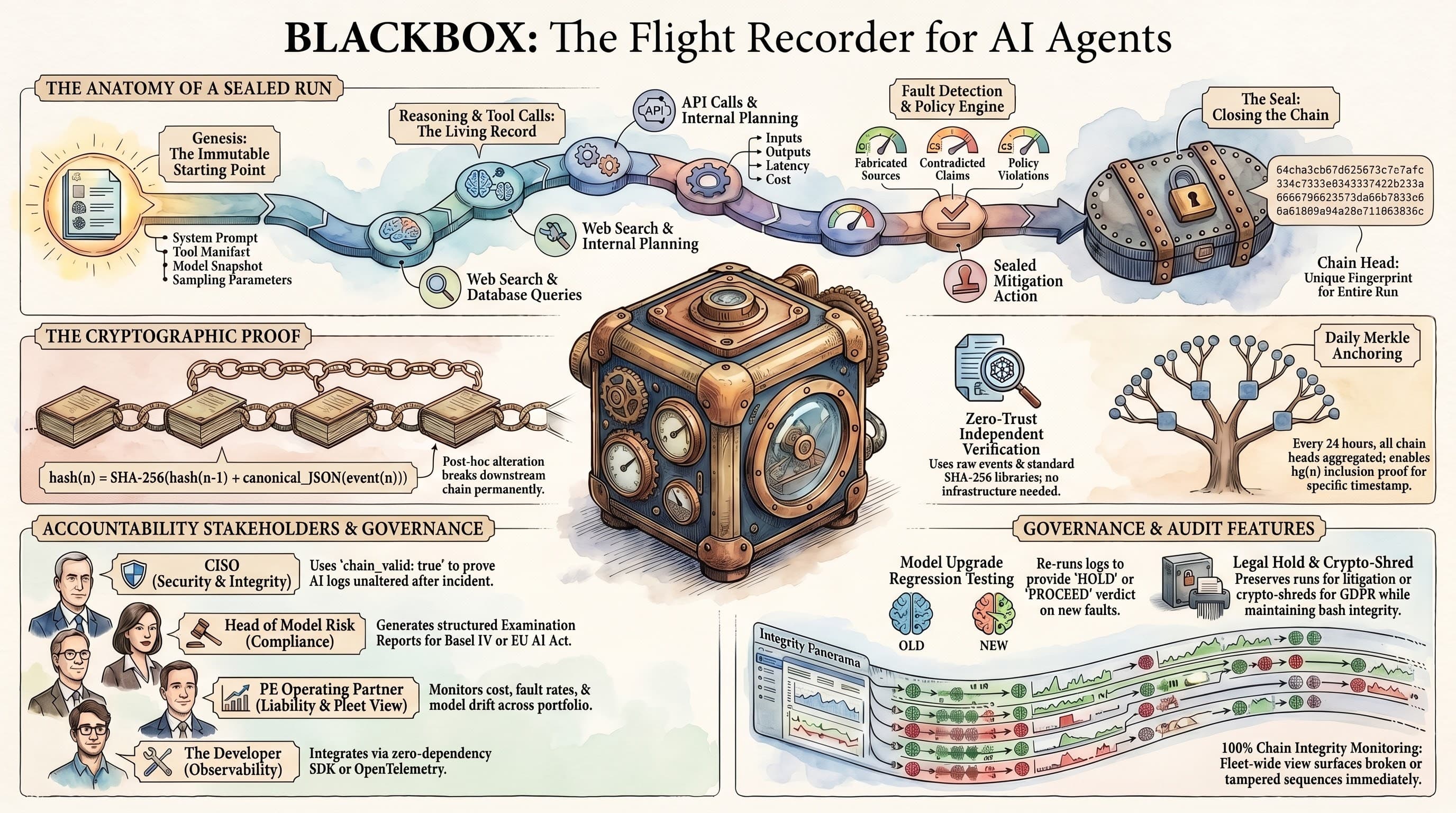
BLACKBOX: The Flight Recorder for AI Agents
When an AI agent makes a wrong decision, enterprises need to answer three questions: what exactly happened, in what order, and can the record be trusted? BLACKBOX provides the infrastructure layer that makes all three answerable. Every event — reasoning step, tool call, output, fault — is sealed into a SHA-256 hash chain. Any alteration to any stored event breaks the chain. Any run can be replayed verbatim. This paper documents the architecture, the three instrumentation paths, the phases completed, and the enterprise case for treating AI agent observability as an insurance requirement, not a nice-to-have.

The Token Economy: A First-Principles Playbook for Governing Claude in Production
At 11:47 PM on a Thursday, a Series C fintech spent its entire monthly inference budget in four hours. The root cause wasn't a malformed JSON — it was the absence of a governance discipline that should have been established before a single line of code was written. This paper specifies that discipline: four levers, one planning artifact, one role, one cadence — in the vocabulary CFOs, CTOs, and Staff+ Engineers already use.
Want to go deeper?
Discuss this paper with my digital twin.
Ask questions, challenge the framework, explore implications.
Open the Digital Twin