AgentPMO: Governing the AI Agent Economy
How the first lifecycle management platform for enterprise AI agents solves the governance vacuum that the EU AI Act just made legally consequential.
“Every enterprise deploying AI agents faces the same governance gap: they know what the agents do in demo, but not what they do in production, at scale, on a bad day. AgentPMO exists to close that gap before a regulator does it for them.”
Paper DNA
Domain
AI Governance & Compliance
Maturity
Live
Market Size
EU AI Act compliance market $67B · Enterprise AI deployment: 80% of Fortune 500
The EU AI Act creates legal exposure for enterprises deploying AI agents without documented risk classification, incident logs, and governance frameworks — effective immediately for high-risk AI systems, with broader coverage phased in through 2027. AgentPMO is the compliance infrastructure layer for this new regulatory reality.
Most enterprises discover their AI agent governance gap when they try to answer a simple question: 'List every AI agent running in our organization, what it does, who owns it, and what its risk classification is.' AgentPMO makes that question answerable in real-time — not in a spreadsheet audit that takes six weeks.
The platform's developer-first architecture — including a CLI for agent registration and a REST API for programmatic access — drives bottom-up adoption by the engineering teams who build agents, creating a data foundation that makes the executive compliance reporting layer self-maintaining.
The AI Agent Governance Gap
By 2026, the average enterprise Fortune 500 company has deployed between 50 and 500 AI agents across its operations. Customer service agents, document processing agents, code review agents, risk monitoring agents, content generation agents, data analysis agents — each built by a different team, on a different timeline, with a different level of documentation rigor.
Ask most CTOs: "What AI agents are running in your organization right now, what do they have access to, and what's your escalation path when one of them behaves unexpectedly?" The honest answer is: "We're working on that."
This is the governance gap. It is not a technology problem — the agents are built and running. It is a visibility, accountability, and compliance problem.
Why the Gap Exists
AI agent deployment has outpaced governance frameworks for three structural reasons:
-
Velocity asymmetry: Engineering teams build and deploy agents faster than governance frameworks can be designed, approved, and implemented. By the time a governance policy is ratified, the engineering team has shipped 20 more agents.
-
Tooling vacuum: Until AgentPMO, there was no purpose-built tool for agent lifecycle management. Teams used Jira tickets, Confluence pages, and spreadsheets — none of which provide real-time status, automated monitoring, or structured compliance outputs.
-
Regulatory lag: The EU AI Act and equivalent frameworks are enforcing governance requirements that most enterprises assumed they had years to prepare for. The enforcement timeline accelerated; the preparation timelines did not.
What the Gap Costs
The governance gap has three cost dimensions:
- Operational cost: Agent incidents that escalate because there is no documented escalation path — no owner identified, no rollback procedure defined, no impact assessment ready for the stakeholder call.
- Compliance cost: Legal exposure under EU AI Act and equivalent frameworks — penalties of up to €30M or 6% of global annual revenue for non-compliant high-risk AI deployments.
- Reputational cost: Customer-facing AI agent failures that become press incidents because internal governance failed to catch the issue before it reached a user.
Agent Registry Architecture
The agent registry is the system of record for every AI agent in the enterprise. It is the foundational data layer on which all other governance capabilities depend.
┌──────────────────────────────────────────────────────────────────┐
│                        AgentPMO Platform                          │
│                                                                    │
│  ┌──────────────────────────────────────────────────────────────┐ │
│  │                   Executive Dashboard                         │ │
│  │    Portfolio View · Compliance Status · Incident Console     │ │
│  └──────────────────────────────────────────────────────────────┘ │
│                               │                                    │
│  ┌──────────────────────────────────────────────────────────────┐ │
│  │                   Governance Engine                           │ │
│  │  Risk Classification · Cost Tracking · Performance Monitor  │ │
│  │  Incident Log · Audit Trail · Compliance Report Generator   │ │
│  └──────────────────────────────────────────────────────────────┘ │
│                               │                                    │
│  ┌──────────────────────────────────────────────────────────────┐ │
│  │                    Agent Registry                             │ │
│  │  Name · Owner · Version · Risk Class · Data Access          │ │
│  │  Deployment Date · Dependencies · Escalation Path           │ │
│  └──────────────────────────────────────────────────────────────┘ │
│                               │                                    │
│  ┌─────────────────┐  ┌────────────────────┐  ┌───────────────┐  │
│  │  CLI Interface  │  │  REST API          │  │  Dashboard    │  │
│  │  (Dev teams)    │  │  (Programmatic)    │  │  (Governance) │  │
│  └─────────────────┘  └────────────────────┘  └───────────────┘  │
└──────────────────────────────────────────────────────────────────┘
Agent Record Structure
Each registered agent maintains:
{
  "agent_id": "ag_8f2a9c",
  "name": "Invoice Processing Agent v2.3",
  "owner": "finance-engineering@company.com",
  "team": "Finance Engineering",
  "risk_classification": "High",
  "eu_ai_act_category": "High-Risk (Annex III - Financial services)",
  "deployment_date": "2025-11-14",
  "last_updated": "2026-03-28",
  "data_access": ["ERP", "Vendor Portal", "Banking API"],
  "decision_autonomy": "Automated decisions up to €10,000; human approval above",
  "affected_population": "External vendors (3,400 active)",
  "escalation_owner": "cfo-operations@company.com",
  "incident_count_90d": 2,
  "performance_score": 94.2,
  "cost_30d_usd": 1840
}
CLI-First Registration
Engineers register agents at deployment time using a CLI that integrates with the CI/CD pipeline:
agentpmo register \
  --name "Invoice Processing Agent" \
  --owner finance-engineering \
  --data-access erp,vendor-portal \
  --autonomy-level medium \
  --env production
The CLI generates a structured registration record, assigns a risk classification based on the declared parameters, and returns an agent ID that is embedded in the agent's runtime configuration — creating the link between the running system and the governance record.
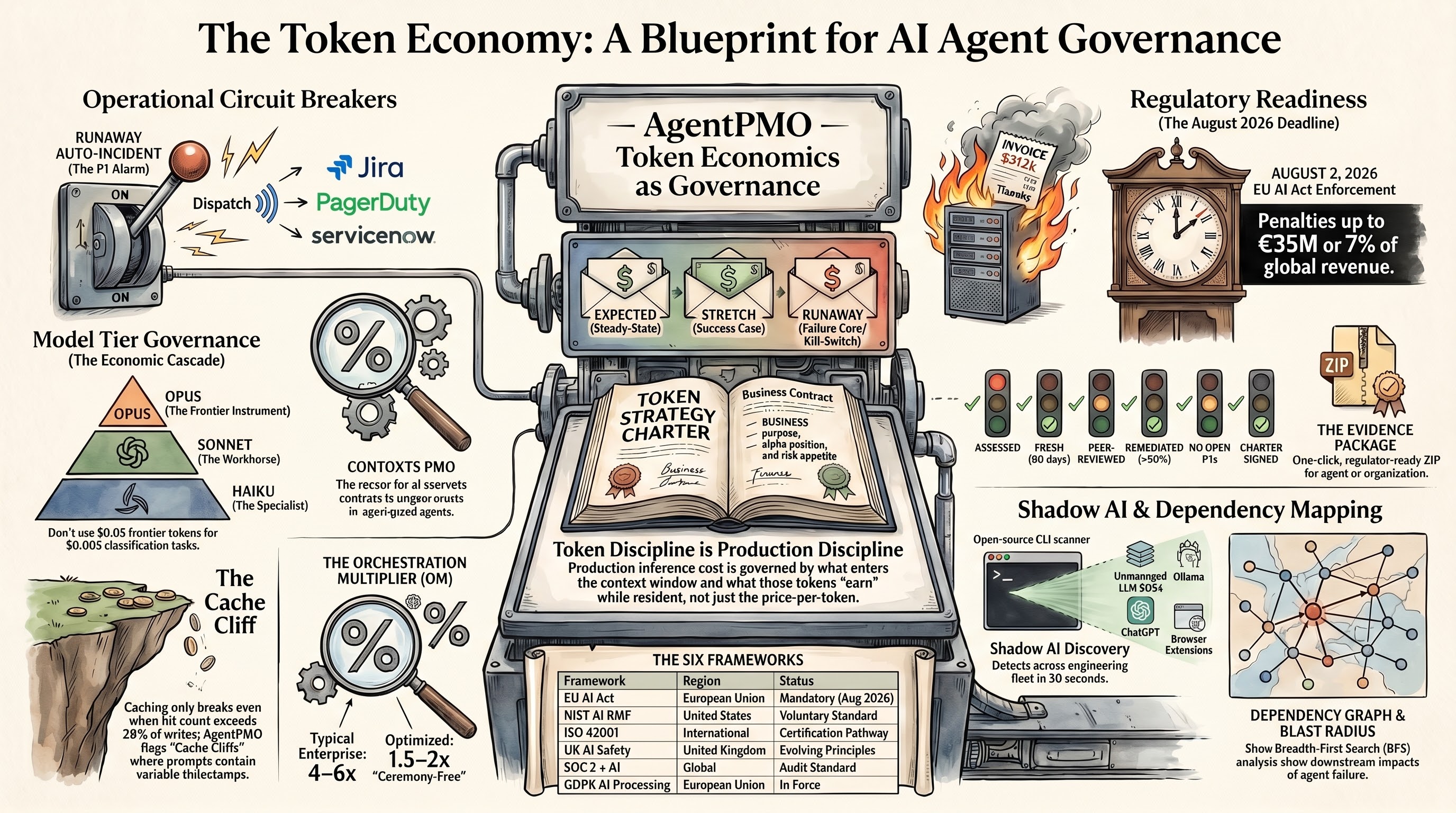 AgentPMO Platform
EU AI Act Risk Classification
The EU AI Act establishes four risk tiers with materially different compliance obligations. AgentPMO automates the classification process and maps it to specific required actions.
Risk Tier Framework
| Risk Tier | Definition | Compliance Obligations |
|---|---|---|
| Unacceptable | AI systems posing clear threat to fundamental rights | Prohibited — cannot be deployed |
| High-Risk | AI in critical infrastructure, employment, essential services, law enforcement | Full conformity assessment, CE marking, registration in EU database, ongoing monitoring |
| Limited Risk | AI interacting with humans (chatbots, emotion recognition) | Transparency obligations — users must be informed they are interacting with AI |
| Minimal Risk | AI spam filters, AI in video games, AI recommendation systems | No specific obligations; voluntary codes of conduct |
Automated Classification Logic
AgentPMO's classification engine takes the agent's declared parameters and applies the EU AI Act's Annex III criteria:
- Sector check: Is the agent used in healthcare, education, employment, critical infrastructure, law enforcement, border control, or administration of justice? → Likely High-Risk.
- Decision autonomy check: Does the agent make decisions affecting individual rights, access to services, or significant financial outcomes without human review? → High-Risk indicator.
- Affected population check: Does the agent interact with vulnerable populations (minors, elderly, economically disadvantaged)? → Risk classification escalation.
- Data access check: Does the agent process biometric, health, financial, or behavioral data? → High-Risk indicator.
The engine produces a classification recommendation with a confidence score and the specific Annex III criteria that drove the recommendation. Organizations can override the classification with documented justification — the override and its rationale are logged in the audit trail.
Compliance Obligation Tracker
For each High-Risk agent, the platform maintains a compliance checklist:
- Conformity assessment completed
- Technical documentation filed (Article 11)
- Automatic logging enabled (Article 12)
- Human oversight mechanisms documented (Article 14)
- Accuracy and robustness testing completed (Article 15)
- Registered in EU AI Act database (when live)
Executive Reporting & Board Communication
The compliance data in the agent registry only produces value if it reaches the stakeholders who need it — in a format they can use, without requiring a compliance analyst to manually assemble it.
Automated Report Types
1. AI Portfolio Executive Summary Generated weekly or on-demand. Shows:
- Total agents by risk classification (donut chart)
- Compliance status by risk tier (% compliant vs. action required)
- Cost trend: total AI agent spend vs. prior period
- Incident summary: open incidents, average resolution time
- Top 5 agents by cost, by performance degradation, by incident count
2. EU AI Act Compliance Report Generated for governance reviews. Shows:
- All High-Risk agents with compliance status per obligation
- Remediation actions in progress with ownership and target dates
- Classification changes since prior report
- Legal risk exposure summary (agents with incomplete compliance)
3. Incident Analysis Report Generated after significant incidents or for board review. Shows:
- Incident timeline and impact assessment
- Root cause categorization
- Remediation actions taken
- Process changes implemented to prevent recurrence
4. Agent Performance Dashboard Real-time, always available. Shows:
- Accuracy / error rate per agent
- Latency percentiles (p50, p90, p99)
- Cost per inference and cost per business outcome
- User satisfaction scores (where applicable)
- Drift detection: performance vs. baseline at deployment
The Board Handoff
The AI Portfolio Executive Summary is designed to be presented to a board of directors in 10 minutes — one slide per major section, no technical jargon, with clear action items highlighted in red. The CTO hands it to the CCO, who hands it to the board, without reformatting. That chain of handoff — currently requiring weeks of manual assembly — is what AgentPMO eliminates.
Go-to-Market & Pricing
Developer-Led Adoption
The platform's growth motion is developer-led, compliance-accelerated. Engineers adopt the CLI because it simplifies their registration workflow. The compliance function discovers the platform because the engineering team has already built the data foundation. The governance reporting layer makes the case to the executive team.
This bottom-up motion means the first champion is not the CISO or CCO — it is the engineering team lead who would otherwise be manually documenting agent deployments in Confluence. The executive adoption follows when the compliance report is shown to work.
Pricing Architecture
| Tier | Price | Agent Limit | Target |
|---|---|---|---|
| Starter | $499/month | 25 agents | SMB and startup AI teams |
| Professional | $1,999/month | 150 agents | Mid-market enterprises |
| Enterprise | Custom | Unlimited | Large enterprises, regulated industries |
Enterprise pricing includes:
- Dedicated compliance success manager
- Custom EU AI Act compliance framework mapping
- Integration with existing GRC platforms (Archer, ServiceNow)
- On-premise or private cloud deployment option
- SLA with uptime and data residency guarantees
Regulatory Urgency Driver
The EU AI Act's enforcement phasing creates a natural urgency driver:
- February 2025: Prohibited AI systems banned
- August 2025: GPAI model obligations in effect
- August 2026: High-Risk AI Act obligations fully in force
- August 2027: Remaining product-embedded AI systems covered
Organizations that have not completed their agent inventory and risk classification by August 2026 are in violation for High-Risk systems from day one. AgentPMO's pipeline is already calibrated for this timeline.
That’s the full picture.
More from The Studio
All Papers →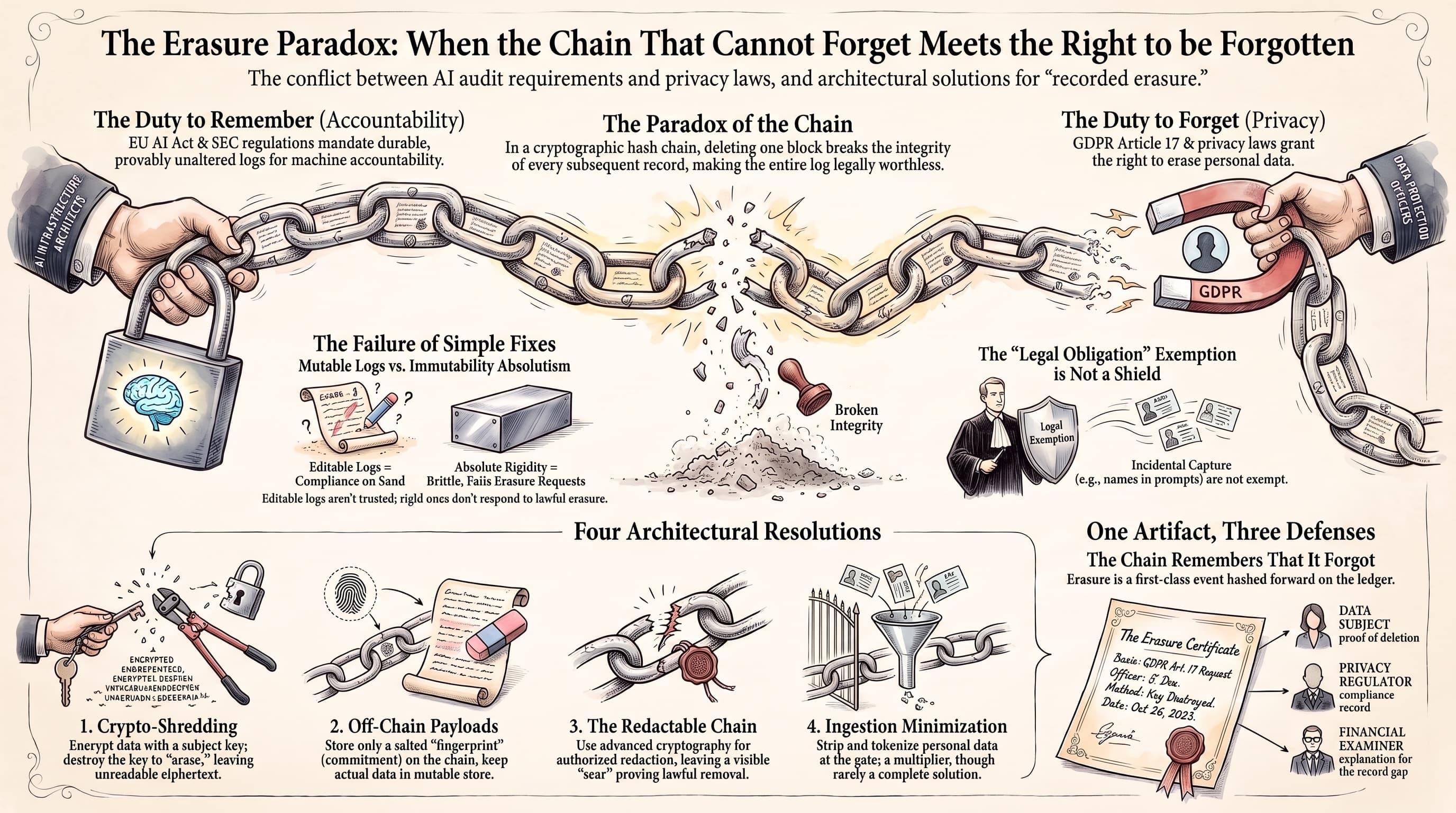
The Erasure Paradox: The Right to Be Forgotten Meets the Chain That Cannot Forget
Everything we have learned to trust about machine accountability rests on records that cannot be altered. Everything privacy law demands rests on records that can be destroyed. These two facts are on a collision course, and almost nobody building AI infrastructure has noticed. This paper states the collision precisely, rejects the two easy answers, examines four architectural resolutions and attacks each of them, and proposes a doctrine: erasure is an event. The chain does not forget silently. It forgets on the record. The chain remembers that it forgot.
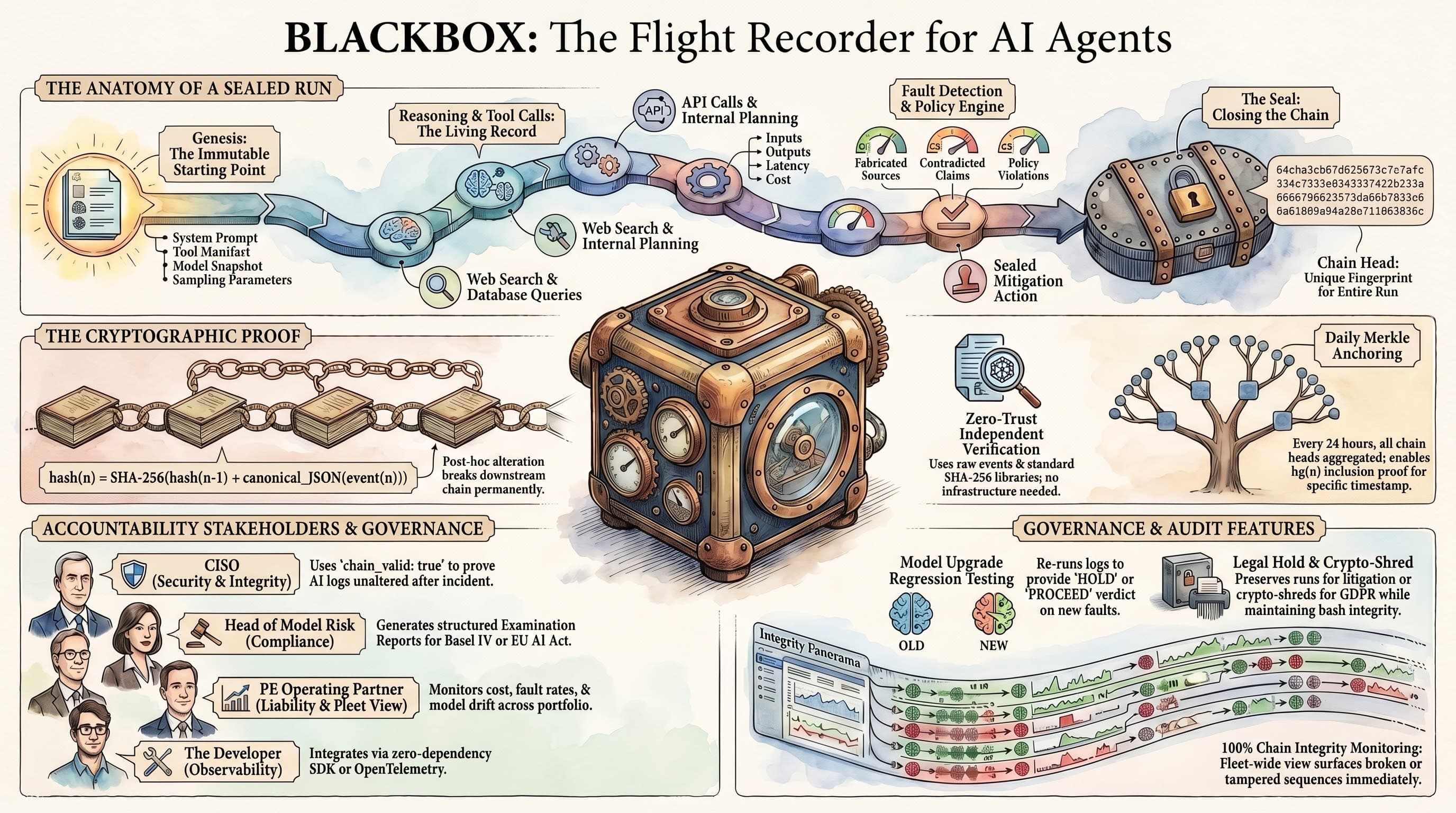
BLACKBOX: The Flight Recorder for AI Agents
When an AI agent makes a wrong decision, enterprises need to answer three questions: what exactly happened, in what order, and can the record be trusted? BLACKBOX provides the infrastructure layer that makes all three answerable. Every event — reasoning step, tool call, output, fault — is sealed into a SHA-256 hash chain. Any alteration to any stored event breaks the chain. Any run can be replayed verbatim. This paper documents the architecture, the three instrumentation paths, the phases completed, and the enterprise case for treating AI agent observability as an insurance requirement, not a nice-to-have.
Want to go deeper?
Discuss this paper with my digital twin.
Ask questions, challenge the framework, explore implications.
Open the Digital Twin