ERIS Pro: Eight Agents for Enterprise Risk
Why autonomous risk intelligence is replacing GRC workflow software — and how eight specialized agents redefine real-time threat detection at enterprise scale.
“Enterprise risk management is not a reporting problem. It is an intelligence problem. Organizations don't fail because they couldn't fill in the risk register — they fail because no one was watching the signals that never made it into the register.”
Paper DNA
Domain
Enterprise Risk Intelligence
Maturity
Live
Market Size
GRC market $58B by 2028 · Cybersecurity risk: $300B+ annual cost
Connected To
ERIS Pro addresses the $58B GRC market with an architecture that replaces manual risk register updates with eight autonomous agents that monitor, predict, analyze, and report — without waiting for a quarterly review cycle to surface what happened last month.
The platform's predictive intelligence layer is the primary competitive differentiator: while traditional GRC tools record risk events, ERIS Pro's agents calculate threat probability trajectories and escalation timelines — giving risk executives the ability to intervene before an event becomes an incident.
The target buyer is the Chief Risk Officer or CISO at a mid-market or enterprise organization who has invested in GRC software and discovered that having a system of record for risk is not the same as having intelligence about risk.
The Risk Intelligence Gap
Organizations spend $58B per year on GRC software. They also experience $300B+ per year in risk-related losses — cybersecurity incidents, compliance penalties, operational failures, and strategic miscalculations. The gap between what organizations spend on risk management and what they lose to risk events has not meaningfully closed in a decade.
The reason is architectural. Traditional GRC platforms are systems of record — sophisticated databases for logging what risk managers already know about. They are not intelligence systems. They do not monitor. They do not predict. They do not alert. They wait to be updated.
The risk intelligence gap is the difference between what is in the risk register and what is actually happening in the operating environment. In a typical enterprise, that gap contains:
- Cyber threat activity not yet correlated with a specific risk identifier
- Third-party vendor behavior changes not yet captured in a due diligence review
- Regulatory environment changes not yet mapped to control frameworks
- Emerging technology adoption patterns not yet assessed for operational risk
- Geopolitical signals not yet translated into supply chain or compliance risk
ERIS Pro does not update the risk register. It watches the gap.
Eight autonomous agents — each specialized for a distinct risk category — run continuously against the enterprise's internal signals, external threat feeds, regulatory horizon, and operational telemetry. They surface what matters, when it matters, with the evidence already assembled for human decision-making.
The Eight-Agent Architecture
┌──────────────────────────────────────────────────────────────────┐
│                         ERIS Pro Platform                         │
│                                                                    │
│  ┌──────────────────────────────────────────────────────────────┐ │
│  │                    Risk Intelligence Hub                      │ │
│  │        Executive Dashboard · Alert Console · Reports         │ │
│  └──────────────────────────────────────────────────────────────┘ │
│                              │                                     │
│  ┌──────────────────────────────────────────────────────────────┐ │
│  │                    Synthesis & Correlation Layer              │ │
│  │      Cross-agent signal correlation · Priority scoring       │ │
│  └──────────────────────────────────────────────────────────────┘ │
│               │         │         │         │                      │
│  ┌────────────┐ ┌────────┐ ┌────────┐ ┌────────┐                 │
│  │ Cyber      │ │Compliance│ │Third  │ │Operational│              │
│  │ Threat     │ │Horizon   │ │Party  │ │ Risk   │                 │
│  │ Agent      │ │ Agent    │ │ Agent │ │ Agent  │                 │
│  └────────────┘ └────────┘ └────────┘ └────────┘                 │
│  ┌────────────┐ ┌────────┐ ┌────────┐ ┌────────┐                 │
│  │ Financial  │ │Strategic│ │Reputational│ │Emerging │            │
│  │ Risk       │ │ Risk   │ │ Risk  │ │ Tech Risk │               │
│  │ Agent      │ │ Agent  │ │ Agent │ │ Agent  │                  │
│  └────────────┘ └────────┘ └────────┘ └────────┘                 │
│                              │                                     │
│  ┌──────────────────────────────────────────────────────────────┐ │
│  │               Data Integration Layer                          │ │
│  │  Internal APIs · Threat Feeds · Regulatory Sources · OSINT  │ │
│  └──────────────────────────────────────────────────────────────┘ │
└──────────────────────────────────────────────────────────────────┘
Agent Specializations
-
Cyber Threat Agent — Monitors threat intelligence feeds (MITRE ATT&CK, CVE database, dark web signals) against the organization's technology stack. Produces daily threat briefings with exploitation probability scores and recommended mitigations.
-
Compliance Horizon Agent — Tracks regulatory changes across all applicable jurisdictions and maps them to existing control frameworks. Surfaces new requirements before their effective date with a control gap pre-assessment.
-
Third-Party Risk Agent — Monitors vendors and partners for financial distress signals, news events, security incidents, and compliance failures. Flags concentration risk when single-vendor exposure exceeds defined thresholds.
-
Operational Risk Agent — Analyzes process telemetry, incident logs, and business continuity metrics. Identifies degradation patterns before they become failures — the operational equivalent of predictive maintenance.
-
Financial Risk Agent — Monitors market exposure, counterparty risk, liquidity ratios, and FX concentration. Correlates financial signals with macroeconomic indicators to produce scenario-adjusted risk trajectories.
-
Strategic Risk Agent — Assesses competitive landscape shifts, M&A activity in the sector, talent concentration risk, and technology disruption signals relevant to the business model.
-
Reputational Risk Agent — Monitors media sentiment, social signals, employee review platforms, and regulatory enforcement actions against peers. Provides early warning of reputational deterioration before it reaches the board agenda.
-
Emerging Technology Risk Agent — Assesses AI adoption, cloud migration, and new technology deployments for operational risk, regulatory exposure, and security surface expansion.
Predictive Risk Intelligence
The distinction between a GRC platform and ERIS Pro is most visible in the predictive intelligence layer. GRC platforms answer the question: "What risks have we logged?" ERIS Pro answers a different question: "What risks are developing — and how fast?"
Threat Trajectory Modeling
Each agent produces not just a current risk assessment but a trajectory: is this risk escalating, stable, or de-escalating? The trajectory model uses:
- Velocity indicators: How fast is the signal changing? A vendor's Altman Z-Score declining 0.3 points in 30 days is a different signal than the same decline over 18 months.
- Correlation amplifiers: When two independent risk signals move together, the system flags correlated risk — a vendor financial distress signal coinciding with a geopolitical disruption in their supply chain is treated as a compound risk, not two separate risks.
- Historical incident calibration: The model's probability scores are calibrated against a database of historical risk events — validating that what the model flags as "High" actually correlates with events that materialized in comparable contexts.
Escalation Timelines
For each high-priority risk, ERIS Pro produces an estimated escalation timeline: the period within which the organization should act to prevent escalation to the next severity level. This timeline is:
- Based on historical comparable risk trajectories
- Adjusted for the organization's specific context (industry, size, control maturity)
- Updated daily as new signals arrive
- Clearly labeled with confidence range to prevent false precision
Board-Level Risk Narrative
The synthesis layer converts the eight agents' outputs into a unified risk narrative structured for three audiences:
- Technical brief: Full signal data for the risk management team
- Management summary: Key risks, trajectories, and recommended actions for the CRO/CISO
- Board report: Strategic risk landscape, major movements, and decisions required — in the format a board can consume in 10 minutes
Deployment & Integration Architecture
Integration Points
ERIS Pro integrates with the existing enterprise technology stack rather than replacing it. The platform ingests from:
- SIEM systems (Splunk, Microsoft Sentinel, IBM QRadar) — cyber and operational risk signals
- ERP systems (SAP, Oracle, Workday) — financial risk and operational telemetry
- Vendor management systems — third-party risk data
- Regulatory content providers (LexisNexis, Thomson Reuters) — compliance horizon data
- External threat feeds — MITRE, CISA, industry-specific ISACs
- Public data sources — OSINT, news, regulatory enforcement databases
Deployment Modes
| Mode | Description | Target |
|---|---|---|
| Cloud (SaaS) | Full platform, managed infrastructure | Mid-market enterprises |
| Hybrid | Agents run in customer cloud; synthesis in managed environment | Regulated industries with data sovereignty requirements |
| On-premise | Full stack deployed in customer environment | Financial services, government |
Onboarding Timeline
- Week 1–2: Integration configuration and data source connection
- Week 3–4: Baseline calibration — establishing what "normal" looks like for this organization
- Week 5–6: First active monitoring cycle; tuning alert thresholds
- Week 7+: Full autonomous operation with weekly calibration reviews
Market Position & Competitive Advantage
The GRC Market Structure
The GRC software market is dominated by platforms that were built for a pre-AI world: Archer (OpenPages), ServiceNow GRC, MetricStream, Riskonnect. Each of these platforms is fundamentally a structured database with workflow automation — they route risk items through approval chains and track remediation status. They are excellent at answering: "Where is the risk ticket right now?"
They cannot answer: "What risk event should we be preparing for?"
ERIS Pro's Competitive Position
| Capability | Traditional GRC | ERIS Pro |
|---|---|---|
| Risk monitoring | Manual updates | Autonomous, continuous |
| Threat detection | Reactive (after event) | Predictive (before event) |
| Coverage | Risk manager's attention span | 8 specialized agents, continuous |
| Reporting | Periodic (quarterly) | Real-time + automated periodic |
| Third-party risk | Periodic reviews | Continuous signal monitoring |
| AI integration | Bolted-on features | Core architecture |
Target Buyer Profile
The primary buyer is the Chief Risk Officer or CISO at an organization between $100M and $5B in revenue — large enough to have complex, multi-dimensional risk exposure; small enough that the existing GRC platform is clearly insufficient; and under sufficient regulatory or board pressure to justify a new investment in risk infrastructure.
Reference Verticals
Priority go-to-market verticals based on regulatory pressure, risk complexity, and willingness to pay:
- Financial services (banks, insurers, asset managers)
- Healthcare and life sciences
- Technology and SaaS (particularly those with enterprise customers)
- Critical infrastructure (energy, utilities, transportation)
- Professional services (accounting, legal, consulting)
That’s the full picture.
More from The Studio
All Papers →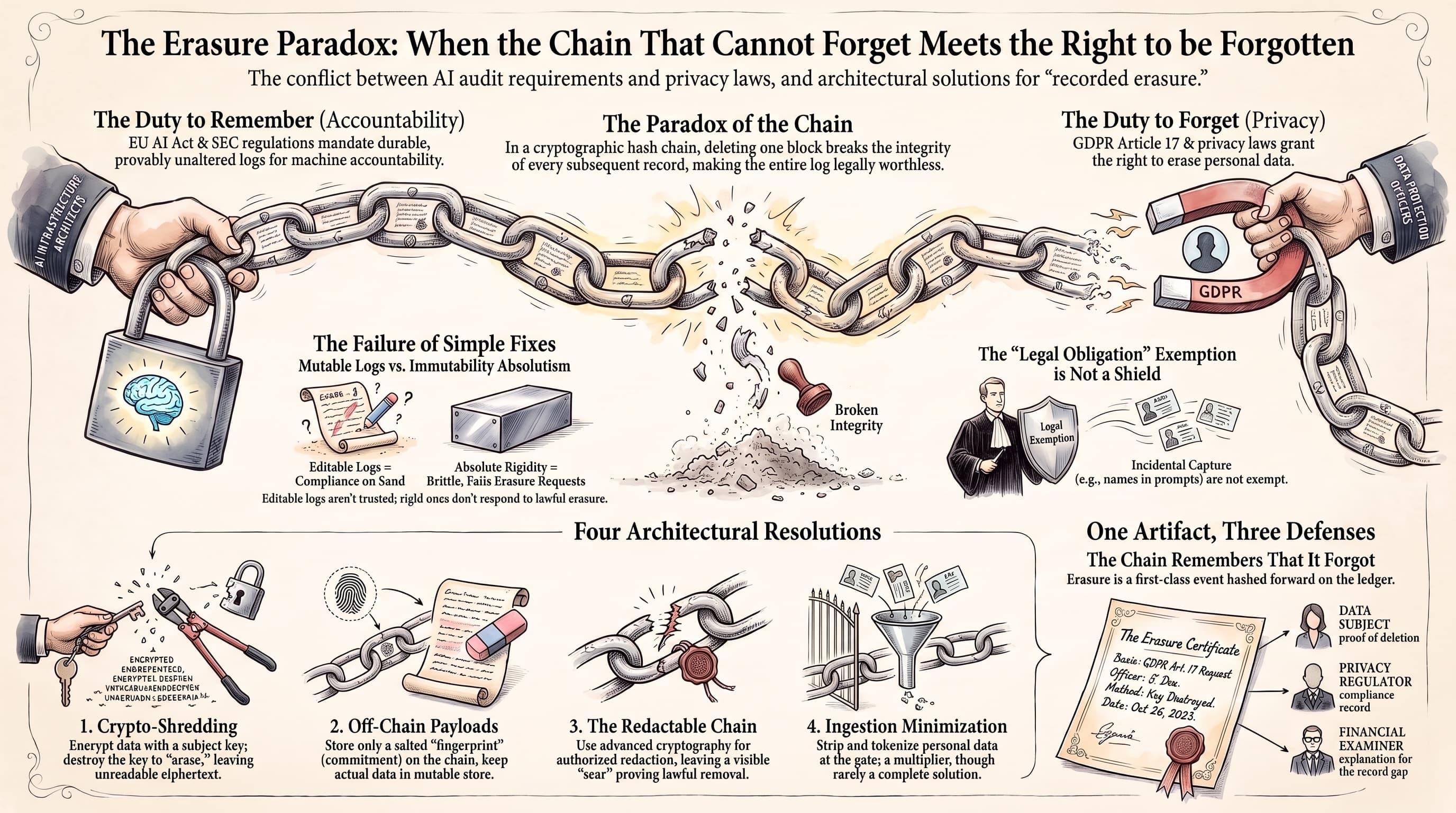
The Erasure Paradox: The Right to Be Forgotten Meets the Chain That Cannot Forget
Everything we have learned to trust about machine accountability rests on records that cannot be altered. Everything privacy law demands rests on records that can be destroyed. These two facts are on a collision course, and almost nobody building AI infrastructure has noticed. This paper states the collision precisely, rejects the two easy answers, examines four architectural resolutions and attacks each of them, and proposes a doctrine: erasure is an event. The chain does not forget silently. It forgets on the record. The chain remembers that it forgot.
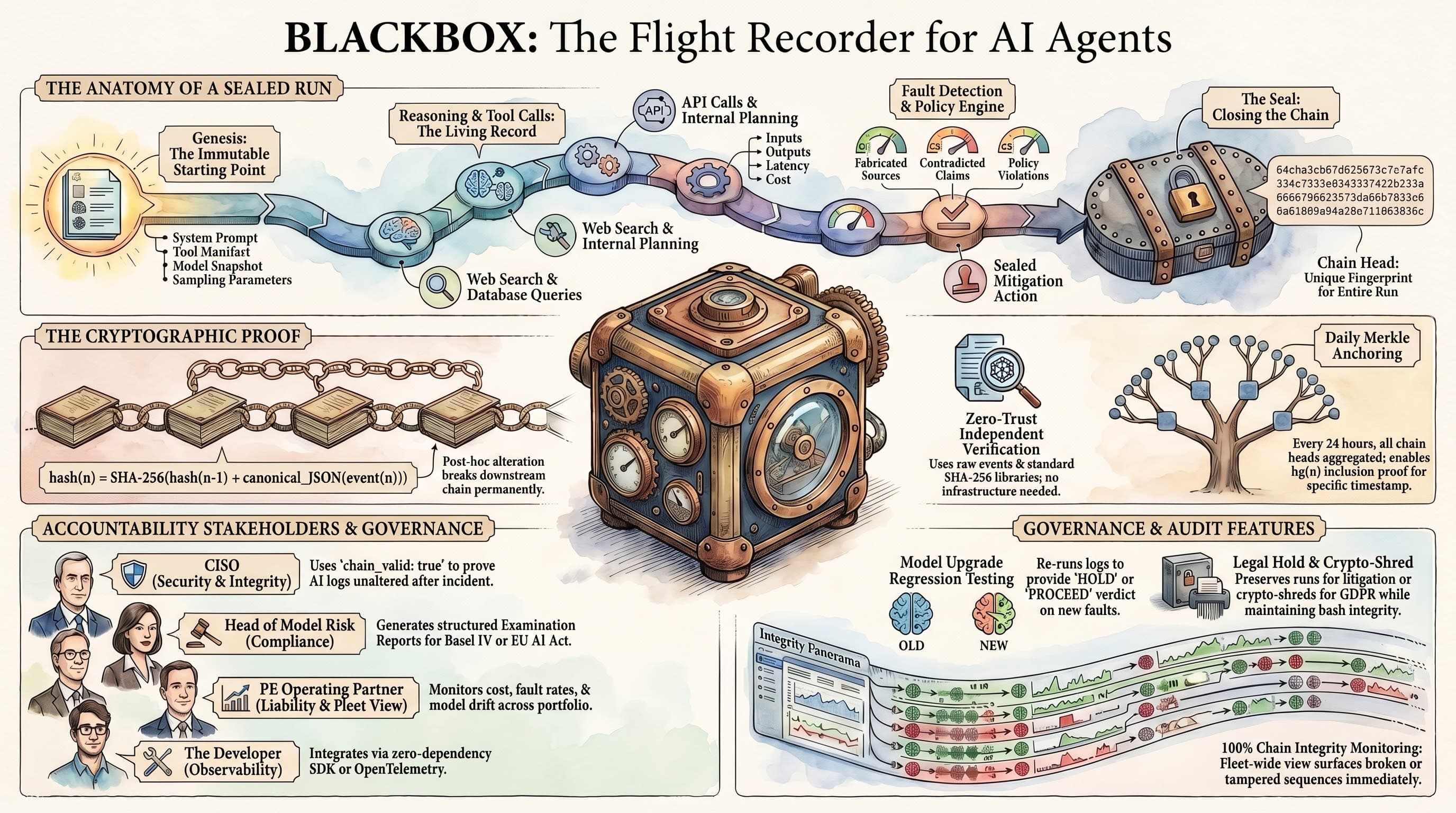
BLACKBOX: The Flight Recorder for AI Agents
When an AI agent makes a wrong decision, enterprises need to answer three questions: what exactly happened, in what order, and can the record be trusted? BLACKBOX provides the infrastructure layer that makes all three answerable. Every event — reasoning step, tool call, output, fault — is sealed into a SHA-256 hash chain. Any alteration to any stored event breaks the chain. Any run can be replayed verbatim. This paper documents the architecture, the three instrumentation paths, the phases completed, and the enterprise case for treating AI agent observability as an insurance requirement, not a nice-to-have.
Want to go deeper?
Discuss this paper with my digital twin.
Ask questions, challenge the framework, explore implications.
Open the Digital Twin