The GRC Displacement Thesis
Why Archer, ServiceNow GRC, and MetricStream are structurally obsolete — and what a regulatory digital twin does instead.
“Legacy GRC platforms were built to track compliance activity. The next generation of regulatory infrastructure is being built to replace compliance activity with autonomous intelligence. These are not different versions of the same product — they are different answers to a different question.”
Paper DNA
Domain
Regulatory Technology
Maturity
Live
Market Size
RegTech $85B by 2030 · US bank supervisory actions: 500+ annually
Connected To
GRC platforms are workflow databases — they organize compliance activity but do not perform it. RegTwin AI's six-agent architecture performs the compliance work autonomously, reducing human compliance effort by an estimated 60–80% for the activities it covers.
The displacement thesis rests on architectural incompatibility: adding AI to a workflow database produces an AI-enhanced workflow database. Producing autonomous regulatory intelligence requires building from the agent up — a ground-up rebuild that incumbents cannot execute without destroying their existing product.
The total addressable market is the $18B global RegTech market, with the highest concentration of pain — and therefore the most accessible revenue — in US bank supervision, where OCC, Fed, and CFPB examination intensity has reached a 15-year high.
The Structural Obsolescence of GRC Platforms
The three dominant GRC platforms — Archer (OpenPages/IBM), ServiceNow GRC, and MetricStream — were all architected in the 2000s to solve a specific problem: giving compliance teams a centralized, structured place to log risk items, track control status, and produce reports for auditors.
They solved that problem. The reports can be produced. The risk items are logged. The control status is tracked. And yet the consent orders keep coming. The MRAs keep multiplying. The enforcement actions against institutions that run Archer on a $5M annual contract continue to increase.
The architecture is the limitation. GRC platforms are, at their core, structured databases with configurable workflow engines. They wait for a compliance professional to input data. They route that data through an approval chain. They surface it in a dashboard when queried. They cannot:
- Monitor regulatory change autonomously
- Predict which findings are coming before the examiner arrives
- Draft a response to an MRA using the specific evidentiary standards the OCC expects
- Simulate the examiner's perspective on the institution's current posture
- Generate a board-ready regulatory report without human assembly
These are not missing features that can be added with a software update. They require a fundamentally different architecture — one built around agents that act, not workflows that route.
Why AI-Enhanced GRC Is Not the Answer
ServiceNow has added "AI capabilities." Archer has integrated LLM features. MetricStream has announced a roadmap. None of this changes the underlying architecture. An AI summary of a compliance workflow database is still a summary of logged data — not autonomous intelligence about the regulatory environment.
The analogy: bolting a GPS antenna to a paper map does not produce a navigation system. Navigation requires real-time data, route calculation, and continuous re-optimization. The paper map cannot be enhanced into those capabilities — it needs to be replaced.
The Regulatory Digital Twin
A regulatory digital twin is not a metaphor — it is a specific technical architecture.
What the Digital Twin Represents
The twin maintains a live, continuously updated representation of three intersecting objects:
- The institution's regulatory posture — current control status, open findings, remediation progress, examination history, regulatory relationship health
- The regulatory environment — active rules from each applicable regulator, pending rule changes, enforcement patterns, examination focus areas
- The gap map — where the institution's posture intersects with the regulatory environment, producing a continuously updated picture of where exposure exists and how it is changing
This three-way model is updated continuously by autonomous agents, not periodically by compliance staff. The result is a regulatory posture representation that is always current — not current as of the last quarterly review.
Why 'Twin' Is the Right Model
The digital twin concept originated in manufacturing: a live virtual model of a physical system, updated in real-time from sensor data, used to predict failure modes before they occur. The same principle applies to regulatory compliance:
- The physical system is the institution's compliance posture
- The sensors are the agents monitoring internal controls, external regulation, and examination signals
- The failure modes are MRAs, consent orders, and enforcement actions
- The prediction capability is what separates proactive regulatory management from reactive crisis response
What the Twin Enables
An institution with a live regulatory digital twin can answer questions that are currently unanswerable without weeks of manual analysis:
- "If the Fed's proposed rule 3284 finalizes next quarter, which of our controls are out of scope?"
- "Based on this year's examination findings at peer institutions, what is our likely focus area in our next exam?"
- "If we acquire the XYZ portfolio, what is the combined regulatory exposure on Day 1?"
- "What is the current probability that our open MRA remediation will be found sufficient at the next examination?"
Six Agents, One Closed Loop
RegTwin AI deploys six specialized agents that form a closed regulatory intelligence loop. Each agent's output feeds the next. The loop is the product.
          ┌─────────────────────────────────────────┐
          │           RegTwin AI — Closed Loop        │
          │                                           │
          │   ┌─────────┐        ┌─────────┐          │
          │   │ Monitor │───────▶│ Predict │          │
          │   │ Agent   │        │ Agent   │          │
          │   └─────────┘        └────┬────┘          │
          │        ▲                   │               │
          │        │                   ▼               │
          │   ┌─────────┐        ┌─────────┐          │
          │   │ Report  │        │ Defend  │          │
          │   │ Agent   │        │ Agent   │          │
          │   └────┬────┘        └────┬────┘          │
          │        ▲                   │               │
          │        │                   ▼               │
          │   ┌─────────┐        ┌─────────┐          │
          │   │Simulate │◀───────│ Prove   │          │
          │   │ Agent   │        │ Agent   │          │
          │   └─────────┘        └─────────┘          │
          └─────────────────────────────────────────┘
Agent 1 — Monitor Continuously scans regulatory sources (Federal Register, CFPB, OCC, Fed, FDIC, SEC, FINRA, state regulators) for rule changes, enforcement actions, examination guidance updates, and interagency communications. Classifies each change by applicability, urgency, and control impact.
Agent 2 — Predict Uses the Monitor output combined with the institution's examination history, peer enforcement data, and control gap analysis to produce a probability-weighted finding forecast. Answers: "What will the next examiner flag — and what evidence will they look for?"
Agent 3 — Defend Assembles the evidentiary package for each predicted or actual finding. Knows that the OCC requires root cause analysis with a corrective action timeline; the Fed requires evidence of systemic remediation; the CFPB requires consumer harm quantification. Each response package is tailored to the specific regulator, not templated generically.
Agent 4 — Prove Documents the remediation trail — what was done, when, by whom, with what outcome. Produces the artifacts needed for the next examination to demonstrate that the finding has been addressed and the control is now sustainable.
Agent 5 — Simulate Runs the institution's current posture through an adversarial examiner model — an AI that has been trained to think like an OCC field examiner, a Fed SR letter analyst, and a CFPB enforcement attorney simultaneously. Surfaces vulnerabilities before a real examiner finds them.
Agent 6 — Report Generates board-ready regulatory intelligence reports, CCO briefing packages, and audit committee presentations — synthesizing the full loop output into governance-ready communication.
The Displacement Window
Regulatory technology markets move slowly — until they move fast. The current moment is the inflection point.
Why Now
Three forces are converging to create the displacement window:
-
Regulatory intensity is at a 15-year high. The OCC, Fed, and CFPB have increased examination staffing, raised enforcement standards, and explicitly communicated that AI-assisted compliance is not a substitute for substantive control effectiveness. Institutions that cannot demonstrate operational excellence in their compliance programs — not just documentation of it — are facing more MRAs, longer remediation timelines, and higher enforcement risk.
-
The cost of current approaches is unsustainable. A consent order response program at a regional bank costs $5M–$15M in consultant fees, FTE burden, and opportunity cost. A regulatory examination cycle requires 3–6 months of preparation and 2–4 months of active examination support. These costs are growing, not declining, as regulations become more complex.
-
The AI infrastructure is ready. The agent orchestration, vector store, regulatory taxonomy, and LLM quality required to build RegTwin AI did not exist at acceptable cost and reliability two years ago. The technical window is open now — and competitors who move first will establish the institutional relationships, regulatory credibility, and data network effects that define the market.
The Early Mover Advantage
The institution that deploys RegTwin AI first in its peer group is not just more efficient — it is redefining what "good" looks like in regulatory compliance management. When that institution's examination outcomes improve — fewer findings, faster remediation, shorter examination cycles — the examiner's expectations for peer institutions adjust accordingly.
Early movers set the benchmark. Late movers implement against it.
Go-to-Market: The Displacement Motion
Entry Point: The Defend Module
The most effective entry point is not Monitor (even though it's the most logically compelling starting point). It's Defend.
A bank under an active MRA or consent order has an existential, near-term problem. The compliance team is overwhelmed. The consultants are expensive. The examination response deadline is fixed. This is a buyer with budget authority, decision urgency, and a clearly defined success metric.
RegTwin AI's Defend module addresses exactly this moment — assembling the evidentiary package, drafting the response, and producing the documentation trail for a fraction of the cost of a full consulting engagement. The Defend module closes the first deal; every other module expands from that foothold.
Expansion Sequence
Once Defend is deployed and the MRA response is complete:
- Prove — Natural extension: the institution needs to demonstrate sustainable remediation at the next examination. Prove maintains the evidence trail automatically.
- Monitor — Once the immediate crisis is resolved, the value of not being caught off guard again is self-evident. Monitor is positioned as the prevention layer.
- Predict — The prediction capability is the most technically impressive module. Once Monitor is generating data, Predict's outputs become immediately demonstrable.
- Simulate — For institutions with upcoming examination dates, Simulate is a logical purchase: a dry run with the system before the real examiner arrives.
- Report — Board-level reporting is the natural final layer — converting all of the above into governance-ready communication.
Target Segments
| Segment | Urgency Driver | Entry Module |
|---|---|---|
| Banks under active consent order | Remediation deadline | Defend |
| Banks with open MRAs | Examination pressure | Defend + Prove |
| Banks approaching scheduled examination | Preparation anxiety | Simulate + Predict |
| Banks seeking proactive compliance posture | Board/CCO mandate | Monitor + Predict |
That’s the full picture.
More from The Studio
All Papers →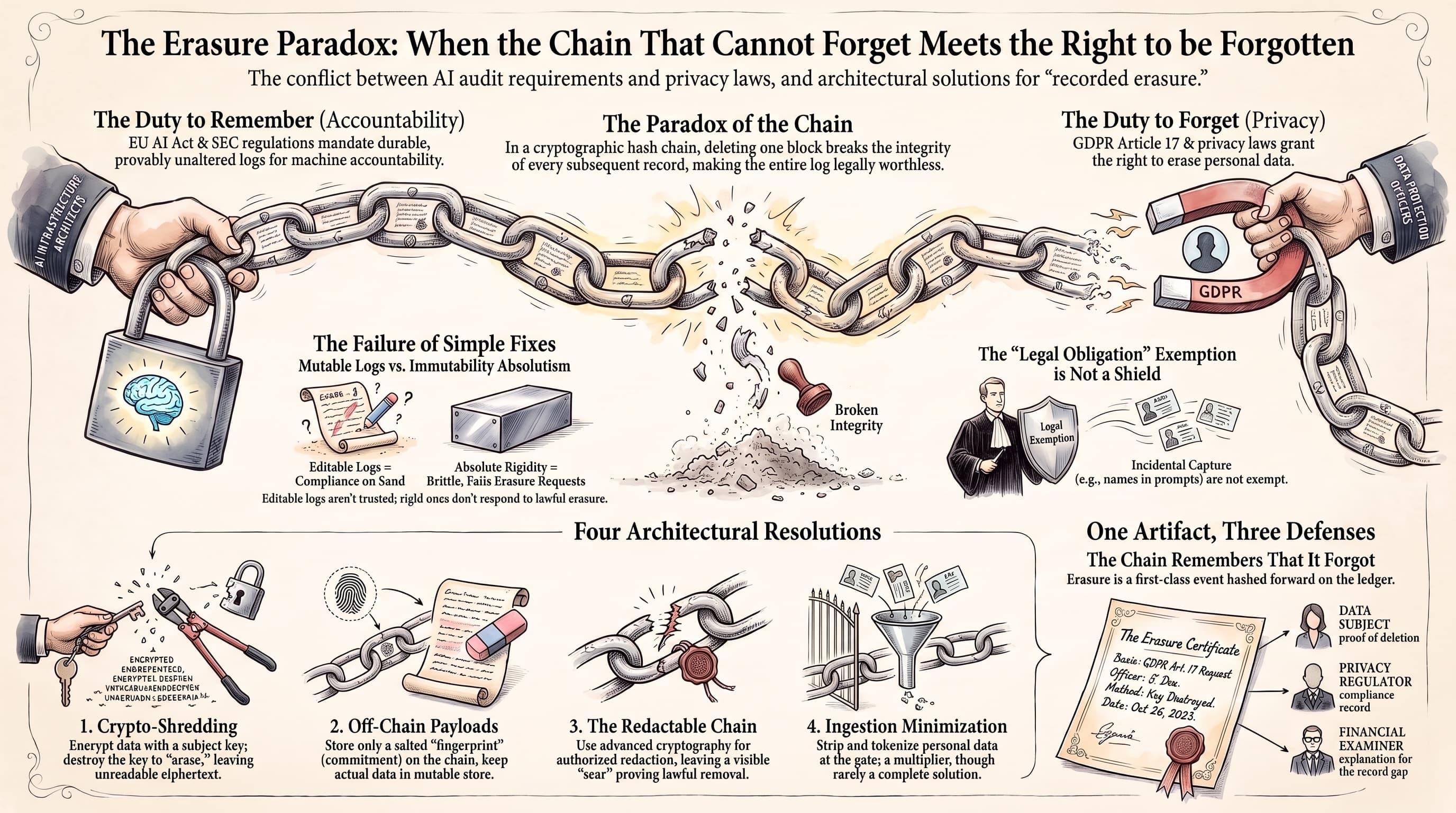
The Erasure Paradox: The Right to Be Forgotten Meets the Chain That Cannot Forget
Everything we have learned to trust about machine accountability rests on records that cannot be altered. Everything privacy law demands rests on records that can be destroyed. These two facts are on a collision course, and almost nobody building AI infrastructure has noticed. This paper states the collision precisely, rejects the two easy answers, examines four architectural resolutions and attacks each of them, and proposes a doctrine: erasure is an event. The chain does not forget silently. It forgets on the record. The chain remembers that it forgot.
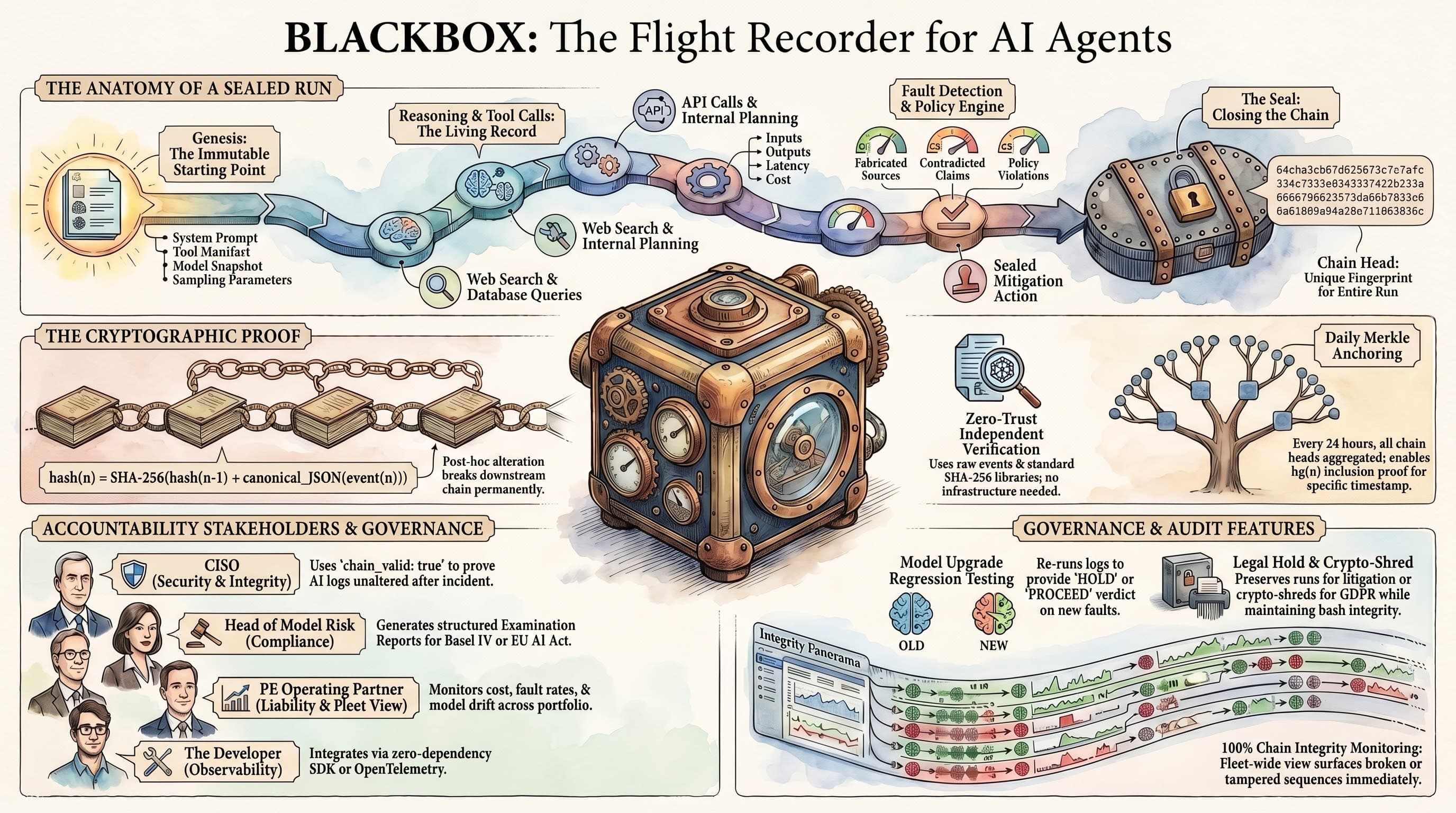
BLACKBOX: The Flight Recorder for AI Agents
When an AI agent makes a wrong decision, enterprises need to answer three questions: what exactly happened, in what order, and can the record be trusted? BLACKBOX provides the infrastructure layer that makes all three answerable. Every event — reasoning step, tool call, output, fault — is sealed into a SHA-256 hash chain. Any alteration to any stored event breaks the chain. Any run can be replayed verbatim. This paper documents the architecture, the three instrumentation paths, the phases completed, and the enterprise case for treating AI agent observability as an insurance requirement, not a nice-to-have.
Want to go deeper?
Discuss this paper with my digital twin.
Ask questions, challenge the framework, explore implications.
Open the Digital Twin