Four AI Ventures That Could Reshape Regulated Finance
A practitioner's product map — from autonomous audit defense to AI agent governance.
“The intersection of 20 years inside Tier-1 banks and hands-on AI product building produces a vantage point that is genuinely rare. What follows is what I see from it.”
Paper DNA
Domain
AI Product Strategy
Maturity
Blueprint
Market Size
$2.5B+ addressable across all four ventures
Connected To
Four distinct AI venture opportunities emerge from the bank + AI engineering intersection — each addresses a category gap where incumbents offer workflow tooling instead of intelligence.
The highest-priority play (AI Audit Defense) directly extends RegTwin AI, completing a monitor-to-defense loop targeting $2.5B+ in addressable consulting spend currently being executed by hand.
AI Agent PMO is a standalone new-category opportunity — driven by EU AI Act enforcement beginning August 2026 — with no incumbent to displace and mandatory enterprise demand building now.
The Vantage Point
Most AI product ideas in finance come from one of two directions: engineers who understand the technology but not the institutional reality of banks, or bankers who understand the problem but not what AI can actually do today.
This paper comes from neither of those places.
Twenty years across six Tier-1 banks — Citi, Bank of America, Credit Suisse, Barclays, Israel Discount Bank, Mizuho — producing transformation programs across risk, compliance, capital markets, and operations. Layered on top of that: direct, hands-on AI product building. Not prompting. Not integrating existing tools. Building: a 13-agent document validator, an 8-agent regulatory intelligence system, a 6-agent PMO platform.
That combination creates a specific kind of vision: the ability to see where the institutional pain is most severe, and to know with precision what AI can do about it today — not in three years, not theoretically, but in production.
What follows are four ventures that sit at that intersection.
1. Autonomous AI Audit Defense Platform
The Problem
When regulators — OCC, Fed, CFPB — issue MRAs, consent orders, or examination findings, banks scramble. They engage armies of Big 4 consultants at $500–$2,000 per hour. The response process is manual, fragmented, slow, and expensive. Each remediation cycle costs $5M–$50M and still produces first-pass rejection rates that are embarrassingly high.
The problem isn't that banks don't try. It's that the process is inherently artisanal: every response drafted from scratch, every evidence package compiled by hand, institutional knowledge locked in the heads of a few senior people who may or may not still be at the bank.
The Solution
A platform where a bank uploads examination findings or MRA letters, and a multi-agent AI system:
- Deconstructs each finding into discrete control obligations
- Maps obligations to the bank's existing control inventory
- Generates a remediation plan with milestones, owners, and evidence requirements
- Drafts the regulator response letter in the exact tone and format each regulator expects
- Tracks evidence collection and produces audit-ready submission packages
- Simulates examiner follow-up questions and stress-tests the response before it goes out
Why First-of-Its-Kind
RegTech today — Archer, ServiceNow GRC — is workflow tooling. It tracks tickets. It manages process steps. It has no capacity to read a regulatory finding and tell you what it actually means, what evidence would satisfy it, or how to write a response that passes the OCC's first-pass review.
Nobody has built an AI that thinks like an examiner. The institutional knowledge of what examiners actually look for — and what language makes them satisfied versus suspicious — is the training signal that nobody else has. That knowledge is the product.
The Market
~5,000 FDIC-insured banks in the US. Each one faces regulatory examinations. Each one pays for the response the hard way. At $500K minimum ARR per institution, this is a $2.5B domestic addressable market — before expanding to European banks under ECB oversight, which face structurally identical problems.
Competitive Moat
Built on lived experience: 80% audit return reduction at Citi, 30% accuracy improvement at Credit Suisse. The RegTwin AI platform provides the monitoring layer; this platform is the response and defense layer that completes the loop.
2. AI-Powered Regulatory Examination Simulator
The Problem
Compliance teams have no structured way to stress-test their readiness before a real regulatory examination arrives. They prepare informally — reviewing past findings, updating policies, conducting internal walkthroughs. But they have no way to know how an OCC examiner would actually respond to their control narrative, or where a Fed examiner would push back on their risk framework.
The result: surprise findings during the real examination. Findings that, with proper preparation, would have been identified and corrected beforehand.
The Solution
A regulatory examination simulator — a "flight simulator" for compliance teams. AI agents roleplay as OCC, Fed, CFPB, and BSA/AML examiners, conducting mock examinations with the bank's actual documentation and staff.
Banks stress-test their controls, evidence packages, and team readiness before the real examiner arrives. Staff practice answering the exact questions they will be asked. Gaps surface in a safe environment where the cost of finding them is low.
The Analogy
Penetration testing, but for regulatory readiness. The cybersecurity industry has normalized paying experts to attack your systems so real attackers can't surprise you. The compliance industry has not yet built the equivalent. This is it.
Monetization
Subscription model. $100K–$500K per year per institution. Can be offered as a standalone product or as the Simulate module within the broader RegTwin AI platform.
3. Fractional AI-PMO-as-a-Service
The Problem
Mid-market banks — institutions between $10B and $100B in assets — cannot afford a $300K/year senior program manager. But they are running transformation programs: core banking migrations, regulatory remediation initiatives, digital platform builds. These programs fail not because of technology, but because of the absence of PMO discipline: no RAID log management, no escalation frameworks, no milestone accountability, no executive-ready reporting.
The cost of that failure is measured in years of delay and tens of millions in overrun.
The Solution
PMO governance discipline delivered as a service, powered by AI. The platform handles RAID log maintenance, milestone tracking, executive reporting, and escalation management autonomously. AI agents surface the decisions that need human judgment and handle the administrative work that currently consumes a program manager's time.
The underlying IP is the PMO methodology itself — built from 20 years of running complex programs across Tier-1 banks. The AI encodes that methodology and makes it available to institutions that couldn't otherwise afford it.
Monetization
Recurring SaaS revenue at a fraction of the cost of a full-time program manager. Turns consulting expertise into a scalable, recurring product. Addresses a market that the high-end consulting firms actively ignore because the deal size is too small for them.
4. AI Agent PMO — Governance for Enterprise AI Agents
The Problem
Enterprises are deploying AI agents at scale — customer service agents, internal operations agents, code generation agents, compliance agents. And nobody is governing them.
There is no enterprise-wide visibility into which agents are running, what data they access, what they cost, and what decisions they are making. There is no lifecycle management: no formal versioning, rollback capability, deprecation process, or change control. There is no performance tracking tied to business outcomes — just vibes and usage logs. And crucially, there is no audit trail for regulators who are now actively asking: "Show me your AI governance framework."
The EU AI Act. The NIST AI RMF. The SEC's statements on AI use in financial services. The regulatory environment around AI governance is forming now, and enterprises are building the liability before they build the controls.
Why Now
EU AI Act enforcement begins August 2026. Every enterprise deploying AI agents in scope of that regulation without a documented governance layer is accumulating mandatory compliance debt. The demand for AI governance tooling is not discretionary — it is driven by regulatory obligation.
The Solution
A platform that applies enterprise program governance discipline to AI agent portfolios:
- Agent Registry — a complete catalog of every AI agent deployed, what it does, what data it touches, who owns it, and what its risk classification is
- Performance Dashboard — cost per agent, accuracy, throughput, and business value delivered — in terms leadership can act on
- Risk & Compliance Layer — EU AI Act risk classification, bias monitoring, immutable audit trails for every agent decision
- Lifecycle Management — formal deployment, versioning, monitoring, escalation, and deprecation workflows
- Executive Reporting — agent portfolio ROI, risk posture summary, and attention items formatted for board-level review
Why This Specific Background
Four qualifications converge here that no other founder currently combines: active program management inside an AI lab (seeing the governance chaos firsthand), AI engineering training (able to build the product), delivery of 4 live multi-agent systems (understanding the operational reality of deployed agents), and 20+ years of enterprise governance across 6 Tier-1 banks (knowing what institutional governance actually requires).
Monetization
| Tier | Annual Price | Primary Buyer |
|---|---|---|
| Starter | $50K | AI Team Lead |
| Enterprise | $200K–$500K | CTO / Chief AI Officer |
| Regulated | $500K–$1M | CISO / CCO (compliance overlay) |
Competitive Moat
A new category with no incumbent to displace. MLOps tools (MLflow, Weights & Biases) track models, not agents. Agents are autonomous actors — they have permissions, make decisions, consume budgets, and interact with customers and systems. They require PMO-level governance, not model monitoring. No existing product category addresses this. The regulatory tailwind from the EU AI Act creates mandatory demand precisely when the first credible solution arrives.
Strategic Notes
These four ventures are not independent bets. They are a portfolio built from a single knowledge base, and they reinforce each other.
Ventures 1 and 2 form a complete regulatory intelligence and defense suite when combined with RegTwin AI. The full loop: Monitor what's coming (RegTwin) → Predict what examiners will find (RegTwin) → Simulate the examination (Venture 2) → Defend with a drafted response (Venture 1) → Report to the board (RegTwin). A bank that adopts the full suite has fundamentally changed how it manages regulatory risk.
Venture 2 (Examination Simulator) could be a feature of Venture 1 rather than a standalone product — the Simulate module within the audit defense platform. The right sequencing depends on which pain point is most acute for the first customers.
Venture 4 (AI Agent PMO) is the standalone new-category play. It is entirely independent of the regulatory stack — it serves any enterprise deploying AI agents, not just banks. The regulatory tailwind (EU AI Act) accelerates adoption in financial services, but the product is relevant to any regulated industry: healthcare, insurance, utilities, government.
All four ventures share underlying infrastructure: multi-agent AI orchestration, document ingestion pipelines, audit trail systems, and enterprise governance frameworks. The person who builds one has already built most of what the others require.
The question is not which venture to pursue. It is which one to pursue first, and in what sequence to build the rest.
That’s the full picture.
More from The Studio
All Papers →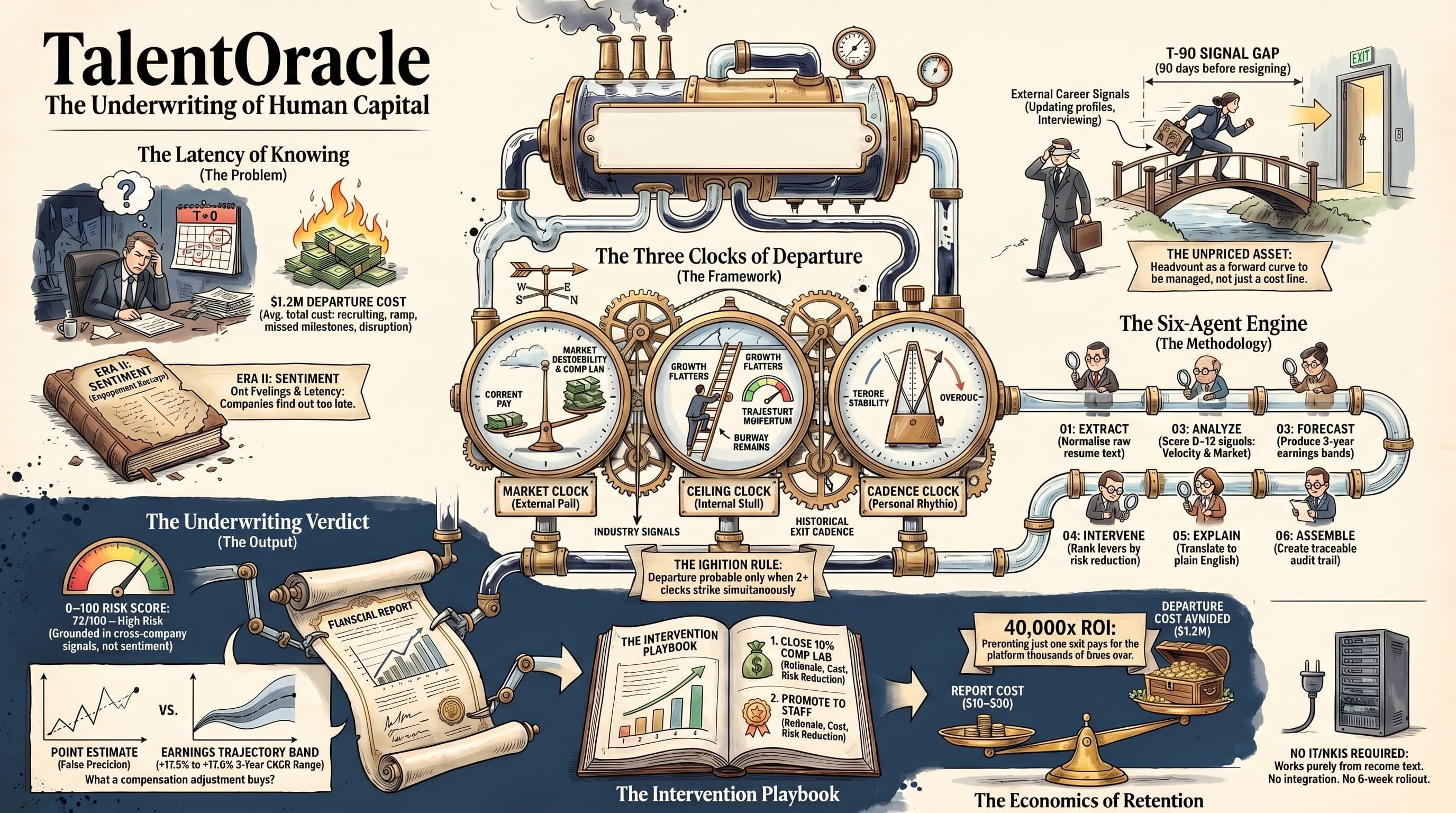
TalentOracle: The Underwriting of Human Capital
The average cost of a senior employee departure is $1.2M when recruiting, ramp, missed milestones, and team disruption are fully loaded. Most companies absorb this cost in silence because they found out too late. TalentOracle is a six-agent AI platform that predicts employee departure 90 days before it happens — using only resume text, with no HRIS integration, no survey, and no manager disclosure required. This paper sets out the Three Clocks of Departure framework, the six-agent engine architecture, the Underwriting Verdict output format, and the economics that make proactive retention the highest-ROI intervention a CHRO can make.

BISO: The Autonomous Security Immune System
BISO — the Bug Immune System — is an autonomous security platform that combines Semgrep, CodeQL, and Snyk scanning with AI-powered vulnerability prediction, autonomous blue-red-judge fix cycles, and semantic bug memory that learns from every outcome. This paper maps the immune system architecture, the self-healing fix loop, the topology-aware prediction model, and the structural case for autonomous AppSec as the successor to reactive vulnerability management.
Want to go deeper?
Discuss this paper with my digital twin.
Ask questions, challenge the framework, explore implications.
Open the Digital Twin