The 13-Agent Validation Machine
How a multi-agent AI platform compresses weeks of startup validation into minutes — delivering market research, financial projections, and GTM deliverables as outputs, not inputs.
“Startup validation fails not because founders lack intelligence, but because the research required to validate properly has always been too expensive, too slow, and too disconnected from decision-making. Thirteen specialized agents, operating in parallel, collapse that barrier to zero.”
Paper DNA
Domain
AI-Powered Startup Intelligence
Maturity
Live
Market Size
Global startup tools $15B · VC-backed startups: 10,000+ annually
The platform compresses 4–8 weeks of traditional startup validation research into a single session — producing the same quality of analysis that previously required a management consulting engagement or a deeply resourced founding team.
Thirteen specialized agents operate in parallel across distinct validation dimensions: market sizing, competitive landscape, financial modeling, regulatory risk, customer persona construction, and go-to-market planning — each producing a structured deliverable, not a summary.
The competitive moat is depth of output: most AI tools produce a brainstormed list; this platform produces a board-ready validation package. That distinction in output quality defines a different product category entirely.
The Startup Validation Gap
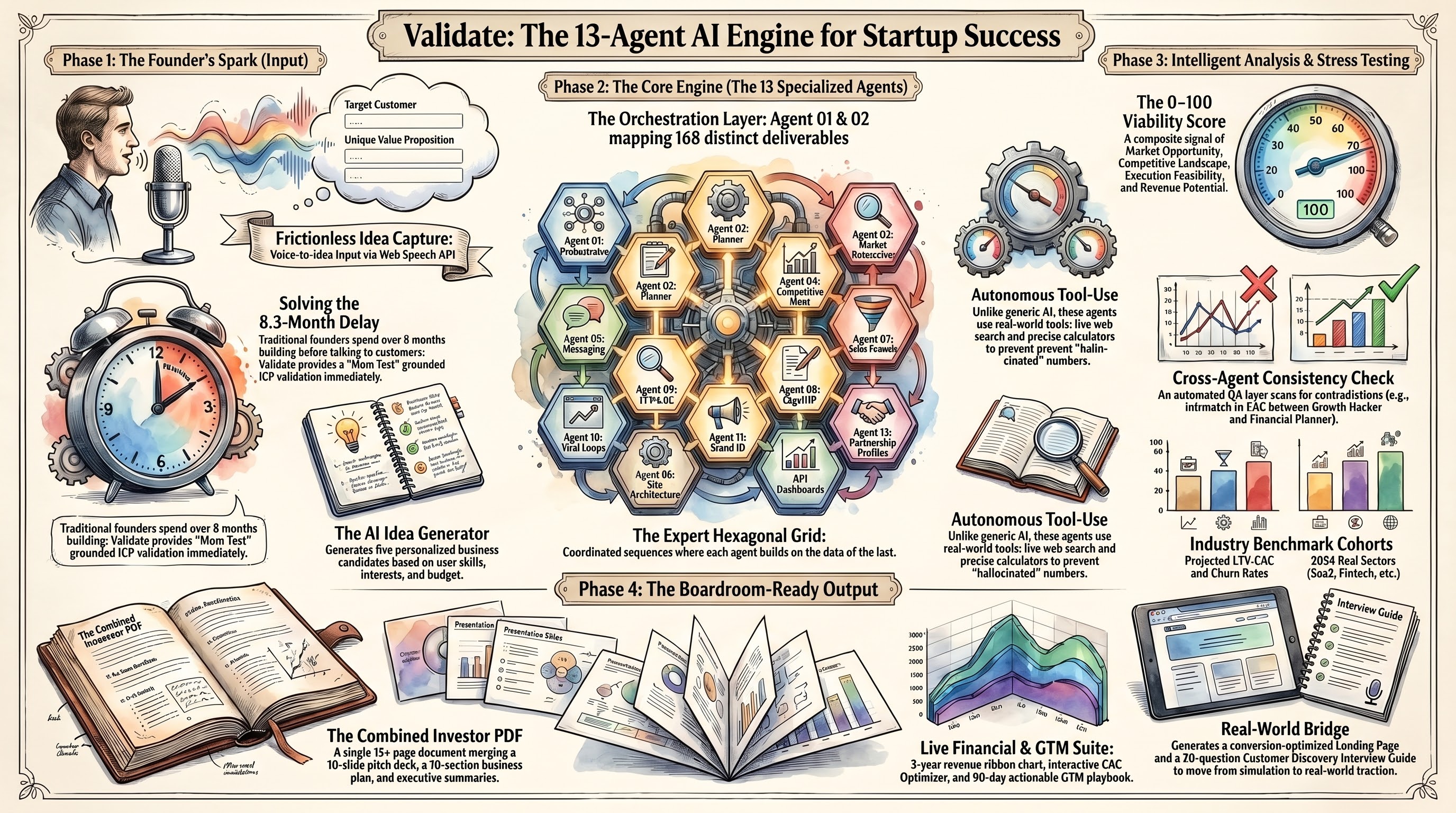 The 13-Agent Validation Machine — AI Startup Success Engine
Every year, more than 3 million new businesses are registered in the United States. Roughly 90% of startups fail within 10 years, and the most frequently cited cause is not execution failure — it is market failure: the product didn't solve a real problem, for a real customer, in a market large enough to sustain a business.
This is a validation failure. Not a product failure, not a team failure — a failure to ask the right questions before spending the wrong resources.
The dirty secret of startup validation is that doing it properly is expensive. A rigorous validation cycle requires:
| Validation Dimension | Traditional Approach | Time + Cost |
|---|---|---|
| Market sizing | Industry reports (IBISWorld, Gartner, Forrester) | $300–$5,000 per report |
| Competitive analysis | Manual research + product trials | 2–4 weeks of analyst time |
| Financial modeling | CFO or finance consultant | $5,000–$25,000 |
| Customer persona research | User interviews + survey platforms | 3–6 weeks |
| Regulatory risk | Specialized legal counsel | $10,000–$50,000 |
| GTM strategy | Strategy consultant or fractional CMO | $15,000–$40,000 |
The founder who can fund this process before building the product is already advantaged. The founder who cannot — which is most founders — builds on assumptions and validates by failure. This is the gap the Business Idea Validator closes.
The 13-Agent Architecture
The platform deploys 13 specialized AI agents, organized into three operational layers: Discovery, Analysis, and Synthesis.
┌─────────────────────────────────────────────────────────────────┐
│               Business Idea Validator — Agent Map                │
│                                                                   │
│  INPUT: Business idea description + target market context        │
│                          │                                        │
│  ┌───────────────────────────────────────────────────────────┐   │
│  │  LAYER 1: DISCOVERY (Parallel Execution)                   │   │
│  │  ┌──────────┐ ┌──────────┐ ┌──────────┐ ┌──────────┐     │   │
│  │  │ Market   │ │Competitor│ │Customer  │ │Regulatory│     │   │
│  │  │ Sizing   │ │Landscape │ │Research  │ │ Risk     │     │   │
│  │  │ Agent    │ │ Agent    │ │ Agent    │ │ Agent    │     │   │
│  │  └──────────┘ └──────────┘ └──────────┘ └──────────┘     │   │
│  └───────────────────────────────────────────────────────────┘   │
│                          │                                        │
│  ┌───────────────────────────────────────────────────────────┐   │
│  │  LAYER 2: ANALYSIS (Sequential + Parallel Mix)             │   │
│  │  ┌──────────┐ ┌──────────┐ ┌──────────┐ ┌──────────┐     │   │
│  │  │Financial │ │Unit Econ │ │Persona   │ │Moat &    │     │   │
│  │  │Projection│ │ Modeler  │ │Builder   │ │Diff.     │     │   │
│  │  │ Agent    │ │ Agent    │ │ Agent    │ │ Agent    │     │   │
│  │  └──────────┘ └──────────┘ └──────────┘ └──────────┘     │   │
│  │  ┌──────────┐ ┌──────────┐                                │   │
│  │  │ GTM      │ │Pricing   │                                │   │
│  │  │Strategy  │ │Strategy  │                                │   │
│  │  │ Agent    │ │ Agent    │                                │   │
│  │  └──────────┘ └──────────┘                                │   │
│  └───────────────────────────────────────────────────────────┘   │
│                          │                                        │
│  ┌───────────────────────────────────────────────────────────┐   │
│  │  LAYER 3: SYNTHESIS (Sequential — Depends on All Above)    │   │
│  │  ┌──────────┐ ┌──────────┐ ┌──────────┐                   │   │
│  │  │Validation│ │Risk Score│ │Executive │                   │   │
│  │  │Scorecard │ │& Verdict │ │ Summary  │                   │   │
│  │  │ Agent    │ │ Agent    │ │ Agent    │                   │   │
│  │  └──────────┘ └──────────┘ └──────────┘                   │   │
│  └───────────────────────────────────────────────────────────┘   │
│                          │                                        │
│  OUTPUT: Full validation package (PDF / Dashboard / JSON)        │
└─────────────────────────────────────────────────────────────────┘
Layer 1 — Discovery Agents (Parallel)
- Market Sizing Agent: Calculates TAM, SAM, SOM using a bottom-up methodology. Draws from structured data sources and cross-references industry benchmarks. Outputs a three-tier market sizing table with methodology transparency.
- Competitor Landscape Agent: Maps the competitive space across four quadrants: direct competitors, indirect competitors, substitutes, and potential entrants. Scores each on features, pricing, distribution, and moat strength.
- Customer Research Agent: Synthesizes likely customer profiles from market data and behavioral signals. Constructs 3 primary personas with jobs-to-be-done, willingness-to-pay estimates, and key buying objections.
- Regulatory Risk Agent: Identifies applicable regulatory frameworks by jurisdiction and industry. Flags licensing requirements, compliance costs, and go-to-market restrictions.
Layer 2 — Analysis Agents (Mixed)
- Financial Projection Agent: Builds a 3-year revenue model with three scenarios (conservative / base / optimistic) using the market size and unit economics as inputs.
- Unit Economics Modeler: Calculates LTV, CAC, payback period, and gross margin estimates for the proposed business model.
- Persona Builder: Deepens the Layer 1 personas with buying journey maps, message resonance analysis, and channel affinity scoring.
- Moat & Differentiation Agent: Evaluates the defensibility of the business across six moat dimensions: switching costs, network effects, proprietary data, brand, scale, and regulatory positioning.
- GTM Strategy Agent: Produces a phased go-to-market playbook with channel prioritization, launch sequencing, and traction metrics.
- Pricing Strategy Agent: Models 3–5 pricing architectures appropriate for the business model, with revenue sensitivity analysis per model.
Layer 3 — Synthesis Agents (Sequential)
- Validation Scorecard Agent: Aggregates all upstream outputs into a structured scorecard across 12 validation dimensions, each scored 1–10 with evidence citations.
- Risk Score & Verdict Agent: Produces a Go / Conditional Go / No-Go verdict with the top 3 risks and the top 3 opportunities that influenced the decision.
- Executive Summary Agent: Writes a one-page investor-grade summary of the full validation, formatted for a first meeting with an angel or seed-stage VC.
The Output Layer
Most AI tools for entrepreneurs produce suggestions. The Business Idea Validator produces deliverables.
The distinction is consequential. A suggestion is something to react to. A deliverable is something to use. The platform's output layer was designed to produce documents that could be handed to an investor, a co-founder, or a board — without reformatting.
Validation Package Contents
| Deliverable | Format | Agent Source |
|---|---|---|
| Market sizing analysis | Structured table + narrative | Market Sizing Agent |
| Competitive landscape map | 2x2 positioning grid + profile cards | Competitor Landscape Agent |
| Customer personas (×3) | Persona cards with JTBD + WTP | Customer Research + Persona Builder |
| 3-year financial model | Scenario table + assumptions | Financial Projection + Unit Economics |
| GTM playbook | Phase-by-phase roadmap | GTM Strategy Agent |
| Pricing strategy analysis | Model comparison + sensitivity | Pricing Strategy Agent |
| Moat assessment | Six-dimension radar chart | Moat & Differentiation Agent |
| Regulatory risk register | Framework map + action items | Regulatory Risk Agent |
| Validation scorecard | 12-dimension score grid | Validation Scorecard Agent |
| Investor-grade executive summary | One-page PDF | Executive Summary Agent |
Export Formats
- PDF validation package (investor-ready layout)
- Structured JSON (for API consumers and developer workflows)
- Interactive dashboard (shareable link with live data)
Iteration Capability
The platform supports validation iteration: change one input variable (pricing model, target market, geography) and re-run affected agents only. This allows founders to test assumptions systematically rather than rebuilding from scratch on every pivot.
Market Opportunity
Primary Buyers: Founders and Operators
The immediate buyer persona is the early-stage founder — pre-seed or seed-stage — who needs to validate an idea before committing resources. But the total addressable buyer population is substantially broader.
| Buyer Persona | Annual Volume | Willingness to Pay |
|---|---|---|
| Pre-product founders | ~500K/year (US) | $29–$99/month |
| Corporate innovation teams | ~15K enterprise teams | $500–$2,000/month |
| Venture capital (pre-diligence) | ~3,000 active US VCs | $200–$1,000/month |
| MBA programs / accelerators | ~500 programs | $5,000–$25,000/year (institutional) |
| Fractional CMOs / consultants | ~100K professionals | $49–$149/month |
The Freemium-to-Paid Funnel
The platform's growth model is freemium-led:
- Free tier: Market sizing + one competitor analysis (demonstrates platform value, creates habit)
- Paid tier ($49/month): Full 13-agent suite, unlimited validations, PDF export
- Pro tier ($149/month): Iteration mode, multi-scenario comparison, white-label export, API access
Conversion economics in AI productivity tools with strong output quality typically run 8–15% from free to paid. At 100,000 free users and a 10% conversion rate at $49/month, that represents $5.9M ARR before any enterprise or institutional revenue.
Competitive Position
The Validation Market Before This Platform
Before the Business Idea Validator, founders had two options: do the research manually (expensive in time) or hire consultants (expensive in money). Several tools have attempted to serve this market:
| Category | Examples | Limitation |
|---|---|---|
| Business plan generators | Bizplan, LivePlan | Template-filling, not intelligence |
| AI writing assistants | ChatGPT direct use | No structure, no data grounding, no deliverables |
| Market research platforms | Statista, IBISWorld | Data without synthesis; expensive access |
| Lean canvas tools | Strategyzer | Framework only; no research or validation |
None of these produce the structured, multi-dimensional validation package that this platform generates. The competitive gap is not marginal — it is categorical.
The Moat
The platform's defensibility comes from three sources:
-
Agent architecture depth: 13 purpose-built agents representing significant prompt engineering, output format design, and orchestration logic — not easily replicated by a general-purpose AI wrapper.
-
Output quality standard: The platform has defined what a complete validation looks like. Users calibrate their expectations against that standard; any competitor must meet or exceed it to compete.
-
Iteration network effect: Users who run multiple validations build a personal validation history. Over time, the platform learns their industry focus, preferred frameworks, and validation style — creating switching costs that increase with usage.
That’s the full picture.
More from The Studio
All Papers →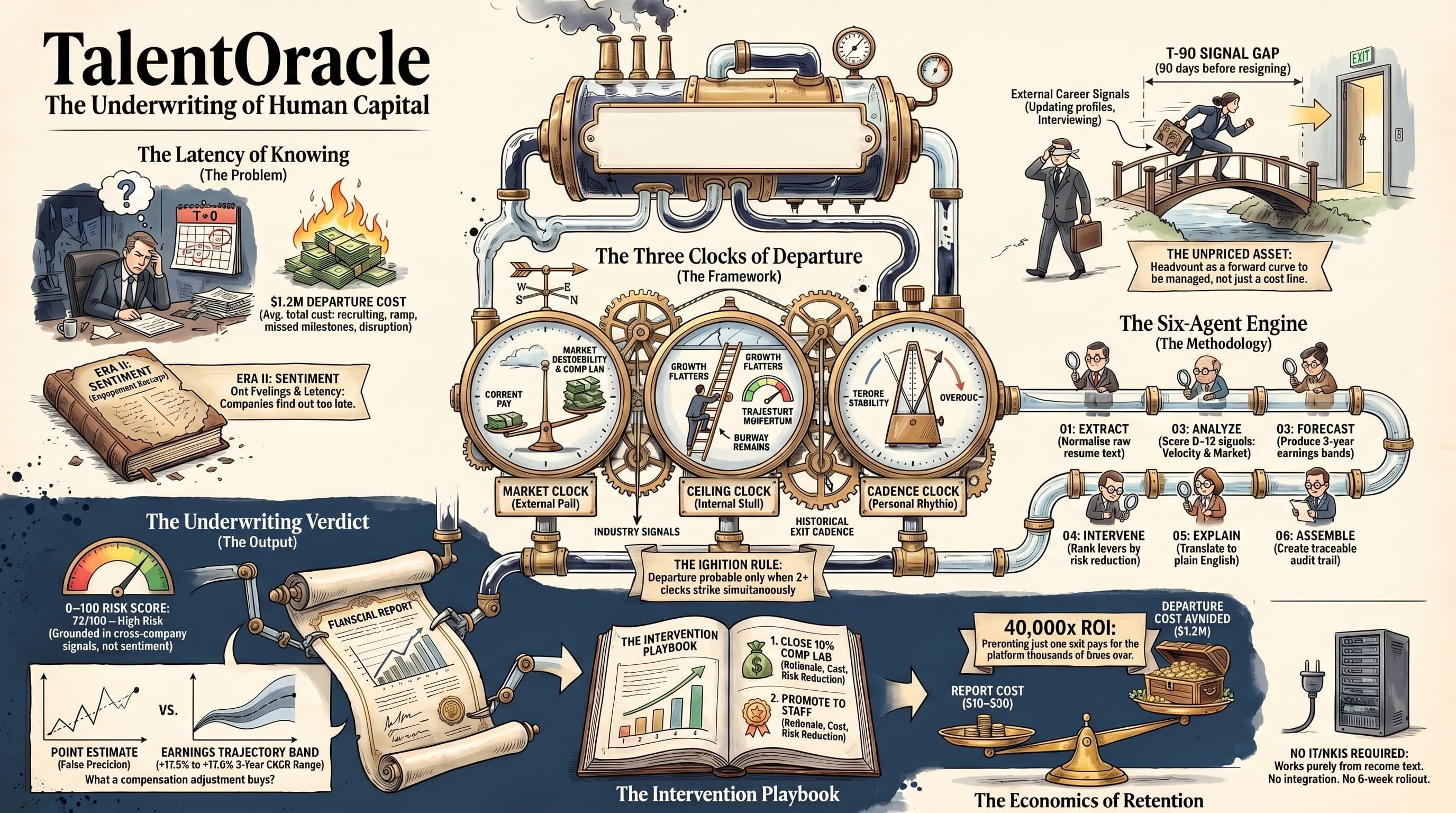
TalentOracle: The Underwriting of Human Capital
The average cost of a senior employee departure is $1.2M when recruiting, ramp, missed milestones, and team disruption are fully loaded. Most companies absorb this cost in silence because they found out too late. TalentOracle is a six-agent AI platform that predicts employee departure 90 days before it happens — using only resume text, with no HRIS integration, no survey, and no manager disclosure required. This paper sets out the Three Clocks of Departure framework, the six-agent engine architecture, the Underwriting Verdict output format, and the economics that make proactive retention the highest-ROI intervention a CHRO can make.

BISO: The Autonomous Security Immune System
BISO — the Bug Immune System — is an autonomous security platform that combines Semgrep, CodeQL, and Snyk scanning with AI-powered vulnerability prediction, autonomous blue-red-judge fix cycles, and semantic bug memory that learns from every outcome. This paper maps the immune system architecture, the self-healing fix loop, the topology-aware prediction model, and the structural case for autonomous AppSec as the successor to reactive vulnerability management.
Want to go deeper?
Discuss this paper with my digital twin.
Ask questions, challenge the framework, explore implications.
Open the Digital Twin